What's inside
As an Amazon Associate I earn from qualifying purchases. This post may contain affiliate links at no extra cost to you.
Most Craftsman riding mowers take a 12-volt Group U1R lawn and garden battery — about 7.7 x 5.1 x 7.3 inches, 18–35 amp-hours, with the positive post on the right when you look down at the terminals. Some older and rear-engine Craftsman models use a standard U1 with the polarity reversed, so the one detail that can ruin a purchase is terminal orientation, not the size. Below is exactly how to confirm which one your tractor needs, how much cranking power to buy, and how to swap it in under 20 minutes.
As an Amazon Associate we earn from qualifying purchases at no extra cost to you.



Group U1 vs. U1R: the spec that actually trips people up
“U1” is a BCI group size, not a brand-specific part. Almost every riding mower made in the last two decades — Craftsman included — uses this compact case. The “R” in U1R simply means reversed polarity: the positive and negative posts are swapped left-to-right. Both versions are physically identical and both are 12 volts, so a U1 will sit perfectly in the tray of a mower that needs a U1R — the cables just won’t reach the correct posts.
| Spec | Group U1 | Group U1R |
|---|---|---|
| Dimensions (L x W x H) | 7.7″ x 5.1″ x 7.3″ | 7.7″ x 5.1″ x 7.3″ |
| Voltage | 12 V | 12 V |
| Positive terminal position | Left (posts facing you) | Right (posts facing you) |
| Typical cold-cranking amps | 230–350 CCA | 230–350 CCA |
| Capacity | 18–35 Ah | 18–35 Ah |
| Weight (flooded lead-acid) | 14–17 lbs | 14–17 lbs |
| Terminal type | Nut-and-bolt posts | Nut-and-bolt posts |
The majority of MTD-built Craftsman tractors (LT-series, T210, T310, rear-engine riders) spec a U1R. The fastest way to verify yours: open the battery compartment, look at the old battery, and note which side the red positive cable bolts to. If it’s on the right, buy U1R. If the label is still readable, it will say “U1” or “U1R” outright. Ten seconds of checking beats a return trip.
How many cold-cranking amps do you need?
Stock batteries ship around 230–300 CCA, which is enough for a single-cylinder engine in mild weather. Buying up is cheap insurance: a battery with 300–350 CCA turns over V-twins more confidently, spins a cold engine faster in spring, and loses less margin as it ages. Amp-hours (18–35 Ah typical) matter less for starting but more if you run headlights or an electric PTO clutch frequently. There’s no penalty for extra CCA — the mower only draws what it needs.
Flooded, AGM, or lithium?
| Type | Typical price | Weight | CCA range | Expected lifespan | Best for |
|---|---|---|---|---|---|
| Flooded lead-acid | $35–$55 | 14–16 lbs | 230–300 | 2–4 years | Lowest upfront cost |
| AGM (sealed) | $50–$80 | 15–18 lbs | 300–360 | 3–5 years | Vibration resistance, no maintenance |
| LiFePO4 lithium | $90–$150 | 5–8 lbs | 350–500 equivalent | 5–8 years | Long life, light weight, fast cranking |
AGM has become the sensible middle ground: sealed against the acid sloshing that kills flooded batteries on rough ground, and tolerant of the constant vibration a mower dishes out. Lithium U1R drop-ins crank impressively and shed 10 pounds, but they need a lithium-compatible charger and most won’t accept a charge below freezing — a real limitation if you trickle-charge in a cold garage. Budget flooded batteries remain fine for fair-weather mowing if you’ll actually maintain them.
Match the battery to your situation
| Your situation | Recommended pick |
|---|---|
| Mow weekly May–September, mild climate, tight budget | Basic flooded U1R, ~300 CCA, $35–$55 |
| Cold springs, large V-twin engine, rough terrain | AGM U1R, 350+ CCA |
| Mower sits 4–5 months every winter | AGM or lithium plus a battery maintainer |
| Want maximum lifespan and minimum weight | LiFePO4 U1R with lithium charger |
| Not sure about polarity and buying sight-unseen | Remove the old battery first and match the post side |
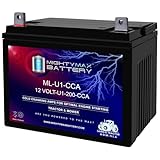
Total riding lawn mower battery cost for a DIY swap lands between about $40 and $80 for most people, plus a refundable core charge (typically $10–$18) if you hand over the old battery. Real options on shelves in 2026 include the Interstate U1R line, DieHard Gold lawn-and-garden batteries, Duralast U1R at AutoZone, and value AGM units like the Mighty Max ML-U1 series — all standard fare at auto parts stores, farm supply stores, and mower dealers.
Swapping the battery, step by step
- Gather a 3/8-inch or 7/16-inch wrench (mower terminal bolts vary), gloves, and a wire brush or baking-soda paste for cleaning.
- Park on level ground, set the parking brake, and remove the key. The battery lives under the seat or under the hood on nearly every Craftsman rider.
- Disconnect the negative (black) cable first. If your wrench touches the frame while loosening the negative post, nothing happens — do it in the wrong order and the same slip creates a direct short across the positive terminal.
- Remove the positive cable, then the hold-down strap or bracket. Lift the battery straight out; at 14–17 pounds it’s awkward but manageable.
- Scrub corrosion off the cable ends with baking soda solution and a wire brush. White or green crust left on the terminals is the number-one cause of “my brand-new battery won’t crank” complaints.
- Set the new battery in with posts oriented the same way as the old one, secure the hold-down (a bouncing battery cracks its own case and shorts plates internally), then connect positive first, negative last.
- Snug the terminal bolts firmly but don’t overtighten — the posts are soft lead set in plastic. Turn the key and verify it cranks.
Keeping it alive: storage and maintenance realities
These batteries die from sitting, not from use. Left discharged over one winter, a flooded U1R sulfates internally and may never recover full capacity — which is why the realistic lifespan is 3–5 years, not the 8 years printed on optimistic labels. A battery tender for a riding lawn mower costs $25–$50 and pays for itself in one avoided replacement: a 0.75–1.5 amp maintainer such as the Deltran Battery Tender Junior or the NOCO Genius1 is sized right for a U1 battery. Hook it up in a ventilated spot for the off-season, or at minimum charge the battery once a month during storage. Other common mistakes: leaving the key in the accessory/lights position (drains the battery in days), ignoring a loose hold-down, and charging a lithium battery with a charger that lacks a LiFePO4 mode.
If a new battery keeps dying, the battery usually isn’t the problem — riding mowers charge off an engine-driven stator, and a failed stator, blown fuse, or corroded ground cable will mimic a bad battery. A healthy system reads roughly 13.5–14.5 volts across the terminals with the engine at full throttle.
The same battery fits most other brands
The U1/U1R format is nearly universal across riding mowers. A Husqvarna riding lawn mower battery is almost always the same U1R group; Murray riders follow the same convention; and a battery for a Yard Man riding lawn mower is identical in spec, since Yard Man and Craftsman share MTD parentage and often the same chassis parts. Troy-Bilt and most big-box-store riders land in the same category. The verification step — matching terminal polarity — applies to every one of them.
One clarification worth making: “Craftsman electric lawn mower battery” searches usually mean something different. Craftsman’s cordless push mowers run on V20 lithium tool packs, and its electric riders use dedicated high-voltage battery systems — neither is interchangeable with the 12-volt starting battery covered here.
FAQ
Can I use a car battery in a riding mower?
No. Even the smallest automotive batteries won’t fit a U1 tray, weigh three times as much, and aren’t built for the vibration duty cycle of a mower. A proper U1R is cheaper anyway.
How long should a mower battery last?
Three to five years is realistic for lead-acid with decent care; lithium can stretch to eight. Batteries that sit discharged all winter often die in under two.
Do I need to charge a new battery before installing?
It’s smart, not strictly required. Most ship at 80%+ charge, but a few hours on a charger first confirms it holds voltage and tops it off for a strong first start.
What does the core charge at checkout mean?
A refundable deposit (usually $10–$18) for the old battery. Bring your dead one to the counter or carry-in and you get it back — plus the lead gets recycled properly.