What's inside
- Husqvarna’s ride-on range at a glance (2026)
- Deck width does the real work — match it to acreage
- Engines and transmissions: read the letters
- Slope is the spec that eliminates half the range
- Measure your gate before you pick a deck
- Decision matrix: which Husqvarna fits your yard
- Ownership realities: what wears first
- FAQ
- Husqvarna’s ride-on range at a glance (2026)
- Deck width does the real work — match it to acreage
- Engines and transmissions: read the letters
- Slope is the spec that eliminates half the range
- Measure your gate before you pick a deck
- Decision matrix: which Husqvarna fits your yard
- Ownership realities: what wears first
- FAQ
As an Amazon Associate I earn from qualifying purchases. This post may contain affiliate links at no extra cost to you.
The right Husqvarna ride-on lawn mower for most buyers comes down to three numbers: deck width matched to acreage, transmission matched to slope, and overall width matched to your narrowest gate. For yards up to about 1.5 acres, a 42-inch lawn tractor like the TS 142 is enough; for 2–4 acres of open ground a 54-inch zero-turn such as the Z254F roughly halves your mowing time; and for steep, tight, or obstacle-heavy gardens, Husqvarna’s articulated R-series Riders beat both. Here’s how to map the range to your yard.
As an Amazon Associate we earn from qualifying purchases at no extra cost to you.


Husqvarna’s ride-on range at a glance (2026)
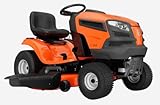
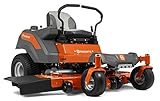
Husqvarna splits its sit-on mowers into three families: TS-series lawn tractors, Z-series zero-turns, and R-series front-cut Riders with articulated steering. US street prices vary by dealer and season, so treat the ranges below as a guide.
| Model | Type | Deck | Engine (approx.) | Transmission | Suits | Typical price (USD) |
|---|---|---|---|---|---|---|
| TS 142 | Lawn tractor | 42″ stamped | ~20 hp single-cylinder | Pedal hydrostatic | 0.5–1.5 ac, flat | $1,800–2,400 |
| TS 146 | Lawn tractor | 46″ stamped | ~22 hp V-twin | Pedal hydrostatic | 1–2 ac | $2,100–2,700 |
| TS 248XD | Lawn tractor | 48″ fabricated | 23 hp Kawasaki V-twin | Hydrostatic + locking diff | 1.5–3 ac, some slope | $3,800–4,600 |
| TS 254XD / 354XD | Lawn tractor | 54″ fabricated | 24 hp Kawasaki V-twin | Hydrostatic + locking diff | 2.5–4+ ac, slopes | $4,300–5,800 |
| Z242F | Zero-turn | 42″ fabricated | 21.5 hp Kawasaki | Twin hydrostatic (EZT) | 0.75–1.5 ac, obstacles | $3,200–3,900 |
| Z254F | Zero-turn | 54″ fabricated | 24 hp Kawasaki | Twin hydrostatic | 2–4 ac, open | $4,500–5,600 |
| R 214T | Front-cut rider | 94 cm (≈37″) Combi | ~16 hp class | Hydrostatic, RWD | Tight gardens ≤1 ac | $3,000–4,000 |
| R 320X AWD | Front-cut rider | 103–112 cm (≈41–44″) | ~18–20 hp twin | All-wheel drive | Steep/rough, ≤3 ac | $6,000–7,500 |
Two gaps worth knowing: the Z254 (non-F) pairs a Kohler engine with a reinforced stamped deck at a lower price than the Z254F, and above the residential range the MZ series offers 61-inch decks for 4+ acres. Husqvarna’s sit-ons are all petrol-powered — its battery mowing strategy sits in the robotic Automower line, not ride-ons.
Deck width does the real work — match it to acreage
A useful estimate: acres per hour ≈ deck width in inches × ground speed in mph ÷ 100, then knock off 20% for turns, overlap, and obstacles.
Worked example, 2-acre lawn:
- TS 248XD (48″, ~4 mph mowing speed): 48 × 4 ÷ 100 = 1.9 ac/hr theoretical, ~1.5 real → about 80 minutes.
- Z254F (54″, ~6.5 mph): 54 × 6.5 ÷ 100 = 3.5 ac/hr theoretical, ~2.8 real → about 45 minutes.
That gap is why dealers steer 2+ acre buyers toward zero-turns. Rough acreage bands:
- Under ~1 acre: 37–42″ (R 214T, TS 142, Z242F)
- 1–2 acres: 46–48″ (TS 146, Z246, TS 248XD)
- 2–4 acres: 54″ (TS 254XD, Z254/Z254F)
- 4+ acres: 61″+ commercial decks (MZ61, Z500-series)
Wider isn’t automatically better. Decks over 48 inches scalp more easily on bumpy lawns because the ends bridge hollows, and a 54-inch deck is wasted on a yard threaded between trees. Fabricated decks (welded steel, badged “ClearCut” on F and XD models) survive roots and curbs better; stamped decks are lighter, cheaper, and move air slightly better for bagging.
Engines and transmissions: read the letters
- Single-cylinder (~20 hp, TS 142): adequate on flat half-acres; louder and rougher over long sessions.
- V-twin (Kawasaki FR-series on XD and Z-F models, Kohler on the Z254): smoother, quieter, better longevity — worth it if you mow weekly for an hour-plus.
- Pedal hydrostatic (base TS models): car-like to drive, but the light transaxles in entry tractors wear faster on hills. If your lawn slopes, step up.
- Locking differential + heavier transaxle (XD models): press a pedal to lock both rear wheels when one slips — the fix for wet slopes and boggy patches.
- Twin hydrostatic levers (Z-series): each rear wheel drives independently; zero turning radius but no steering wheel feel.
- Mechanical AWD (R 216T AWD, R 320X AWD): all four wheels driven; the best hillside option in the range.
Slope is the spec that eliminates half the range
Husqvarna publishes a slope gauge in each operator’s manual, and most of its sit-ons are rated to roughly 15 degrees maximum. In practice, wet grass erodes margin fast — treat ~10–12° as the comfortable working limit, and always mow tractors up and down slopes, never across.
Zero-turns need extra caution: traction and steering live on the same rear wheels, so a downhill turn can let the machine drift or pivot unexpectedly. On anything steeper than a gentle bank, a tractor with diff-lock (TS XD models) or an AWD Rider is the safer machine.
Measure your gate before you pick a deck
Deck width is not machine width — the side discharge chute adds roughly 10–15 inches. Chutes flip up or come off for transport, but they should stay fitted while mowing since they’re a safety deflector.
| Deck size | Approx. width, chute down | Narrowest practical gate |
|---|---|---|
| 42″ tractor | ~57–60″ | ~62″, or ~50″ with chute raised |
| 48″ tractor/ZTR | ~63–66″ | ~68″, or ~54″ with chute raised |
| 54″ tractor/ZTR | ~69–72″ | ~74″, or ~60″ with chute raised |
| R-series Rider (94–112 cm) | ~40–48″ | ~46–54″ — no side chute |
The R-series’ secret advantage: Combi decks mulch or rear-discharge, so there’s no chute — machine width is barely more than deck width, and the front-mounted deck trims under benches, fences, and low branches. Measure your tightest passage and add 2–3 inches of margin; a 54-inch machine behind a 5-foot gate is a purchase you’ll regret.
Decision matrix: which Husqvarna fits your yard
| Your situation | Best fit | Why |
|---|---|---|
| ≤0.75 ac, narrow gates, dense obstacles | R 214T | Compact, articulated, trims under edges |
| 0.5–1.5 ac, mostly flat, tight budget | TS 142 | Cheapest entry; a tractor is still faster than walking |
| 1–2 ac, obstacles, want speed | Z242F | Fabricated deck, nimble around beds |
| 1.5–3 ac with moderate slopes | TS 248XD | Diff-lock + heavier transaxle built for hills |
| 2–4 ac, open and flat | Z254F | ~2.8 ac/hr real output, fabricated deck |
| 2.5+ ac with hills or soft ground | TS 254XD / 354XD | Big deck plus hill-capable drivetrain |
| Steep, rough, wooded or banked | R 320X AWD | Four driven wheels, low-slung front deck |
| 4+ ac estate or commercial cutting | MZ61 or Z500-series | 61″+ decks and commercial-duty frames |
Ownership realities: what wears first
- Blades: the first consumable — sharpen every 25–50 hours (once or twice a season), replace yearly on sandy soil. Mulching “BioClip” blades and side-discharge blades are different parts.
- Belts: deck belt lasts ~3–5 seasons; a squeal or slow blade spin means it’s glazed. Keep the old one as a spare.
- Fuel: ethanol-blended petrol gumming the carb is the number-one cause of “won’t start in spring.” Use stabiliser or ethanol-free fuel, and expect ~1 gallon per hour of mowing on a V-twin.
- Transaxles: entry-level hydrostatics wear early on hills and under heavy towing — Husqvarna tractors are light-tow machines, not smallholders’ tractors. Hills are the strongest argument for an XD model.
- Uneven cut? Check tyre pressures first (they should match side to side), then re-level the deck — most “bad deck” complaints are a half-flat tyre.
- Cleaning: use the deck washout port after mowing, scrape packed clippings monthly, and blow grass off the engine cooling fins — a choked engine kills V-twins faster than mowing does.
FAQ
Tractor or zero-turn for a 2-acre yard?
Open ground with few obstacles: zero-turn — you’ll save roughly 30–40 minutes per mow. Slopes above ~10°, heavy towing, or lots of trees: the tractor is safer and cheaper.
Can these mowers bag and mulch?
Yes. Tractors and Z-series machines accept a triple-bagger accessory, and all support mulching kits. R-series Combi decks mulch and rear-discharge natively.
Is a 54-inch deck too big for a 2-acre lawn?
Not if the lawn is open and fairly level — it’s the sweet spot for that acreage. Step down to 48 inches if the ground is bumpy (scalping), the layout is maze-like, or your gate is under ~60 inches.