What's inside
- What “Industrial” Actually Means in a Welding Machine
- Spec Comparison: Representative Industrial Welding Machines (2026)
- The Five Decision Criteria, Ranked by What Actually Matters
- Decision Matrix: Match Your Situation
- A Quick Duty-Cycle Calculation Before You Buy
- Ownership Realities Listings Don’t Mention
- FAQ
- What “Industrial” Actually Means in a Welding Machine
- Spec Comparison: Representative Industrial Welding Machines (2026)
- The Five Decision Criteria, Ranked by What Actually Matters
- Decision Matrix: Match Your Situation
- A Quick Duty-Cycle Calculation Before You Buy
- Ownership Realities Listings Don’t Mention
- FAQ
As an Amazon Associate I earn from qualifying purchases. This post may contain affiliate links at no extra cost to you.
The best industrial welding machine for heavy-duty shop work in 2026 is a 3-phase multi-process unit with at least a 60% duty cycle at 250+ amps — but if your shop runs occasional jobs on single-phase power, a 200–240A inverter MIG/TIG/stick machine will cover 90% of work at half the cost. The right pick comes down to duty cycle first, then input power, then the materials you actually weld.
As an Amazon Associate we earn from qualifying purchases at no extra cost to you.

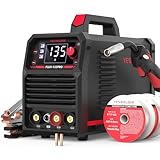


What “Industrial” Actually Means in a Welding Machine
An industrial welding machine differs from a hobbyist unit in three measurable ways: duty cycle at rated output, build quality of the wire feed and cooling systems, and serviceability. A machine rated 60% duty cycle at 300A can weld for six minutes out of ten at full power indefinitely, day after day. A 20% duty cycle unit at the same amperage will thermal-out every two minutes — fine for repair work, unacceptable for production fabrication.
The other marker is the drive system. Industrial MIG feeders use four drive rolls, metal housings, and reversible tensioners that run .045″ and 1/16″ flux-core without slipping. Plastic two-roll feeders are the first failure point on cheaper machines under continuous use.
Spec Comparison: Representative Industrial Welding Machines (2026)
| Machine (type) | Amperage range | Duty cycle | Input power | Weight | Processes | Typical price |
|---|---|---|---|---|---|---|
| Miller XMT 350 FieldPro (multi-process) | 5–425A | 60% @ 350A | 208–575V 3-phase | ~80 lbs | Stick, TIG, MIG (w/ feeder), gouging | $5,500–7,000 |
| Lincoln Power MIG 360MP | 20–300A | 60% @ 300A | 208–575V 1/3-phase | ~118 lbs | MIG, flux-core, TIG, stick | $4,500–5,500 |
| ESAB Rebel EMP 285ic | 10–285A | 40% @ 285A / 60% @ 200A | 120/230V single-phase | ~55 lbs | MIG, flux-core, TIG, stick | $2,800–3,500 |
| Miller Multimatic 255 | 30–230A (MIG) | 60% @ 200A | 208/230V single-phase | ~84 lbs | MIG, flux-core, TIG, stick | $3,200–4,000 |
| Fronius TransSteel 2700 | 10–270A | 45% @ 270A | 230V single-phase | ~53 lbs | MIG, stick (TIG optional) | $3,500–4,500 |
| Everlast PowerMTS 251Si (value multi-process) | 10–250A | 60% @ 200A | 110/220V | ~50 lbs | MIG, TIG, stick, pulse MIG | $1,400–2,000 |
Numbers vary slightly by configuration, but the pattern holds: true production duty cycles live in 3-phase machines above $4,500, while the best single-phase machines plateau around 60% duty at 200–250A.
The Five Decision Criteria, Ranked by What Actually Matters
1. Duty cycle — decide this first
Continuous fabrication (production runs, structural steel, trailer manufacturing) demands 60%+ duty at the amperage you’ll actually use. A machine rated “60% at 350A” welding 1/4″ steel at 220A is effectively running at near-100% duty — the rating only binds at the stated amperage. A useful rule: buy a machine whose 60% duty point sits 20% above your most common welding amperage.
2. Input power — check your panel before the catalog
Single-phase 230V machines cap out around 250–300A output. Anything welding above 5/16″ steel in a single pass, or running carbon arc gouging, needs 3-phase 208–480V. If your shop lacks 3-phase service, installing it typically costs $2,000–8,000 — sometimes more than the machine itself. Dual-voltage inverters (120/230V) add field flexibility but sacrifice top-end output on 120V.
3. Amperage range and process coverage
Match the range to material thickness: roughly 1 amp per thousandth of an inch for MIG on mild steel (1/4″ = ~250A with spray transfer headroom). Low-end range matters for thin work — a machine that bottoms out at 30A can’t cleanly weld 18-gauge sheet.
4. Portability vs. output
Inverter technology has collapsed the old weight penalty: a 285A machine at 55 lbs was impossible a decade ago. For work that leaves the shop — field repair, construction — sub-60-lb inverters win. For a fixed station feeding a boom-mounted feeder, weight is irrelevant and transformer durability still has appeal.
5. Materials
Aluminum MIG work needs a spool gun or push-pull gun and, ideally, pulse MIG capability — a feature worth paying for if aluminum exceeds ~15% of your volume. Stainless needs TIG with high-frequency start or pulse MIG. Cast iron and dissimilar repair work favors stick capability up to 300A+.
Decision Matrix: Match Your Situation
| Your situation | Recommended class | Why |
|---|---|---|
| Production fab shop, 8-hr shifts, 3-phase available | 300–400A 3-phase multi-process (XMT 350, Power MIG 360MP) | Sustained 60–100% duty, gouging capability, multi-arc feeder options |
| Job shop, mixed repair + fab, single-phase only | 250–285A single-phase multi-process (Rebel EMP 285ic, Multimatic 255) | Best duty-cycle-per-volt available; one machine covers MIG/TIG/stick |
| Mobile welding / field repair | Sub-60 lb dual-voltage inverter + engine drive for remote sites | Runs off generators and household circuits; every pound matters on a truck |
| Heavy equipment repair (gouging, hard-facing) | 400A+ stick/gouging-capable unit | Carbon arc gouging needs sustained high amperage MIG machines can’t deliver |
| Serious home/farm shop, occasional heavy work | 200–250A value inverter ($1,200–2,000) | 60% duty at 200A handles farm implement repair; save the difference for consumables |
A Quick Duty-Cycle Calculation Before You Buy
Say your most common job is welding 3/16″ steel brackets at 190A, in runs of about 8 inches at a time. Estimate arc-on time: at a 10 ipm travel speed, that’s ~5 seconds of arc per bracket, so even a 30% duty cycle at 190A never binds. But the same machine doing continuous 3-foot seam welds at 190A for a jig line? A 20%-duty machine overheats within minutes. Score your typical weld length and frequency honestly — buyers routinely overpay for duty cycle they never touch, or underpay and hit thermal limits mid-job.
Cost-per-hour sanity check: a $5,000 machine with a 10-year service life amortizes to about $1.40/hour in a 7-hour-a-day shop — trivially worth it versus a $2,500 unit that fails out of warranty or bottlenecks production.
Ownership Realities Listings Don’t Mention
- Drive rolls and liners wear first. Flux-core wire is abrasive; plan on a liner replacement every 6–12 months under heavy use and keep spare contact tips on hand — they’re consumed continuously.
- Fans clog. Shop dust and grinding grit kill inverters via the cooling path, not the electronics. Blow out the case monthly with dry air; fume extraction nearby makes it worse if aimed wrong.
- Torch consumables are the real ongoing cost. Budget $15–40/month in tips, nozzles, and diffusers for a busy MIG station — more than the gas in many cases.
- Undersized extension cords cause “bad arc” complaints. Voltage drop on a 100-foot 12-gauge cord mimics machine faults. Use 8-gauge minimum for a 250A machine on 230V.
- 3-phase machines need correct rotation on some feeders. Wire-feed motors and cooling pumps can run backward on reversed phases — check phase rotation at install.
FAQ
Can one industrial welding machine cover MIG, TIG, and stick?
Yes — modern multi-process inverters genuinely do all three well, unlike the compromise units of the 2000s. The trade-off is TIG features: dedicated TIG machines still offer finer AC balance and frequency control for aluminum TIG. If aluminum TIG is a core job, buy a dedicated AC/DC TIG unit alongside a MIG machine.
Is a transformer or inverter machine better for industrial use?
Inverters dominate in 2026 for good reason — lighter, more efficient, better arc control, dual-voltage options. Transformers survive abuse and dirty power slightly better and can be cheaper to repair, which keeps them relevant in harsh foundry-style environments.
How much amperage do I need for 1/2″ steel?
Single-pass MIG on 1/2″ plate wants 300A+ with spray or pulsed-spray transfer. With multi-pass technique, a 250A machine can still get there — slower, but workable for occasional heavy repairs.