What's inside
As an Amazon Associate I earn from qualifying purchases. This post may contain affiliate links at no extra cost to you.
The best oscillating tool masonry blade for most tile and grout work is a carbide-grit blade, while a diamond-grit blade is the better choice for frequent cutting in hard mortar, porcelain tile, and abrasive cement board.
Choosing between them depends less on the tool brand than on the material, joint width, cutting depth, and how much edge life you need. Carbide is usually faster and less expensive; diamond lasts longer in hard, abrasive materials and produces a cleaner, more predictable cut when used with light pressure.
As an Amazon Associate we earn from qualifying purchases at no extra cost to you.
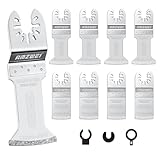
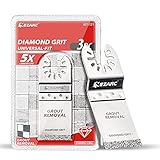


Quick picks by job
- Removing ordinary cement grout: 1/16- to 1/8-inch carbide-grit grout blade.
- Removing wide or hard grout: 1/8- to 3/16-inch diamond-grit blade.
- Cutting mortar around a brick: carbide-grit blade for occasional work; diamond-grit for repeated joints.
- Cutting brick or soft masonry: a wide carbide-grit blade can work for small notches, but a dedicated masonry saw is faster for long cuts.
- Cutting porcelain or dense ceramic tile: diamond-grit blade, used with shallow passes and minimal pressure.
- Working in a narrow corner: a narrow 1-1/8- to 1-1/4-inch blade with a fine grit edge.
Carbide versus diamond masonry blades
A carbide oscillating tool masonry blade has tungsten-carbide particles bonded to its cutting edge. The particles aggressively abrade grout, mortar, plaster, and some tile adhesive. It normally cuts more quickly at the beginning of its life, but the exposed grit wears down sooner when used on porcelain, brick, or concrete containing sand.
A diamond-grit blade uses industrial diamond particles on the edge. It generally costs more, cuts more slowly under heavy pressure, and can generate substantial heat. Its advantage is edge retention: diamond is better suited to repeated work in dense tile, cured mortar, cement board, and other abrasive materials.
For most homeowners, the sensible masonry blade for a multi tool is not the most expensive option. Buy carbide for one bathroom repair or occasional grout removal. Choose diamond when you expect several rooms, thick mortar joints, porcelain tile, or repeated renovation work.
Head-to-head comparison
The figures below are practical comparison ranges for common 18-volt oscillating tools using new blades. Actual results vary with tool speed, material hardness, joint width, and operator pressure; they are not manufacturer performance claims.
| Blade type | Typical edge width | Approx. new-blade weight | Best materials | Typical useful cutting life | Typical market range |
|---|---|---|---|---|---|
| Carbide grout blade | 1/16-1/8 in. | 0.8-1.5 oz | Cement grout, mortar, adhesive | 15-40 linear ft of grout | $12-$25 |
| Wide carbide masonry blade | 1/8-3/16 in. | 1.2-2.2 oz | Soft mortar, plaster, cement board | 8-25 linear ft of joint or notch work | $18-$35 |
| Diamond-grit grout blade | 1/16-1/8 in. | 1.0-1.8 oz | Hard grout, porcelain, dense adhesive | 30-80 linear ft of grout | $25-$50 |
| Diamond-grit masonry blade | 1/8-1/4 in. | 1.5-2.8 oz | Brick mortar, cement board, hard tile | 15-50 linear ft of abrasive material | $30-$65 |
Blade life is affected dramatically by joint width. A 1/16-inch blade removing a 1/8-inch joint may need two passes, doubling contact time. A blade that appears expensive can therefore be cheaper per foot if it avoids repeated passes and premature replacement.
What matters beyond the grit
Kerf width and control
Kerf is the width of material removed. A thin blade removes less grout and is easier to control beside a tile edge, but it may flex if forced sideways. Wider blades clear material faster and are more stable in mortar, though they remove more surrounding material and are less forgiving.
Match the blade to the existing joint rather than trying to widen the joint with a thin blade. For example, a 1/16-inch carbide blade is appropriate for a narrow glazed-tile joint, while a 1/8-inch blade is more efficient in a standard floor-tile joint.
Mounting system
Starlock, StarlockPlus, and universal-fit mounting systems are not interchangeable in every combination. Check the tool manual before buying. Bosch Starlock blades, for example, are designed around Bosch’s Starlock interface, while universal blades are intended to fit several common oscillating-tool mounts. A blade that physically attaches may still have poor clearance or an unsuitable clamping pattern.
Cutting depth
Many grout blades expose roughly 1-1/4 to 1-5/8 inches of working width, but useful cutting depth is usually less because the blade must remain visible and controllable. For a wall tile, the aim is to remove grout without contacting the substrate or plumbing behind it. A depth stop or painter’s-tape mark can prevent an expensive mistake.
Decision matrix
| Your situation | Recommended blade | Why |
|---|---|---|
| Budget repair under 20 linear ft | Carbide, 1/16-1/8 in. | Lowest purchase cost and fast initial cutting |
| First-time user working near glazed tile | Narrow carbide or fine diamond | Better visibility and less accidental joint widening |
| Several rooms or weekly renovation work | Diamond, 1/8 in. | Longer edge life reduces blade changes |
| Dense porcelain tile and hardened grout | Diamond-grit blade | Maintains abrasive performance in hard material |
| Large mortar removal in a tight space | Wide carbide or diamond masonry blade | More stable and faster material clearance |
| Long straight cuts in brick or block | Dedicated masonry saw instead | Oscillating tools are slow and produce substantial dust |
Dust control and cutting technique
Oscillating tools do not remove masonry dust as efficiently as a wet saw or shrouded angle grinder. Use eye protection, hearing protection, and a suitable respirator for the dust involved. Isolate the room, close HVAC vents, and use a vacuum with a fine-particle filter where possible. Do not use water around a tool unless the tool and procedure are specifically designed for wet operation.
- Mark the joint. Use painter’s tape on the tile face and mark the intended depth on the blade with a permanent marker.
- Start at a moderate speed. High speed can overheat diamond grit and make carbide particles shed faster.
- Let the abrasive edge work. Apply light forward pressure and keep the blade aligned with the joint. Sideways twisting is a common cause of broken or prematurely worn blades.
- Make shallow passes. Remove roughly 1/16 inch at a time rather than forcing the full depth immediately.
- Pause for cooling. If the blade becomes too hot to touch after a short cooling period, reduce pressure, lower speed, or use shorter passes.
- Vacuum frequently. Dust packed into the joint hides the cutting line and increases friction.
Which blade lasts longer in real ownership?
The cutting edge usually wears before the tool does. Carbide blades tend to lose sharp exposed particles first, then polish over and cut progressively slower. Diamond blades can look intact while their bond becomes smooth or glazed. If a diamond blade stops cutting efficiently, brief work on a scrap abrasive masonry surface may expose fresh grit, but do not grind aggressively or alter the blade profile.
Store blades dry and separated from ordinary steel tools. Clean dust from the tool’s accessory interface before installing a replacement; grit between the washer and mount can cause wobble. Inspect the blade for missing segments, cracks, bent teeth, or excessive heat discoloration. Replace it rather than continuing when the blade vibrates or no longer tracks straight.
Cost per use: when diamond pays off
Suppose a $20 carbide blade removes 25 linear feet before becoming slow. Its approximate cost is $0.80 per foot. A $40 diamond blade lasting 60 feet costs about $0.67 per foot. Diamond is therefore economical when its longer life is actually used. For a single 10-foot repair, however, the carbide blade costs about $2 of edge life, while the diamond blade may leave most of its capacity unused.
The best multi tool blades for masonry are consequently matched to the job, not chosen by price alone. Select narrow carbide for controlled occasional grout removal, wide carbide for quick soft-mortar work, and diamond when hard materials, repeated cuts, or reduced blade changes justify the higher upfront cost.