What's inside
As an Amazon Associate I earn from qualifying purchases. This post may contain affiliate links at no extra cost to you.
The best jigsaw tool battery depends on the cuts you make
For longer runtime, choose the largest amp-hour battery that fits your jigsaw without making it awkward to control: a compatible 5.0Ah pack is a strong all-around choice, while a lighter 2.0Ah or 3.0Ah battery suits overhead work and short cuts. Voltage is not a simple upgrade choice—your saw must match the battery platform it was designed for.
There is no universal jigsaw tool battery. DeWalt 20V MAX, Milwaukee M18, and Makita 18V LXT, for example, are separate platforms; their packs are not interchangeable. Check the model manual or battery compatibility chart before buying. The figures below are representative of common packs, not guaranteed specifications for every model or market.
As an Amazon Associate we earn from qualifying purchases at no extra cost to you.

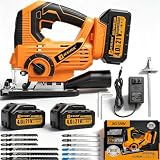

Compare runtime, weight, and charging trade-offs
| Battery type and example | Nominal voltage | Capacity | Approx. pack weight | Typical charge time | Best suited to |
|---|---|---|---|---|---|
| Compact 18V/20V MAX pack, such as DeWalt DCB203 | 18V nominal / 20V max | 2.0Ah | About 0.9 lb (0.4 kg) | About 30 minutes with a compatible fast charger | Trim cuts, overhead work, and lighter handling |
| Mid-capacity 18V pack, such as Makita BL1830B | 18V | 3.0Ah | About 1.3 lb (0.6 kg) | About 22 minutes with a compatible rapid charger | General home and workshop use |
| Full-size 18V/20V MAX pack, such as Milwaukee M18 XC 5.0Ah | 18V nominal / 20V max | 5.0Ah | About 1.5 lb (0.7 kg) | About 45 minutes with a compatible rapid charger | Longer sessions and repeated cutting |
| High-capacity 18V pack, such as Makita BL1850B | 18V | 5.0Ah | About 1.4 lb (0.6 kg) | About 45 minutes with a compatible rapid charger | Balancing extended runtime with a familiar 18V tool |
Weights and charging times are approximate and vary by pack revision, charger, temperature, and regional specifications. “20V MAX” and “18V” commonly describe the same nominal voltage class using different labeling conventions; compare capacity and compatibility rather than treating the label as a direct power ranking.
Amp-hours indicate stored charge, not a promise of a particular number of cuts. Under similar conditions, a 5.0Ah pack holds about 2.5 times the charge of a 2.0Ah pack on the same voltage platform. Actual runtime also depends on blade sharpness, material thickness, stroke rate, orbital setting, and how often the motor is working hard.
Choose by the way you use the saw
- Occasional household repairs: A 2.0Ah or 3.0Ah pack is usually enough for short cuts and is easier to maneuver. If you already own compatible batteries, use one of those before buying a dedicated pack.
- Long sessions in plywood or shelving: A 4.0Ah or 5.0Ah battery reduces interruptions. It is a practical balance for users who make repeated cuts but still need to steer accurately.
- Overhead or detailed work: Favor a compact battery. Extra mass at the handle can make it harder to keep the base plate flat and follow a line, so a lighter pack may produce better work even if it needs swapping sooner.
- Frequent jobsite use: Consider two compatible packs and a charger that matches your schedule. One battery can run while the other charges; confirm the charger’s stated time for your exact pack rather than assuming every “rapid” charger performs alike.
- Buying into a cordless system: Compare the cost of the bare battery and charger with a tool-and-battery kit. General market prices vary widely by capacity, brand, and promotions; compact packs often cost less, while high-capacity packs commonly land in a higher price tier. Buying a kit can be better value if you need both components.
Estimate runtime without relying on a cut-count claim
Battery energy gives a useful, though imperfect, comparison. Multiply nominal voltage by amp-hours: an 18V, 5.0Ah battery stores about 90 watt-hours (18 × 5). An 18V, 2.0Ah pack stores about 36 watt-hours. The larger pack therefore has roughly 2.5 times the nominal energy, but it will not necessarily deliver 2.5 times as many cuts if it runs hotter, powers a more demanding workload, or changes how you operate the saw.
For a realistic buying estimate, note how long your current battery lasts doing the same kind of work. If a 2.0Ah pack lasts about 20 minutes in your typical cutting session, a 5.0Ah pack might offer around 50 minutes under comparable conditions. Treat that as a planning estimate, not a guaranteed runtime; dense material and dull blades can reduce it substantially.
Check fit before prioritizing capacity
Battery fit involves more than voltage. Confirm the brand, platform, and exact tool compatibility, then consider the battery’s shape and clearance. A larger pack may extend below the handle or shift the balance, which can interfere with a narrow workpiece or make the saw tiring to hold. If possible, compare the pack dimensions with the clearance under your jigsaw’s grip and around the work surface.
Adapters are not a dependable shortcut to platform compatibility. They may affect fit, electrical protection, or warranty coverage. Use a battery approved for the tool, and do not force a pack that fails to latch securely.
Get more useful life from each battery
- Use a sharp blade suited to the material. A dull or inappropriate blade makes the motor work harder and can drain the pack faster.
- Clear sawdust from the battery rails and tool contacts with a dry brush or cloth. Avoid metal tools and liquids around electrical contacts.
- Let a hot battery cool before charging, and follow the manufacturer’s storage and temperature guidance. Heat and prolonged storage fully charged or fully depleted can shorten pack life.
- Do not leave the saw running between cuts. Switch it off when repositioning, especially during long sessions.
Battery capacity gradually declines with use and age. If runtime drops sharply, check the blade, material, charger, and operating temperature before concluding that the pack has failed. When replacing it, compare the price of a genuine compatible battery with a kit, and avoid packs that lack clear platform compatibility and safety information.
Bottom line
For most users seeking longer runtime without an extreme handling penalty, a compatible 4.0Ah or 5.0Ah battery is the sensible upgrade. Choose 2.0Ah or 3.0Ah for lighter, precise, or overhead cutting; choose the larger pack when uninterrupted work matters more. Match the jigsaw’s platform first, then balance capacity against weight, charging time, and the cost of the battery system you already own.