What's inside
As an Amazon Associate I earn from qualifying purchases. This post may contain affiliate links at no extra cost to you.
Best Milwaukee Tool Batteries: M12 and M18 Options Compared
Choose an M12 battery for compact tools and lighter work, or an M18 battery for Milwaukee’s larger, higher-demand tools; then pick the smallest capacity that will comfortably finish your typical job. M12 and M18 batteries are separate systems, so a battery from one platform will not power a tool from the other. For many buyers, a compact M12 pack and a mid-capacity M18 pack make a more useful starting combination than buying the largest battery available.
M12 vs. M18: the key difference
Milwaukee’s M12 platform is built around 12-volt-class tools where size and access matter: installation drivers, compact drills, lights, and other smaller-format equipment. M18 is the 18-volt-class platform for a broader range of full-size tools, including demanding saws, grinders, and outdoor equipment. Voltage alone doesn’t determine runtime; capacity, tool load, battery design, and work conditions all matter.
As an Amazon Associate we earn from qualifying purchases at no extra cost to you.


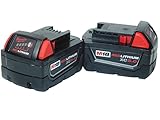

Battery amp-hour (Ah) is a measure of electrical charge capacity, not a promise of a particular number of minutes. A 5.0Ah pack may run longer than a 2.0Ah pack in the same tool, but the exact difference depends on how hard the tool is working. Larger packs generally add weight and bulk, which can make a tool tiring or awkward overhead.
Representative battery options compared
The figures below are representative of Milwaukee battery models commonly found in these capacity classes. Weights are approximate and can vary slightly by model revision; confirm the specification for the exact pack before purchasing. Runtime is intentionally described by use case rather than minutes, since a drill, circular saw, and light draw power at very different rates.
| Battery option | Platform | Capacity | Approx. weight | Best fit |
|---|---|---|---|---|
| M12 REDLITHIUM CP2.0 | M12 | 2.0Ah | About 0.4 lb | Compact tools, short tasks, and reducing tool weight |
| M12 REDLITHIUM XC4.0 | M12 | 4.0Ah | About 0.8 lb | Longer sessions where a larger pack still fits the tool comfortably |
| M18 REDLITHIUM XC5.0 | M18 | 5.0Ah | About 1.5 lb | General-purpose drills, impact drivers, and many everyday jobsite tasks |
| M18 REDLITHIUM HIGH OUTPUT XC6.0 | M18 | 6.0Ah | About 2.4 lb | Higher-demand tools needing a balance of capacity and manageable size |
| M18 REDLITHIUM HIGH OUTPUT HD12.0 | M18 | 12.0Ah | About 4.9 lb | Long, demanding work where runtime matters more than tool balance |
Battery naming can be confusing: CP generally denotes a compact pack, XC an extended-capacity pack, and HD a high-demand format. “HIGH OUTPUT” identifies a battery family designed to deliver stronger performance in compatible tools, not simply a larger Ah number. Check both the tool’s battery compatibility and the pack’s dimensions; a physically compatible battery may still make a handheld tool poorly balanced.
Choose by the work you actually do
| Your situation | Practical starting choice | Why |
|---|---|---|
| Light assembly, cabinet work, or occasional repairs | M12 CP2.0; add an M12 XC4.0 if sessions run long | The smaller pack keeps a compact tool easy to handle. |
| One-battery M18 starter kit for regular DIY | M18 XC5.0 | A useful middle ground for runtime, weight, and broad everyday use. |
| Repeated cutting or other demanding M18 work | M18 HIGH OUTPUT XC6.0 | More capacity and output headroom without the bulk of the largest packs. |
| Long shifts using high-draw tools | M18 HIGH OUTPUT HD12.0, if the tool accepts it and balance is acceptable | High capacity reduces battery changes, but adds substantial weight. |
| Tools from both Milwaukee platforms | At least one battery for each platform | M12 and M18 packs are not interchangeable. |
What runtime and weight mean in practice
For a compact drill used intermittently, the lightest compatible pack can be the best value because the tool spends much of the day in your hand. For continuous cutting, sanding, or grinding, reducing battery swaps may matter more than minimizing weight. Consider where the battery sits: an extra pound at the base of a drill is noticeable during overhead work, while the same added capacity may be less troublesome in a tool supported on a work surface.
A simple planning estimate can help compare capacities. If your current pack lasts through one typical work block, doubling its Ah is a rough way to think about potential capacity—not a guarantee of exactly twice the runtime. A saw cutting thick stock can drain a pack much faster than one making shallow cuts in softwood. Keep a charged spare for uninterrupted work rather than relying on a large battery to solve every runtime problem.
Buying for value, not just maximum capacity
Compare the cost of a battery with the value of the tool kit it supports. Battery prices vary by capacity, product line, and whether a pack is sold alone or bundled, so use general market ranges and current local listings rather than treating one price as universal. A kit that includes a tool, charger, and battery may be better value when you need all three; a bare tool can make sense if you already own compatible packs.
- For a first purchase: Buy into the platform that has the tools you expect to use most. Avoid collecting both systems just to gain a small convenience.
- For frequent work: Two moderate batteries often offer better workflow than one very large pack: one can run while the other charges.
- For occasional use: Don’t pay for capacity you rarely need. A smaller pack is easier to store and can improve handling.
- For high-demand tools: Check the tool manual’s recommendations. A high-output battery can be a better match than a compact pack even when their stated capacities look similar.
Compatibility and battery care
Match the platform first, then verify that the battery physically fits and is approved for the specific tool. M12 packs fit M12 tools; M18 packs fit M18 tools. Do not assume that a charger supports both platforms—check the charger label or manual. Original compatible chargers also provide the intended charging and battery-management features.
To extend useful service life, keep battery contacts clean and dry, avoid leaving packs in extreme heat or cold, and store them away from metal objects that could bridge the terminals. Let a hot pack cool before charging, and don’t force a battery into a tool or charger if the fit is wrong. Dust, impact damage, worn contacts, and long-term heat exposure are common ownership problems; inspect the housing and terminals periodically and replace a pack that is cracked, swollen, leaking, or otherwise damaged.
Bottom line
For compact woodworking and installation tools, start with an M12 CP2.0 and add an XC4.0 when longer runtime is worth the extra weight. For an everyday M18 setup, the XC5.0 is a balanced general-purpose choice; step up to a HIGH OUTPUT XC6.0 for sustained demanding work, or choose the HD12.0 when extended runtime outweighs portability. The best Milwaukee tool batteries are the ones that match the tool’s platform and workload without making the tool unnecessarily heavy.