What's inside
As an Amazon Associate I earn from qualifying purchases. This post may contain affiliate links at no extra cost to you.
The best 8K mirrorless cameras for most buyers are the Nikon Z8 for value and image quality, the Nikon Z9 for long recording sessions, the Canon EOS R5 Mark II for fast autofocus and compact 8K RAW, and the Fujifilm GFX100 II when large-format detail matters more than speed.
As an Amazon Associate we earn from qualifying purchases at no extra cost to you.

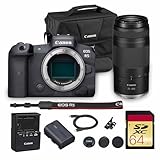


Quick comparison: the leading 8K mirrorless cameras
| Camera | 8K recording | Sensor and crop considerations | Approx. body weight | Heat and recording reality | Typical body price range in 2026 |
|---|---|---|---|---|---|
| Nikon Z8 | 8K up to 60p RAW internally; 8K UHD and 8K N-RAW options | 45.7MP full frame; 8K60 may require a crop or specific recording mode depending on firmware and settings | 910g with battery and card | Strong active cooling design, but high frame rates and warm surroundings reduce continuous time | $3,300–$3,800 |
| Nikon Z9 | 8K up to 60p RAW internally; long-GOP and intraframe options | 45.7MP full frame; full-frame and DX crop modes | 1,340g with battery and cards | Integrated vertical grip and large battery improve endurance; still produces substantial heat at 8K60 | $5,000–$5,500 |
| Canon EOS R5 Mark II | 8K up to 60p RAW internally; compressed 8K formats also available | 45MP full frame; crop options can reduce field of view | 746g with battery and card | Optional cooling grip is important for repeated high-resolution recording | $4,000–$4,500 |
| Canon EOS R5 C | 8K up to 60p RAW with suitable power; 8K30 is more practical on battery | 45MP full frame; wide-area recording modes vary by frame rate | 680g body only | Active cooling helps, but the small battery and power demands make external power useful | $2,500–$3,200 |
| Fujifilm GFX100 II | 8K up to 30p in selected formats | 102MP medium format; no conventional full-frame crop, but lenses are larger and costlier | 948g with battery and card | Cooling fan accessory supports demanding video work; 8K30 is its practical ceiling | $7,000–$7,800 |
Prices are broad body-only market ranges rather than fixed offers. Kit lenses, memory cards, spare batteries, cooling accessories and video support can add several hundred to several thousand dollars.
Which 8K camera should you choose?
Best overall value: Nikon Z8
The Nikon Z8 is the sensible choice for filmmakers who want high-end 8K features without paying for the larger professional body of the Z9. It records 8K N-RAW internally, giving you substantial grading flexibility while avoiding the expense and bulk of an external RAW recorder. Its 45.7-megapixel stacked full-frame sensor also provides fast readout, useful autofocus and reduced rolling-shutter distortion compared with slower high-resolution sensors.
The trade-off is endurance. The Z8 has no permanently built-in vertical grip, and its smaller battery and body have less thermal mass than the Z9. For interviews, landscape work, product films and short narrative takes, that is rarely a problem. For repeated 8K60 takes in warm weather, the Z9 is safer.
Best for long professional sessions: Nikon Z9
The Z9 is the strongest choice when 8K is a regular production format rather than an occasional reframing tool. Its large battery, integrated grip, dual card slots and robust body make it better suited to extended shoots. Nikon’s internal N-RAW is particularly useful when you want RAW latitude without attaching a recorder.
It is also the heaviest and most expensive option here. The extra size is worthwhile for sports, wildlife, documentary work and all-day production, but excessive for a small gimbal or travel kit. Its autofocus is strong for people, animals and vehicles, although no tracking system eliminates the need to choose sensible shutter speeds, focus areas and subject-detection settings.
Best autofocus and compact high-resolution kit: Canon EOS R5 Mark II
The EOS R5 Mark II is appealing when subject recognition and a relatively light body matter as much as codec choice. Its 45MP full-frame sensor supports 8K RAW and high-speed shooting, while Canon’s autofocus system is designed for people, animals and vehicles. The optional cooling grip is more than a comfort accessory: it can make the difference between a short 8K clip and a usable production day.
Canon’s RF lens range includes excellent professional zooms and primes, but the system can become expensive quickly. A 24–70mm f/2.8, 70–200mm f/2.8 and wide-angle zoom can cost more than the camera body. Third-party RF autofocus availability is also more limited than in some competing full-frame systems, so calculate the complete lens budget before choosing the body.
Best lower-cost cinema-oriented option: Canon EOS R5 C
The R5 C remains interesting for creators who prioritize video controls, active cooling and Canon’s 8K RAW workflow over stills convenience. It is often available at a lower body price than newer 8K models, and its cinema-oriented interface makes it comfortable in a rig.
Its weakness is power management. The small battery is not designed for carefree all-day 8K work, and the camera may need USB-C power or a larger external battery. Budget for a cage, power solution, media and monitoring rather than treating the low body price as the finished system cost.
Best for maximum detail and shallow depth of field: Fujifilm GFX100 II
The GFX100 II uses a 102MP medium-format sensor and can record 8K video, making it attractive for controlled commercial, studio and landscape productions where fine texture and tonal transitions matter. Its larger sensor can produce a distinctive look, but 8K is limited to 30 frames per second, and the lenses are generally larger and more expensive.
This is not the automatic winner simply because it has more pixels. Autofocus, readout, storage and lens cost are more important than sensor size for many moving-subject projects. Choose it when the medium-format rendering and still-image resolution have direct value.
8K formats: RAW is not always the best setting
8K describes image dimensions, not quality by itself. Common choices include RAW, intraframe compressed video and long-GOP compressed video.
- RAW: retains extensive sensor information for exposure, white-balance and color adjustments. It creates large files and demands a fast editing computer.
- Intra-frame formats: each frame is encoded independently. They are easier to edit than long-GOP files, but usually use more storage.
- Long-GOP formats: store complete frames plus changes between frames. They are efficient for storage, but harder for some computers to decode and less convenient when every frame needs heavy manipulation.
As a planning example, a 1,000 megabit-per-second recording rate uses approximately 125 megabytes per second. A 10-minute clip therefore needs about 75GB before card formatting and file overhead. At 2,600 megabits per second, the same clip needs roughly 195GB. Two 10-minute takes at that higher rate can fill a 512GB card surprisingly quickly once proxy files and other footage are included.
Use the highest-bitrate RAW mode for green-screen work, major exposure corrections or aggressive reframing. For a finished 4K delivery, a less demanding 8K compressed mode may preserve enough flexibility while reducing storage and editing costs.
Crop factors and the real angle of view
An 8K camera may not use the entire sensor in every mode. A DX, APS-C, Super 35 or other crop narrows the field of view. A 24mm lens on a full-frame camera gives a diagonal field of view comparable to approximately 36mm when a 1.5x crop is applied. That matters when filming interiors, architecture or handheld talking-head work.
Some cameras also crop at high frame rates, with electronic stabilization, or in particular RAW modes. Check the camera’s recording table rather than assuming that “8K60” uses the same sensor area as “8K24.” A crop can improve apparent reach for wildlife, but it makes a wide lens less useful and reduces the amount of light reaching the final image area.
Decision matrix by shooting situation
| Your situation | Best fit | Why | What to budget for |
|---|---|---|---|
| First serious 8K camera, mixed photo and video | Nikon Z8 | High-quality internal RAW, strong stills performance and smaller body | Fast CFexpress cards, spare battery and external cooling for long takes |
| Frequent 8K60 work or full-day documentary production | Nikon Z9 | Large battery, integrated grip and professional endurance | Additional cards, heavy-duty tripod or monopod and larger lenses |
| Fast-moving subjects and compact professional setup | Canon EOS R5 Mark II | Responsive autofocus and high-resolution RAW in a relatively light body | Cooling grip, RF lenses and high-capacity power banks |
| Rigged cinema setup on a tighter body budget | Canon EOS R5 C | Active cooling and video-focused operation | External power, cage, monitor and audio accessories |
| Controlled studio, fashion or landscape production | Fujifilm GFX100 II | Medium-format detail and distinctive rendering | Medium-format lenses, cooling accessory and substantial storage |
Storage, heat and ownership costs
Plan for at least two high-speed cards, a card reader rated for the chosen media, a backup drive and a second working drive. Do not buy storage based only on the advertised camera bitrate. Keep at least 25 percent free space on working media, and back up footage before formatting a card.
Heat is affected by resolution, frame rate, codec, ambient temperature, screen brightness, stabilization and whether the camera is recording internally or outputting video. The published limit is not a universal promise: a camera that records for a long time in a cool studio may stop sooner in direct sun. Shade the body, open the screen when appropriate, remove unnecessary accessories that block vents and avoid repeatedly starting and stopping hot cameras without allowing them to cool.
The first consumables are usually batteries, memory cards and cable connectors rather than the sensor itself. Dust on the sensor becomes more visible at small apertures, especially against a bright sky or plain wall, so use the camera’s cleaning cycle and a proper blower; avoid touching the sensor with improvised materials. Protect lens mounts from grit, and remember that an expensive body cannot compensate for a slow, unreliable card or insufficient backup storage.
Final recommendation
Choose the Nikon Z8 if you want the broadest balance of price, 8K RAW capability and manageable size. Choose the Nikon Z9 when uninterrupted professional endurance is worth the weight and cost. Choose the Canon EOS R5 Mark II for autofocus-led production and the Canon EOS R5 C for a rigged, actively cooled video setup. Select the Fujifilm GFX100 II only when medium-format image character and extreme stills resolution justify its slower 8K30 ceiling and more expensive lens system.