What's inside
- Best Floor Mirrors for Every Room
- Quick comparison: which floor mirror fits your room?
- Best floor mirror for a bedroom: a wide leaning or tilting design
- Best floor mirror for an entryway: narrow, anchored, and easy to clean
- Best mirror for compact spaces: wall-mounted or over-the-door
- Decision matrix for choosing the right style
- Mounting and stability: the detail that matters most
- Ownership realities: what wears first and how to maintain it
- Best Floor Mirrors for Every Room
- Quick comparison: which floor mirror fits your room?
- Best floor mirror for a bedroom: a wide leaning or tilting design
- Best floor mirror for an entryway: narrow, anchored, and easy to clean
- Best mirror for compact spaces: wall-mounted or over-the-door
- Decision matrix for choosing the right style
- Mounting and stability: the detail that matters most
- Ownership realities: what wears first and how to maintain it
As an Amazon Associate I earn from qualifying purchases. This post may contain affiliate links at no extra cost to you.
Best Floor Mirrors for Every Room
The best floor mirrors are full-length mirrors sized to your available wall or floor space, built with a frame that suits the room, and supported by a stable stand or secure wall anchor rather than chosen by appearance alone.
A bedroom usually benefits from a tall, wide mirror that shows an outfit from head to toe. An entryway needs a narrower design with a small footprint and reliable stability around passing traffic. For a compact room, an over-the-door or wall-mounted mirror can provide nearly the same reflective area without using valuable floor space.
As an Amazon Associate we earn from qualifying purchases at no extra cost to you.
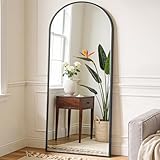


Quick comparison: which floor mirror fits your room?
| Mirror type | Typical size | Approx. weight | Floor footprint | Best location | Mounting and stability |
|---|---|---|---|---|---|
| Leaning full-length mirror | 24–32 in wide × 65–75 in tall | 25–55 lb | 8–14 in deep | Bedroom or dressing area | Leans against a wall; wall anti-tip strap strongly recommended |
| Freestanding cheval mirror | 18–28 in wide × 55–70 in tall | 18–40 lb | 16–24 in deep | Bedroom, guest room, studio | Built-in legs; generally stable when placed on a level surface |
| Over-the-door mirror | 12–16 in wide × 48–68 in tall | 8–18 lb | About 2–4 in beyond the door | Small bedroom or apartment | Hanging brackets; check door clearance and hinge capacity |
| Wall-mounted full-length mirror | 18–30 in wide × 48–72 in tall | 15–45 lb | Less than 3 in from wall | Entryway or compact room | French cleat, D-rings, or rated brackets fixed to suitable structure |
| Tilting full-length mirror | 20–30 in wide × 60–72 in tall | 25–60 lb | 10–18 in deep | Bedroom or dressing room | Frame-mounted support; secure the top if children or pets are present |
These are useful planning ranges rather than universal specifications. The mirror glass, frame, backing, hardware, and packaging can change the final dimensions and weight, so check the manufacturer’s installation sheet before buying.
Best floor mirror for a bedroom: a wide leaning or tilting design
For daily outfit checks, choose a mirror at least 65 inches tall and 24 inches wide. A 72-inch-tall mirror allows most adults to see their entire body when standing several feet away. Width matters just as much: a 16-inch mirror can show a full silhouette, but a 24- to 30-inch model is easier to use when checking clothing proportions or moving around in front of it.
A leaning mirror uses less floor depth than a cheval mirror and often provides a larger reflective surface. Its weakness is that it depends on the wall and anti-tip hardware. A tilting mirror can compensate for a low ceiling or slightly awkward viewing angle, but its deeper frame occupies more space.
Frame materials for bedrooms
- Solid wood: Warm appearance and good repairability, but it can expand or contract with humidity. Look for properly joined corners and a sealed finish.
- Engineered wood: Often lighter and more dimensionally consistent than solid wood. Inspect the edge treatment and fastener points, since damaged particleboard is difficult to repair.
- Metal: Slim, durable, and easy to coordinate with contemporary furniture. Thin tubing can flex if the stand or rear brace is poorly designed.
- Plastic or resin: Lightweight and often affordable. It resists some moisture but may scratch or become brittle with prolonged sunlight.
For a bedroom, the most useful balance is usually a 24- to 28-inch-wide glass mirror in a solid-wood, engineered-wood, or rigid metal frame, with a rear anti-tip strap included or easily added.
Best floor mirror for an entryway: narrow, anchored, and easy to clean
Entryways reward a different design. Keep the body of the mirror narrow enough to leave a clear walking path, especially beside a shoe cabinet or coat rack. A 12- to 20-inch-wide mirror is usually easier to place than a 30-inch decorative frame. If the entryway is tight, wall-mounting is safer than allowing a tall object to project into the route of travel.
Choose a frame with a sealed surface and simple edges. Dust, fingerprints, umbrellas, and damp coats are more likely to reach an entryway mirror than a bedroom mirror. Powder-coated steel, sealed wood, and smooth composite frames are practical choices. Deep carved details look attractive but take longer to dust.
For a freestanding model, check whether the base extends farther than the mirror face. A broad base improves stability, but it must not create a toe-catching ledge. Adjustable leveling feet are useful on older or uneven floors. If the mirror can be touched by children, pets, or a closing door, use a wall anchor even when the product is advertised as freestanding.
Best mirror for compact spaces: wall-mounted or over-the-door
When every inch matters, compare the mirror’s reflective area rather than its outside dimensions. A 14-inch-wide over-the-door mirror can provide a useful full-length view while using almost no floor area. Its trade-offs are door movement, possible rattling, and reduced width.
A wall-mounted mirror is the better compact-space choice when you can locate a stud or install an appropriate masonry anchor. It keeps the floor clear and can be positioned above a slim shoe cabinet or dresser. Use a French cleat for a heavier framed mirror because it distributes the load across a wider section of wall. D-rings and individual hooks can work well, but only when the combined hardware rating exceeds the mirror’s actual weight.
Worked fit calculation
Suppose a bedroom has 34 inches of clear wall width and 12 inches of usable depth before a dresser. A 28-inch-wide leaning mirror leaves 6 inches of side clearance. If its frame and lean require 10 inches of depth, it fits the available zone with 2 inches to spare. A 32-inch mirror would leave only 2 inches of total side clearance and may feel visually crowded, even though it technically fits. In this case, the 28-inch option is the better choice.
For a walkway, aim for at least 30 inches of clear passage where possible. If a leaning mirror occupies 10 inches of depth, place it outside that passage or choose a wall-mounted design. Measure the base, not merely the glass, because the stand is often the widest or deepest part.
Decision matrix for choosing the right style
| Your situation | Recommended type | Target specification | Why |
|---|---|---|---|
| Daily clothing checks and ample bedroom space | Wide leaning mirror | 24–30 in wide; 65–75 in tall | Large view with relatively small depth |
| Frequent repositioning or renting | Cheval mirror | 18–28 in wide; stable leg spread | Moves without wall installation, though it uses more floor space |
| Narrow hallway or small apartment | Wall-mounted mirror | 18–24 in wide; rated hardware | Preserves the walking path |
| Very limited floor area | Over-the-door mirror | 12–16 in wide; padded hooks | Uses the door plane instead of the floor |
| Children, pets, or high-traffic areas | Anchored framed mirror | Anti-tip strap or positive wall attachment | Reduces the chance of tipping when bumped |
Mounting and stability: the detail that matters most
Before installation, weigh the assembled mirror rather than relying on an estimate. Select hardware rated well above that weight, and use the correct anchor for the wall: a stud screw for wood framing, a masonry fastener for brick or concrete, or a suitable hollow-wall anchor for drywall when a stud is unavailable. Do not attach a heavy mirror to drywall with a small picture hook alone.
For a leaning mirror, place the bottom on a level, non-slip surface and attach the upper frame to the wall with the supplied anti-tip restraint. Avoid positioning it where a door, drawer, or chair can strike the glass. For an over-the-door model, confirm that the hooks do not prevent the door from closing and that the mirror does not hit the wall when the door moves.
Ownership realities: what wears first and how to maintain it
The reflective coating is usually protected behind the glass, but moisture can still damage the edges over time. Do not spray cleaner directly onto the mirror; spray a microfiber cloth lightly, then wipe from the center outward. Keep liquid away from the lower edge, frame joints, and backing board. Abrasive powders, rough paper towels, and ammonia-heavy cleaners can dull finishes or leave residue.
Inspect the rear brackets, stand screws, and anti-tip strap every few months. Loose hardware is more common than damaged glass and can make a stable mirror unsafe. Tighten fasteners without overtightening, which can stress the frame or distort the glass. If a mirror develops a crack, sharp edge, or loose backing, stop using it and replace or professionally repair it rather than trying to tape the glass in place.
In short, choose height and width for the viewing task, frame material for the room’s moisture and traffic, and mounting hardware for the mirror’s actual weight. The best floor mirrors are not necessarily the largest or most decorative; they are the ones that provide the required reflection while remaining stable, cleanable, and proportionate to the room.