What's inside
As an Amazon Associate I earn from qualifying purchases. This post may contain affiliate links at no extra cost to you.
The Best Grater for Parmesan Cheese Depends on How You Use It
For fluffy Parmesan over pasta, a fine microplane-style grater is the best choice for most kitchens; choose a box grater if you also need coarse shreds and slices, or a rotary grater if you regularly grate at the table and prefer a covered cutting surface. The right pick comes down to the texture you want, how long you’ll grate by hand, and how much cleaning and storage you’ll tolerate.
Microplane vs. Box vs. Rotary: The Practical Differences
These grater types can all handle hard Parmesan, but they produce different results. Fine teeth make light, delicate shavings that melt quickly into warm food. Coarser holes create distinct strands with more bite. A rotary drum produces fairly even shreds while keeping fingers away from the cutting surface, though its output is usually less fluffy than fine zest-style grating.
As an Amazon Associate we earn from qualifying purchases at no extra cost to you.


| Type | Typical working size | Typical weight | Common material | Best for |
|---|---|---|---|---|
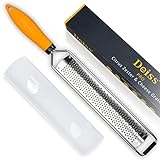
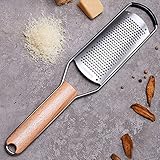
| Microplane-style fine grater | About 30–35 cm long; 2–4 cm across the blade | About 100–200 g | Stainless-steel etched or stamped blade; handle may be plastic or stainless steel | Fine, fluffy Parmesan for finishing |
| Four-sided box grater | About 20–25 cm tall; 10–13 cm wide | About 250–500 g | Stainless-steel cutting panels; metal or plastic handle and base | Fine or coarse shreds, plus other cutting styles |
| Rotary grater | About 15–20 cm long; 8–12 cm wide | About 200–400 g | Stainless-steel drum; plastic or metal frame and handle | Table service and repeated grating into a dish |
These are approximate ranges, not fixed standards. Designs vary by manufacturer, and “stainless steel” alone doesn’t tell you the blade thickness, edge geometry, handle comfort, or resistance to staining. Check the product’s dimensions and care instructions before buying, especially if it needs to fit a drawer or dishwasher.
Which Grater Fits Your Situation?
| Your situation | Best fit | Why |
|---|---|---|
| You mostly finish pasta, soup, or salad with Parmesan | Fine microplane-style grater | It produces light shavings with little bulk and stores easily. |
| You want one tool for cheese, vegetables, and occasional slicing | Four-sided box grater | Multiple surfaces cover more jobs, though the larger body takes more storage. |
| You grate cheese often at the table or have limited grip strength | Rotary grater with a stable clamp or base | The crank does the cutting work and helps keep fingers away from the drum. |
| You have little storage space and grate small amounts | Microplane-style grater with a protective cover | The slim shape is easier to store than a box or rotary assembly. |
| You need large quantities for a group meal | Box grater or sturdy rotary model | A broader working surface or cranked drum can be more practical than repeated short passes on a narrow blade. |
How to Choose by Grate Fineness and Comfort
Choose fine for quick-melting cheese
A fine microplane-style blade is a strong choice when you want Parmesan that falls loosely over food rather than sitting in thick strands. It is also useful for grating a small amount directly over a plate. The trade-off is that its narrow surface can make a large batch feel slow, and the sharp teeth need careful handling during washing and storage.
Choose coarse for texture and versatility
A box grater’s coarse face makes thicker shreds that remain noticeable on baked dishes, salads, and pasta. Its fine face can handle smaller finishing amounts, although the result may not be as airy as shavings from a dedicated fine grater. A broad base and nonslip footing matter: a grater that shifts on the counter can turn a simple task into an awkward one.
Choose rotary for repetitive grating
A rotary grater lets you feed a piece of cheese into a drum and turn a handle. That can be more comfortable for repeated portions than holding cheese against a stationary blade, particularly when the model stays firmly anchored. Check that the handle turns smoothly, the drum can be removed for cleaning, and the clamp or suction base suits your counter or bowl. Rotary drums are not interchangeable across all models, so replacement options are worth checking before purchase.
Stainless Steel: What Matters Beyond the Label
Stainless-steel blades are a practical choice for a cheese grater because they resist rust better than ordinary steel and retain a cutting edge through normal kitchen use. But they are not immune to damage. Dishwasher detergent, trapped moisture, and contact with other utensils can dull edges or leave marks over time. For any grater, follow the manufacturer’s care instructions; if hand-washing is recommended, rinse promptly, wash carefully, and dry fully before putting it away.
On a microplane-style grater, the etched cutting surface is the part most likely to lose its bite or get damaged by scrubbing. On a box grater, thin panels, welded joints, and a loose or cracked handle are common points to inspect. On a rotary model, the drum’s cutting edge may last while the crank, hinge, or locking parts wear first. These are reasons to look for a rigid frame, secure handle, and available replacement parts—not simply a high-polish finish.
Ownership Tips That Make a Difference
- Use a cold, firm wedge. Parmesan that is cool and solid is easier to control than cheese that has softened at room temperature.
- Match the motion to the tool. On a flat grater, use steady strokes and stop before the rind or a small remnant reaches your fingers. With a rotary grater, avoid forcing an oversized piece into the drum.
- Clean before cheese dries. Rinse the teeth or drum promptly. Dried cheese is harder to remove and often tempts people to scrub across sharp edges.
- Brush away residue safely. Use a brush from the back of the grating surface toward the cutting edges only when the design allows; keep fingers clear of the teeth.
- Protect the blade in storage. A sheath or cover prevents accidental cuts and reduces contact with other utensils that could damage the edge.
- Don’t assume dishwasher-safe means dishwasher-proof. Heat and detergent can shorten the life of handles, coatings, and moving parts. Follow the care label, especially for rotary assemblies.
Bottom Line
For most people asking for the best grater for Parmesan cheese, a fine microplane-style grater is the simplest pick for delicate finishing shavings, compact storage, and small portions. Choose a box grater if versatility and coarse shreds matter more than space, or a rotary grater if repeated table-side grating and a crank-operated motion suit your routine. Whichever style you choose, prioritize a comfortable grip, a stable working position, stainless-steel cutting parts, and a cleaning method you’ll actually use.