What's inside
- Budget Cordless Heat Guns Compared: Specs That Matter
- What Separates a Usable Budget Gun From a Toy
- Best Budget Cordless Heat Gun by Situation
- Decision Matrix: Which One Fits Your Work
- Runtime Math: How Long Will a Battery Actually Last
- Durability and Ownership Realities
- Where Cordless Still Falls Short
- FAQ
- Budget Cordless Heat Guns Compared: Specs That Matter
- What Separates a Usable Budget Gun From a Toy
- Best Budget Cordless Heat Gun by Situation
- Decision Matrix: Which One Fits Your Work
- Runtime Math: How Long Will a Battery Actually Last
- Durability and Ownership Realities
- Where Cordless Still Falls Short
- FAQ
As an Amazon Associate I earn from qualifying purchases. This post may contain affiliate links at no extra cost to you.
The best budget cordless heat gun for most DIYers in 2026 is the Ryobi ONE+ 18V Heat Gun (P3150) for its balance of 875°F max temperature, dual airflow settings, and wide nozzle support, while the Craftsman V20 and Bauer 20V are cheaper alternatives if you already own those batteries.
Budget cordless heat guns now top out around 900°F to 1,000°F, heat up in under 10 seconds, and run 20 to 40 minutes on a 4.0Ah battery – enough for heat shrink, vinyl wrap, paint softening, and small repairs, but not a full replacement for a 1,200°F+ corded gun for heavy paint stripping. Choosing comes down to battery platform, actual airflow, and how well the tool shields heat from your hand and workpiece.
As an Amazon Associate we earn from qualifying purchases at no extra cost to you.


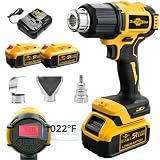
Budget Cordless Heat Guns Compared: Specs That Matter
Maximum temperature gets the headline, but airflow (CFM or liters per minute), warm-up time, and heat shielding determine whether the gun is actually useful for stripping or just for shrink tubing. Budget models use a single ceramic element and a two-stage fan, so high-temp often means low-airflow.
| Model (Bare Tool) | Max Temp | Temp Settings | Airflow | Warm-Up Time | Runtime on 4.0Ah | Weight (w/o Battery) | Nozzles Included |
|---|---|---|---|---|---|---|---|
| Ryobi ONE+ 18V P3150 | 875°F / 468°C | 2 (475°F / 875°F) | 2 settings | ~8-10 seconds | ~25-30 min (low), ~18-22 min (high) | 1.4 lbs / 0.63 kg | 2 (deflector, concentrator) |
| DeWalt 20V MAX DCE530 | 990°F / 532°C | 1 (990°F) | ~5.5 CFM | ~6-8 seconds | ~30-35 min | 1.1 lbs / 0.50 kg | 0 (sold separately, 2 optional) |
| Milwaukee M18 Compact 2688-20 | 875°F / 468°C | 1 (875°F) | ~6 CFM | ~7 seconds | ~25-28 min | 0.97 lbs / 0.44 kg | 0 (optional concentrator) |
| Craftsman V20 CMCE530 | 800°F / 427°C | 2 (500°F / 800°F) | 2 settings | ~9-11 seconds | ~22-26 min (high) | 1.5 lbs / 0.68 kg | 2 (flat, concentrator) |
| Bauer 20V (Harbor Freight) | 840°F / 449°C | 2 (480°F / 840°F) | ~4.8 CFM | ~10-12 seconds | ~20-24 min (high) | 1.6 lbs / 0.72 kg | 2 (hook, concentrator) |
| Worx 20V MakerX WX743 | 480°F / 249°C | 1 (480°F) | Low-flow precision | ~5 seconds | ~40+ min | 0.66 lbs / 0.30 kg | 3 (precision tips) |
Notes: Runtime estimates are based on manufacturer data and user-reported averages with 18V/20V 4.0Ah lithium-ion packs at room temperature. Cold weather or continuous high-temp use reduces runtime by 15-25%. The Worx MakerX is a craft-grade gun by design – much lower temperature for electronics and small heat shrink.
What Separates a Usable Budget Gun From a Toy
1. Maximum temperature and real heat control
For heat-shrink tubing, vinyl wrap, and thawing or bending PVC, 400°F to 600°F is sufficient. For softening latex paint, loosening threadlocker, or activating adhesives, you need 750°F to 900°F. Budget cordless guns cluster at 800°F to 990°F on high, which will soften most house paints within 20-30 seconds at 2-3 inches distance but will struggle with multiple layers of oil-based paint compared to a corded 1,100°F gun.
Two-temperature guns (Ryobi, Craftsman, Bauer) are more versatile than single-temperature compact models (DeWalt, Milwaukee). Use low for shrink wrap and electronics where you want to avoid melting, high for stripping and forming.
2. Warm-up time
All lithium cordless guns now use rapid-heating ceramic cores. Expect 6 to 12 seconds to reach working temperature, versus 30-45 seconds for older corded guns. The difference between 6 and 10 seconds is negligible in practice, but models that pulse or cycle the element to save battery will dip in temperature if you hold the trigger continuously for more than 2-3 minutes.
3. Airflow
Budget guns typically deliver 4 to 6 CFM, versus 8 to 15 CFM for corded. Lower airflow means more precise heat but slower stripping. For stripping a door jamb or softening adhesive over a large area, low airflow doubles work time. For heat shrink and soldering, low airflow is an advantage – it prevents blowing small parts around.
4. Heat shielding and ergonomics
This is where cheap tools diverge. Look for:
- A recessed nozzle collar and plastic heat shield that keeps the body under 110°F after 5 minutes of use.
- A flat or kickstand base so the hot nozzle never rests on the workpiece. All the models above except the Worx MakerX have an integrated stand.
- An angled head (DeWalt and Milwaukee) that keeps your hand out of the hot air path when working horizontally.
Guns with exposed metal barrels (common on sub-$40 no-name imports) transfer heat to the housing and can soften their own plastic after 10 minutes of continuous high use. The listed brands use shielded barrels that stay cooler.
5. Nozzle options
A concentrator nozzle (narrow slit) is essential for stripping and for directing heat onto a bolt or pipe without cooking surrounding material. A deflector/spreader nozzle helps with vinyl and for bending plastic sheet evenly. Budget kits including two nozzles save $15 to $25 versus buying separately. DeWalt and Milwaukee sell nozzles as accessories, which adds cost if you need them.
Best Budget Cordless Heat Gun by Situation
Best overall on a budget: Ryobi ONE+ P3150
It hits the useful middle of temperature and runtime, includes two nozzles, and has a two-stage switch that actually changes temperature rather than just fan speed. Its larger body is less compact than Milwaukee or DeWalt but stays cooler and has a more stable stand. If you are already in the Ryobi ONE+ system, it is the lowest total cost. General market range for the bare tool is $50 to $70.
Most compact for repairs and electrical: Milwaukee M18 Compact 2688-20 and DeWalt DCE530
Both are pistol-grip, one-temperature guns built for heat shrink, wire terminals, PEX bending, and thawing. The DeWalt runs slightly hotter (990°F) and is better for adhesive removal. The Milwaukee is lighter and shorter, better for cramped engine bays or inside cabinets. Neither is ideal for large-area stripping due to single-temp operation and focused airflow. General bare tool range is $70 to $110, often higher than the budget Ryobi/Craftsman but justified if you need the size.
Lowest price if you own the batteries: Craftsman V20 and Bauer 20V
The Craftsman V20 and Bauer 20V deliver 800°F to 840°F with two settings and two nozzles at a bare tool price typically $40 to $60. Trade-offs are slightly longer warm-up, more plastic flex in the housing, and louder fans. For occasional use – shrinking 20-30 connectors, softening caulk, removing decals – they perform the same as premium compacts for stripping small patches.
For crafts and electronics only: Worx MakerX WX743
Do not buy this as a general heat gun. At 480°F max it will not strip paint or loosen seized hardware. It excels at embossing, small heat shrink, and 3D-print cleanup where you want low, precise heat without scorching. Its pen-like size and lowest weight make it ideal for bench work. General kit range with battery and charger is $50 to $80.
Decision Matrix: Which One Fits Your Work
| Your Situation | Pick This Type | Why |
|---|---|---|
| Already own Ryobi 18V, Craftsman V20, or Bauer 20V batteries | Same-brand gun as your batteries | Battery cost is more than the tool; matching platform saves $40-$80 vs buying a new battery and charger. |
| Mainly heat shrink, automotive wiring, PEX, small repairs | Milwaukee M18 Compact or DeWalt DCE530 | Compact head, fast warm-up, focused 5-6 CFM airflow prevents collateral damage. |
| Light paint stripping, vinyl wrap, decal removal, upcycling furniture | Ryobi P3150 or Craftsman V20 (2-temp) | Low setting avoids scorching wood/vinyl; high setting softens paint without a cord. |
| Tight shop, apartment, or occasional use (monthly or less) | Craftsman V20 or Bauer 20V | Lowest upfront cost, adequate for short bursts; limited runtime less relevant. |
| Paper crafts, resin, 3D prints, small electronics | Worx MakerX | 480°F ceiling prevents burning delicate materials; precision tips included. |
Runtime Math: How Long Will a Battery Actually Last
Budget guns draw 250-350 watts on high. A 20V 4.0Ah pack holds about 72-80 watt-hours (20V x 4.0Ah = 80Wh nominal, ~72Wh usable). Calculation for continuous high:
Runtime (hours) = Usable Watt-Hours / Watt Draw
Example: 72Wh / 300W = 0.24 hours = ~14 minutes of trigger-on time on high.
Manufacturers advertise 20-35 minutes because that includes cycling on low, cool-down intervals, and intermittent trigger use. In real stripping work where you work in 2-minute bursts, a 4.0Ah battery yields roughly 18 to 28 minutes of effective heating before cut-off.
- A 2.0Ah battery: expect 9-14 minutes effective on high – enough for 15-20 heat-shrink terminals or softening a 2×3 foot paint section.
- A 4.0Ah battery: doubles that and stays cooler, with less voltage sag at the end.
- A 6.0Ah battery: adds weight (+0.5 lb) but extends high-temp sessions to ~35-45 minutes effective.
If you plan to strip a full door or remove floor tile adhesive, budget two 4.0Ah packs and let the gun cool 2-3 minutes between packs to protect the element.
Durability and Ownership Realities
Cordless heat guns have few moving parts, but three things wear first:
- Heating element and mica insulator: Repeated full-heat cycles from cold eventually cracks the insulator. Avoid running on high for more than 5 minutes continuously; use 30-second cool-down on low or fan-only if available before shutoff. This extends element life from ~500 hours to well over 800 hours.
- Nozzle fit and carbon buildup: Adhesive vapors and paint residue bake onto the nozzle. Clean the nozzle bore with a brass brush while warm (not hot) after stripping sessions. A loose concentrator that rattles will leak hot air onto the housing – pinch the retention tabs slightly for a snug fit.
- Battery contacts: Heat travels down the barrel to the handle. After extended use, allow the tool to stand upright for 3-4 minutes before removing the battery; pulling a hot pack can soften the terminal housing.
Common mistakes that shorten life are blocking the rear air intake with your palm, running the gun pointed straight down for minutes (heat reflects back into the electronics), and storing the gun while the nozzle is still above 200°F inside a toolbox. Let the nozzle cool to touchable temperature on its stand.
Consumables are minimal: no filters on most budget models, but blow out dust from the intake with compressed air monthly. Replacement nozzle sets are $12 to $25 depending on brand. If the element fails out of warranty, replacement is rarely economical – bare tool replacement is typically cheaper than service.
Where Cordless Still Falls Short
No budget cordless gun matches a $90-$150 corded gun for sustained stripping. Corded models hold 1,000°F to 1,350°F with 9+ CFM for 30+ minutes without battery sag, which matters if you are stripping a deck or multiple doors. Consider cordless as a complement for portability – roof, car, job site without power, or quick repairs – rather than a sole stripping tool if you do that work weekly.
FAQ
Can a budget cordless heat gun strip paint to bare wood?
Yes for small areas and latex paint at 800°F+ held 1-2 inches from the surface, moving at 2-3 inches per second. For thick, alligatored oil-based paint or lead paint, a corded gun with higher airflow and a sharp scraper is faster and safer. Always check for lead and use respiratory protection and ventilation when heating paint.
Will a cordless heat gun loosen rusted bolts?
It can help soften threadlocker and expand a nut slightly, but at 800°F to 990°F it is marginal for heavily rusted fasteners compared to a propane torch. Keep the flame-free advantage in mind for fuel and brake areas, and cycle heat for 45-60 seconds, then apply penetrant after cooling slightly.
Do I need a special battery?
Any lithium-ion pack from the same platform works, but 3.0Ah or larger is recommended. High-draw heating pulls high current, and small 1.5Ah/2.0Ah packs heat up and hit low-voltage cutoff sooner, reducing both runtime and max temperature near the end of the charge.