What's inside
- Portable solar panel comparison
- Best choices by camping and backup situation
- What the wattage really means
- Connector compatibility matters more than brand matching
- Decision matrix for choosing the right panel
- Setup practices that improve real-world output
- Durability and ownership considerations
- Bottom line
- Portable solar panel comparison
- Best choices by camping and backup situation
- What the wattage really means
- Connector compatibility matters more than brand matching
- Decision matrix for choosing the right panel
- Setup practices that improve real-world output
- Durability and ownership considerations
- Bottom line
As an Amazon Associate I earn from qualifying purchases. This post may contain affiliate links at no extra cost to you.
The best portable solar panels reviews point to the same conclusion: choose a rigid-folding 200W panel for faster campsite charging, a 100W panel for portability, and a compact USB solar charger only when low weight matters more than dependable output.
Portable panels are not interchangeable. Their advertised wattage is measured in ideal laboratory conditions, while shade, heat, cable loss, charging limits, and the angle of the sun determine what reaches your power station. The comparisons below focus on the details that matter outdoors: usable output, folded size, weight, connectors, and setup effort.
As an Amazon Associate we earn from qualifying purchases at no extra cost to you.
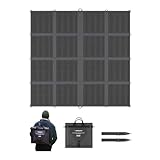


Portable solar panel comparison
| Panel | Rated output | Folded size | Weight | Connector | Best suited to |
|---|---|---|---|---|---|
| Jackery SolarSaga 100 | 100W | 24.0 × 21.0 × 1.0 in | 5.1 lb | 8 mm DC; USB-A and USB-C on panel | Jackery Explorer power stations and small camps |
| Jackery SolarSaga 200 | 200W | 21.0 × 24.0 × 2.0 in | 17.6 lb | 8 mm DC | Fast charging with compatible Jackery stations |
| Goal Zero Nomad 100 | 100W | 20.5 × 15.5 × 2.0 in | 10.2 lb | 8 mm DC | Rugged, established 100W systems |
| BLUETTI PV200 | 200W | 23.2 × 24.8 × 2.0 in | 16.1 lb | Standard MC4 output | Power stations that accept higher-voltage solar input |
| EcoFlow 110W Portable Solar Panel | 110W | 16.5 × 20.2 × 0.8 in | 8.8 lb | MC4-to-XT60 cable | EcoFlow systems and users wanting a protective case |
| BioLite SolarPanel 100 | 100W | Approximately 20 × 14 × 2 in | Approximately 10 lb | DC output with USB charging | Portable camps with direct USB charging needs |
Dimensions and weights can vary slightly by revision or regional packaging. Confirm the panel’s current manual before combining it with a power station. A panel’s connector may physically fit an adapter without being electrically compatible.
Best choices by camping and backup situation
Best for most car campers: a 100W folding panel
A 100W panel is the practical middle ground. Models such as the Jackery SolarSaga 100 can recharge a small power station, run USB devices, and fit in a vehicle without consuming much cargo space. The built-in kickstand reduces setup time, and integrated USB ports can charge smaller devices without using the power station’s inverter.
Expect roughly 55–80W during a good midday period rather than a continuous 100W. That range is a planning estimate, not a guarantee. In five equivalent peak-sun hours, a 100W panel might harvest about 275–400Wh after allowing for conversion and environmental losses.
Best for faster charging: a 200W folding panel
A 200W panel such as the BLUETTI PV200 or Jackery SolarSaga 200 is the better choice when a refrigerator, electric blanket, CPAP battery, or communications equipment must be replenished during the day. It can collect energy twice as quickly in favorable conditions, but it is not twice as convenient. These panels occupy more ground when unfolded and are substantially heavier.
Check the power station’s solar-input limits before buying. If the station accepts only 100W, a 200W panel will not automatically charge it faster. Some stations also impose maximum voltage and current limits; exceeding them can prevent charging or damage equipment.
Best when storage space is tight: EcoFlow 110W
The EcoFlow 110W Portable Solar Panel is a useful compromise for vehicle travel. Its folded footprint is relatively compact, and its protective case helps during transport. The MC4-to-XT60 cable is convenient for EcoFlow equipment but means that users of another brand may need the correct manufacturer-approved cable rather than a generic adapter.
Best for direct small-device charging: a USB solar charger
A compact USB solar charger weighs less than a folding power-station panel and can be useful for phones, headlamps, and battery banks. It is not a substitute for a 100W or 200W panel. Small panels often produce inconsistent power as clouds pass, causing phones to repeatedly start and stop charging. A better arrangement is to charge a power bank from the panel, then charge the phone from the power bank.
What the wattage really means
Rated wattage is a peak figure produced under controlled sunlight, panel temperature, and orientation. Three common losses reduce outdoor production:
- Angle and direction: a panel lying flat in the morning produces less than one aimed toward the sun.
- Heat: photovoltaic cells generally lose efficiency as they become hot.
- Electrical conversion: the panel, cable, charge controller, and battery each introduce losses.
A useful planning formula is:
Estimated daily energy = panel wattage × effective sun hours × 0.65 to 0.80.
For example, a 200W panel in four effective sun hours produces:
200W × 4 × 0.70 = 560Wh.
That could replenish a 500Wh power station on a clear day, but it leaves little margin for morning shade, clouds, heat, or a poorly positioned panel. If the station is rated at 512Wh, the theoretical charging time at 560Wh of harvested energy is about one day of favorable sunlight, not a few hours of continuous 200W output.
Connector compatibility matters more than brand matching
Most portable panels use one of three connection arrangements:
- MC4: common on larger folding panels, including the BLUETTI PV200 and EcoFlow’s panel family. MC4 cables are weather-resistant and easy to extend, but polarity must be checked.
- 8 mm barrel-style DC: used by several Jackery and Goal Zero systems. The plug size alone does not confirm voltage or polarity compatibility.
- Proprietary or system-specific plugs: convenient within one ecosystem but less flexible when changing power-station brands.
Before purchase, compare the panel’s open-circuit voltage and short-circuit current with the power station’s permitted solar-input range. Also check whether the station requires an adapter cable. Never connect panels in series or parallel merely because the plugs fit; the combined voltage or current may exceed the controller’s limit.
Decision matrix for choosing the right panel
| Your situation | Recommended type | Why | Acceptable compromise |
|---|---|---|---|
| Occasional weekend camping, small power station | 100W folding panel | Portable and sufficient for phones, lights, and camera batteries | Slower recovery after cloudy weather |
| Frequent off-grid use or emergency backup | 200W panel, or two compatible 100W panels | More useful energy during limited daylight | Higher cost, larger footprint, heavier cables |
| Limited vehicle storage | 100–110W compact folding panel | Easier to pack and position | May require an extra charging day for large batteries |
| Beginner using one manufacturer’s power station | Matching ecosystem panel | Usually the simplest cable and input-limit pairing | Less flexibility if the power station is replaced |
| Backpacking or short hikes | Small USB solar charger | Lowest carried weight | Unreliable output under shade and moving weather |
Setup practices that improve real-world output
- Locate unobstructed sun. A narrow tree shadow across one cell section can reduce output far more than expected. Move the panel during the day if necessary.
- Use the kickstand or adjustable support. Aim the panel toward the sun rather than leaving it flat. Reposition it every few hours for better collection.
- Connect the panel before starting high-draw devices. This lets the power station establish solar input before its inverter or load begins consuming energy.
- Keep cables short and protected. Avoid crushed connectors, tight bends, and cables lying in standing water. Longer extensions create additional voltage drop.
- Watch the display for input watts. If a supposedly sunny setup shows only a few watts, check shading, connector seating, the station’s input mode, and the panel angle before assuming the panel is defective.
Durability and ownership considerations
The hinges, kickstand joints, fabric cover, cable ends, and MC4 seals generally experience more wear than the solar cells themselves. Do not carry a folded panel by a loose cable, lean objects against its surface, or fold it while grit is trapped in the hinges. Keep the panel dry before storage and avoid leaving it permanently in a hot vehicle.
Clean dust and bird residue with a soft damp cloth. Avoid abrasive cleaners, pressure washers, and aggressive solvents that can damage coatings or seals. If the panel is wet, let it dry before folding it into its case. A scratched surface may still work, but cracked laminate, exposed wiring, or a loose junction box calls for replacement rather than improvised repair.
Bottom line
For most campers, a reputable 100W folding panel offers the best balance of weight, price, and usable energy. Choose a 200W model when restoring a larger battery quickly matters more than easy carrying. Select by connector and electrical limits first, then compare folded size and weight. The panel that fits your power station, campsite, and storage space will outperform a higher-rated panel that is difficult to position or incompatible with the charging system.