What's inside
As an Amazon Associate I earn from qualifying purchases. This post may contain affiliate links at no extra cost to you.
The best rat cages for multiple rats are usually tall, full-metal cages with a large uninterrupted floor, bar spacing of about 1/2 inch, at least two wide doors, and removable trays that can be cleaned without dismantling the enclosure.
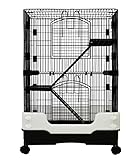
For most groups, the MidWest Critter Nation 162 is the strongest all-round choice; the MidWest Critter Nation 162 Double Unit suits larger groups when floor space and vertical room are limited; and the Savic Suite Royal 95 Double is a practical premium alternative when you want a narrower footprint with multiple levels. A properly modified ferret cage can also work, but many inexpensive “small-animal” cages have unsafe bar spacing, shallow trays, or too little usable floor area.
As an Amazon Associate we earn from qualifying purchases at no extra cost to you.

What matters when housing several rats
Rat cages are often advertised by external height or the number of shelves. Those figures can be misleading. A cage with many small platforms may provide less useful living space than a shorter enclosure with two large, easy-to-clean levels.
- Usable floor area: Measure the inside of each full-size level, not just the outside of the cage. Rats need room to move horizontally, nest, forage, and avoid one another.
- Bar spacing: About 1/2 inch, or 12–13 mm, is a safe target for most adult rats and smaller young rats. Wider gaps can allow escapes, especially for juveniles or slender females.
- Levels: Full-width floors are more useful than narrow corner shelves. Ramps should be stable and easy to cover with a washable surface.
- Access doors: Large front doors make introductions, furnishing, lifting an unwell rat, and deep cleaning much easier. Small feeder doors are not a substitute.
- Cleaning design: Deep pull-out trays, smooth surfaces, and removable shelves reduce the time spent dealing with urine, bedding, and food debris.
- Ventilation and security: Powder-coated metal bars allow airflow and resist chewing. Avoid untreated wood as a primary structural surface because it absorbs odors and moisture.
Head-to-head comparison
The figures below are useful buying benchmarks. Dimensions can vary slightly by production run and market, so confirm the final specification before ordering. “Usable floor area” is an approximate calculation based on the main internal levels and excludes ramps and small shelves.
| Cage | Approx. external size | Bar spacing | Main levels | Approx. usable floor area | Access and cleaning |
|---|---|---|---|---|---|
| MidWest Critter Nation 162 | 36 × 25 × 62 in (91 × 64 × 157 cm) | 1/2 in (1.27 cm) | 2 full levels plus shelves | About 1,600 sq in (1.03 m²) | Two large front doors per section; pull-out trays; rolling stand |
| MidWest Critter Nation 162 Double Unit | 36 × 25 × 77 in (91 × 64 × 196 cm), approximate | 1/2 in (1.27 cm) | 4 full levels plus shelves | About 3,200 sq in (2.06 m²) | Large split front doors; multiple trays; can be divided |
| Savic Suite Royal 95 Double | 37 × 23 × 63 in (95 × 62 × 162 cm), approximate | About 1/2 in (12.7 mm) | 2 main levels plus shelves | About 1,500 sq in (0.97 m²) | Wide front doors; removable trays and platforms |
| Prevue Hendryx 485 Deluxe Critter Cage | 37 × 23 × 63 in (94 × 58 × 160 cm), approximate | Check current specification; commonly around 1/2 in | 2 levels plus ramps and shelves | About 1,400–1,500 sq in (0.90–0.97 m²) | Large doors; removable shelves; tray design varies by version |
| Typical budget ferret cage | Approximately 31–36 × 20–24 × 55–70 in | Often 3/4–1 in | 2–4 shallow platforms | About 900–1,500 sq in | Usually smaller doors and more seams to clean |
The two Critter Nation configurations provide the clearest advantage in everyday use: broad, nearly full-width levels and large front openings. The Savic design is a good alternative for a group that needs substantial space but cannot accommodate a very wide cage. The Prevue model can be suitable, but inspect the exact bar spacing and tray construction because specifications and regional versions differ.
Best choice by situation
| Your situation | Best fit | Why |
|---|---|---|
| Two to four adult rats and limited experience | Critter Nation 162 or Savic Suite Royal 95 Double | Wide doors, predictable bar spacing, and enough room for large furnishings |
| Five or more rats, or a group needing separation options | Critter Nation 162 Double Unit | Greater floor area and the ability to close off sections during introductions or illness |
| Narrow room with limited floor width | Savic Suite Royal 95 Double | Good vertical capacity without an unusually wide footprint |
| Lowest purchase budget | A used full-metal cage with 1/2-inch bars | Second-hand savings can be substantial, but budget for replacement trays and a thorough inspection |
| Young or very small rats | Any model with verified 1/2-inch spacing | Reduces escape risk through doors, corners, and joining seams |
Worked space calculation: why floor area beats height
Suppose a cage has two internal levels measuring approximately 34 by 23 inches. Each level provides 782 square inches, so the combined nominal floor area is:
34 × 23 × 2 = 1,564 square inches
Now compare that with a tall cage containing four shelves measuring 17 by 15 inches:
17 × 15 × 4 = 1,020 square inches
The taller cage may look more impressive, but it offers roughly 35% less horizontal floor area. Small shelves can still be useful for climbing and enrichment, but they should supplement—not replace—large primary levels. When comparing cages, also subtract any section blocked by a large ramp, feeder, or litter tray.
Cleaning effort and ownership realities
For a group of rats, cleaning access is nearly as important as size. A cage with 1,500 square inches of floor can be a poor choice if the trays are shallow, the shelves have exposed wire, or the doors are too small to remove a hideout.
What usually wears first
- Plastic trays and shelves: Urine, chewing, and repeated scrubbing eventually roughen plastic. Replace cracked or sharp-edged parts rather than taping them indefinitely.
- Door latches: Check that every latch closes firmly. Rats can exploit a door that is only slightly misaligned.
- Wheel casters: Heavy cages put stress on wheels and their mounting points. Lock the casters after positioning the cage and avoid dragging it while loaded.
- Fabric accessories: Hammocks and liners absorb odor and need frequent washing. Keep spare sets so the cage does not have to remain bare while they dry.
- Coating at seams: Inspect corners, welds, and tray edges for corrosion or sharp damage, particularly on used cages.
A practical cleaning routine
- Daily: Remove wet bedding, spoiled food, and visibly soiled fabric. Wipe high-traffic areas and check doors, bottles, and bowls.
- Every few days: Replace litter-box material and wash food and water equipment. Rotate washable hammocks and liners.
- Weekly: Remove platforms and trays, wash them with a mild unscented detergent, rinse thoroughly, and dry completely before reassembly.
- Monthly or as needed: Inspect all bars, welds, ramps, latches, caster mounts, and tray edges. Clean behind the cage and under the stand.
Do not rely on fragrance to mask odor. Strongly scented cleaners can irritate small animals, and incomplete rinsing leaves residue where rats groom themselves. A smooth, removable tray and several washable liners generally reduce cleaning effort more effectively than adding extra small shelves.
Common mistakes when choosing a group cage
- Buying for the current number only: If the group may grow, choose a cage that can be divided or expanded rather than replacing it soon.
- Accepting “ferret size” without checking bars: Ferret cages often have gaps that are unsafe for young or slender rats.
- Counting every platform as a full level: A corner shelf does not provide the same usable area as a full-width floor.
- Ignoring furniture clearance: Measure doors, stairs, and the final position, not just the empty room. A cage that cannot be carried through the doorway is a costly mistake.
- Using wire floors uncovered: Cover them with secure, washable solid surfaces. Exposed wire is difficult to keep comfortable and clean.
- Choosing a cage that cannot be separated: Dividers are valuable for introductions, temporary recovery, or preventing conflict around food.
Final recommendation
For most households, choose the MidWest Critter Nation 162 when the cage will house a small group and the room can accommodate its footprint. Choose the Double Unit when you need substantially more usable floor area or flexible separation. Choose the Savic Suite Royal 95 Double when width is restricted but you still want large doors, multiple levels, and a purpose-built small-animal enclosure.
Whatever the brand, verify three things before purchase: the actual bar gap is around 1/2 inch, the main levels are large enough for group movement, and every tray and door can be removed or opened without wrestling with the cage. Those details determine whether a cage remains practical after the novelty wears off.