What's inside
As an Amazon Associate I earn from qualifying purchases. This post may contain affiliate links at no extra cost to you.
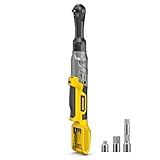
A cordless ratchet saves time on repeated fasteners, but tight engine bays reward a small head and a slim battery more than a high torque figure. A long-neck tool can reach past a hose or bracket; a bulky battery can still stop it from getting onto the fastener. Buy for the spaces you actually work in, and plan to break fasteners loose by hand.
As an Amazon Associate we earn from qualifying purchases at no extra cost to you.


What matters in an engine bay
Measure the gap around the fastener, not just the distance to it. Ratchet heads are often roughly 1.5 to 2 inches across, and a 3/8-inch drive head is generally larger than a 1/4-inch version. Check the tool’s head height and width, overall length, and battery dimensions in the manufacturer’s specifications. A low-profile head may fit between a bracket and a pulley where a longer tool cannot.
Reach and clearance are different problems. A long-neck ratchet helps when the fastener sits down a narrow channel, but it does not help if the tool head cannot turn into position. A compact tool is easier to maneuver around wiring and hoses, while a long-neck version can reduce knuckle contact on recessed fasteners. Test the tool with the socket installed: the socket adds length and can be the part that collides with surrounding hardware.
Speed is usually more useful than high torque for this job. Cordless ratchets are intended to run a fastener once it has started, not to replace a breaker bar. Many manufacturers specify maximum torque in the neighborhood of 30 to 70 ft-lb, but that figure is not a safe removal promise for a corroded or over-tightened bolt. Use a hand ratchet or breaker bar to loosen it, then use the cordless tool to spin it out.
Choose the drive size
A 1/4-inch drive is the better fit for small fasteners and tight access. It accepts smaller sockets and is less likely to crowd nearby components. Its limit is leverage: avoid using it to force stubborn hardware, and check that your common socket sizes are available in 1/4-inch drive.
A 3/8-inch drive covers more general automotive work and is a practical first ratchet if you already own 3/8-inch sockets. The larger head and socket can be a disadvantage in cramped spaces. A 1/2-inch cordless ratchet is usually too bulky for the specific job of tight engine-bay access; it makes more sense when larger fasteners and torque matter more than clearance.
Compare the common choices
| Type | Best use | Main trade-off |
|---|---|---|
| Compact 1/4-inch | Small fasteners, crowded spaces, short reach | Less leverage and a narrower useful socket range |
| Compact 3/8-inch | General engine-bay work with existing 3/8-inch sockets | Larger head may not clear nearby parts |
| Long-neck 3/8-inch | Fasteners recessed behind brackets or hoses | More length to control; still needs head clearance |
| High-torque or 1/2-inch ratchet | Larger fasteners and less confined work | Extra bulk is often wasted in tight access |
For most DIY engine-bay work, start with a compact 3/8-inch model if your sockets are already that size. Choose a 1/4-inch tool if access is the recurring problem, or a long-neck model if you can identify recessed fasteners it will reach. Compare the head dimensions and bare-tool length rather than relying on labels such as “compact.”
Battery platform and pack size
For occasional work, a small battery can make the tool easier to position and is often enough for a session of light fasteners. Larger packs add runtime but can hang below the handle and hit a radiator hose, subframe, or body panel before the head reaches the bolt. If you already own compatible batteries and chargers, staying on that platform can be cheaper than buying into a new one. Check the tool’s required voltage and battery compatibility; packs from different voltage families are not automatically interchangeable.
Some cordless ratchets use a small built-in or dedicated battery rather than a common tool-platform pack. That can produce a slimmer handle, but it means another charger or battery system to manage. For a homeowner who uses a ratchet a few times a year, the lower purchase cost of a bare or compact tool may matter more than matching a full shop ecosystem. For frequent automotive work, shared batteries and an available spare are more useful.
Browse the relevant categories before choosing: cordless 1/4-inch ratchets, long-neck 3/8-inch cordless ratchets, and compatible ratchet batteries and chargers. Verify the exact battery family and whether the listing includes a battery before ordering.
Use it without damaging hardware
Start the fastener by hand for several turns, especially on aluminum engine parts. Cross-threading is easy when a powered tool is introduced at an angle, and a cordless ratchet gives less tactile feedback than fingers. Keep the socket square on the fastener and use the lowest practical speed. When tightening, stop before final torque and finish with a calibrated torque wrench to the vehicle’s service specification.
Common failure modes are predictable: the head will not fit, the battery strikes an obstruction, a socket slips off at an angle, or the tool stalls on a seized bolt. Do not keep pulling the trigger on a stalled ratchet; that can heat the motor, drain the pack, or damage the tool. Apply penetrating oil where appropriate and use hand leverage for removal. Also keep the tool clear of belts and fans, and disconnect the battery when working near exposed electrical connections if the service procedure calls for it.
A practical buying checklist
Before buying, compare head width and height, neck length, total length, battery placement, drive size, and bare-tool versus kit price. Look for a readily available replacement battery if the pack is proprietary. A modest compact ratchet is fine for occasional trim, brackets, and already-loosened fasteners; paying extra for a long neck is worthwhile only when the extra reach solves a real access problem. If you cannot confirm that the head and battery clear your tightest work area, choose the smaller configuration rather than the higher torque number.
Related guides
- Longest Lasting Lawn Mower Battery: AGM vs Lithium vs Flooded Lifespan and Cost per Season
- Duralast Gold Lawn Mower Battery Review: U1 Fit, CCA and When to Pay for AGM
- Greenworks Pro 80V 21-Inch Mower Review: Runtime Math, Push vs Self-Propelled and Yard Fit
- Bosch High Pressure Washer Gun Replacement: Fittings, Adapters and What Fits Your Model