What's inside
As an Amazon Associate I earn from qualifying purchases. This post may contain affiliate links at no extra cost to you.
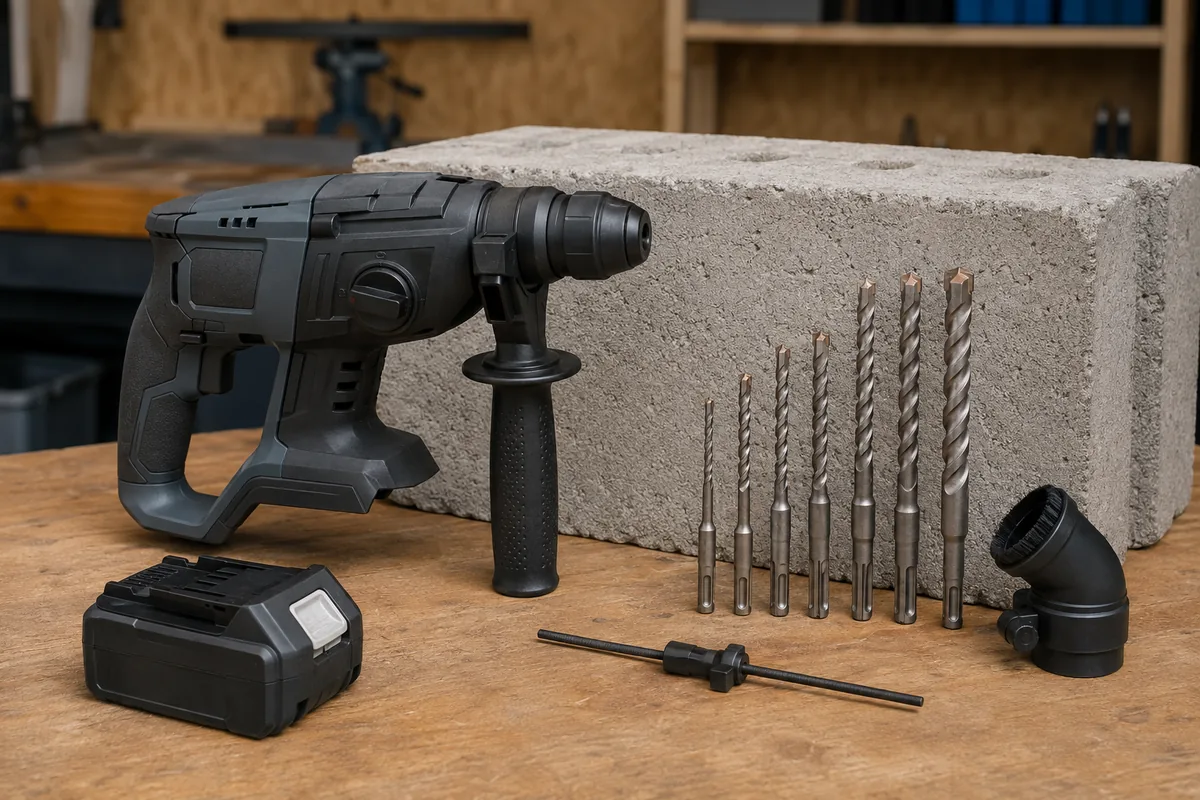
A cordless SDS-Plus rotary hammer is useful when a regular drill starts to struggle with brick, block, or concrete. For light masonry work—hanging shelves, fitting wall plugs, or drilling holes for small anchors—the main choice is not maximum power. It is whether the tool is light enough to handle comfortably, has enough impact energy for your holes, and fits batteries you already own.
As an Amazon Associate we earn from qualifying purchases at no extra cost to you.


What to look for
For occasional holes around 6–10 mm in brick or block, a compact SDS-Plus hammer is usually sufficient. Look for a stated impact energy around 1–2 joules, a hammer-drill mode, and a clutch or other kickback protection. Impact-energy figures are measured differently by manufacturers, so treat them as a rough comparison, not a guarantee of drilling speed.
SDS-Plus bits lock into the chuck and move back and forth as the hammer works. That makes them more effective in masonry than ordinary round-shank bits in a standard drill. Most SDS-Plus hammers also have a rotary-only mode for driving or drilling with a suitable chuck, but they are not a substitute for a comfortable general-purpose drill or impact driver.
Check the tool’s weight with a battery installed. A bare-tool weight can look attractive, but a large battery adds noticeable weight and can make overhead drilling tiring. A compact battery is often a better match for short jobs; a larger one makes sense if you are drilling many holes or already have it in your kit.
Compare the main options
| Option | Best fit | Trade-off |
|---|---|---|
| Compact 18V or 20V SDS-Plus hammer | Occasional small holes in brick and block | Less comfortable for long runs or larger bits |
| Mid-size cordless SDS-Plus hammer | Regular anchor holes and mixed masonry | More weight and cost than light work requires |
| Wired SDS-Plus hammer | Long sessions near an outlet | Cord management; no battery-platform convenience |
| Hammer drill with round-shank masonry bits | A few small holes in soft brick | Slower and more tiring in dense masonry |
For a first cordless rotary hammer, compare compact cordless SDS-Plus rotary hammers with bare tools from your existing battery platform. A bare tool is usually the economical choice if you already have compatible batteries and a charger. If not, compare the kit price, battery capacity, and charger—not just the tool price.
Battery platform matters
Battery compatibility can save money, but only within the manufacturer’s platform and supported voltage range. A battery that physically fits is not necessarily compatible with every tool in a brand’s lineup. Check the manufacturer’s compatibility list before buying, particularly if the listing uses broad “18V/20V” wording.
For a few holes at a time, a small battery is generally enough. Repeated drilling, larger diameters, or harder concrete can drain a small pack faster and make it warm. Keep a second charged battery available for a longer task, and let a hot battery cool before charging. Avoid buying a bigger battery solely to compensate for a tool that is underpowered for the job.
If you are not already invested in a platform, a kit can be better value than a bare tool, especially when it includes a usable battery and charger. But a cheap kit with a small battery may not be the bargain it appears if you later need a larger pack. Compare SDS-Plus hammer kits with battery and charger against the cost of adding the tool to a platform you already use.
Match the tool to the hole
Use the smallest bit that fits the anchor or fixing instructions. A 6 mm hole is easier on a compact hammer than a 12 mm hole; moving up in diameter increases the work quickly, especially in dense concrete. For a handful of holes in soft brick, a hammer drill may do the job at lower cost. In hard brick or concrete, the SDS-Plus hammer is usually worth the upgrade because it makes progress with less pressure from the user.
Do not use a light SDS-Plus hammer as a demolition tool just because it has a hammer-only setting. Small chipping jobs may be within its limits, but removing tile or breaking concrete over a broad area calls for a tool designed for that workload. Continuous heavy use can overheat the motor, strain the mechanism, and wear bits rapidly.
Use sharp masonry bits intended for rotary hammers. A worn or unsuitable bit can wander, drill slowly, and make the tool seem weak. Keep the bit straight, let the hammer do the work, and withdraw it occasionally to clear dust from the hole. Pushing hard usually adds fatigue and heat rather than speed.
Avoid common failures
Before drilling, check for wiring, pipes, and reinforcement. A wall scanner can help, but it cannot identify every hazard reliably; use plans and inspect both sides where possible. Wear eye protection and hearing protection. Masonry dust is a health hazard, so use dust extraction or a suitable dust-control setup, particularly indoors.
Dense concrete can stop a bit abruptly, and a snagged tool can twist your wrist. Use the side handle, maintain a balanced stance, and choose a tool with kickback control when available. Do not grip the tool in a way that leaves your hand exposed to the body twisting around the bit. If you repeatedly hit steel, stop rather than forcing the bit; check whether the hole location can move or use an appropriate method for the reinforcement.
For light masonry work, the best buy is usually the smallest SDS-Plus hammer on a battery platform you already own that can comfortably handle your planned bit sizes. Pay extra for a larger model only if you expect frequent holes, harder material, or longer sessions. If the job is just a few holes in soft brick, a hammer drill and a good masonry bit remain a sensible cheaper option.
Related guides
- Longest Lasting Lawn Mower Battery: AGM vs Lithium vs Flooded Lifespan and Cost per Season
- Duralast Gold Lawn Mower Battery Review: U1 Fit, CCA and When to Pay for AGM
- Greenworks Pro 80V 21-Inch Mower Review: Runtime Math, Push vs Self-Propelled and Yard Fit
- Bosch High Pressure Washer Gun Replacement: Fittings, Adapters and What Fits Your Model