What's inside
As an Amazon Associate I earn from qualifying purchases. This post may contain affiliate links at no extra cost to you.
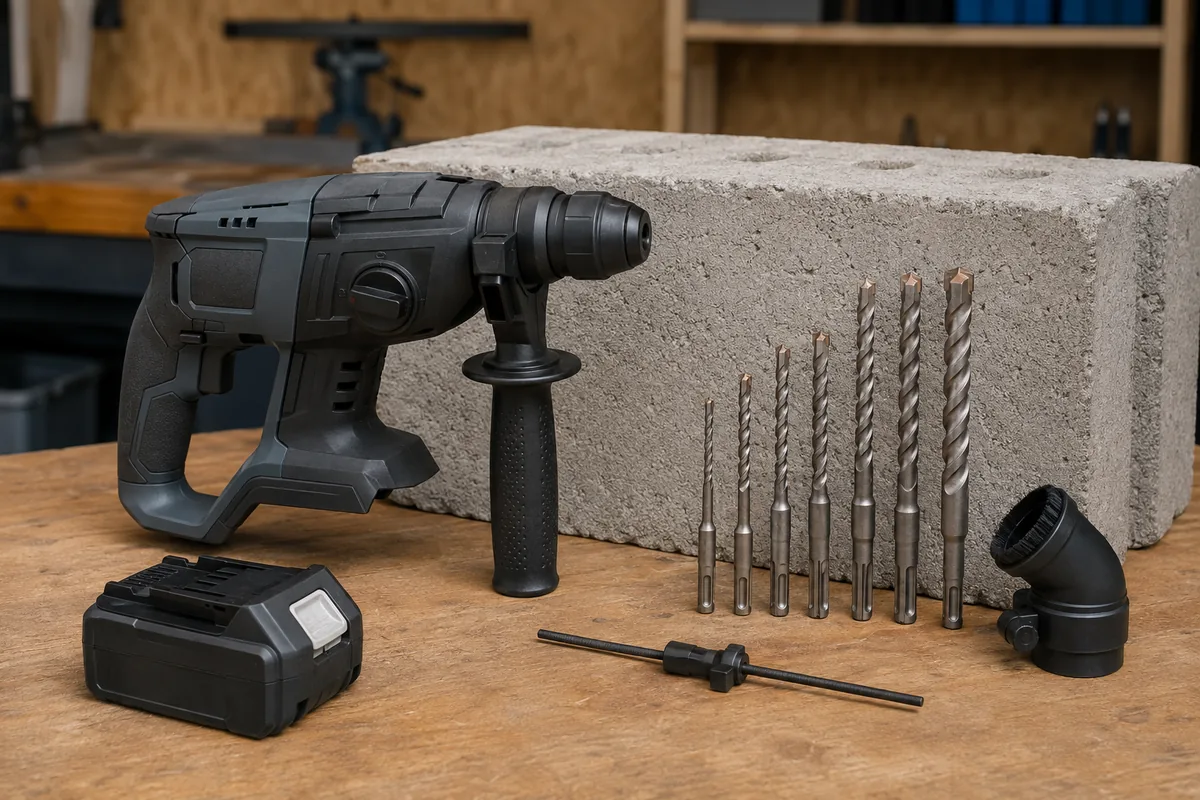
SDS-Plus is the standard chuck system on most compact rotary hammers, including cordless models in the 18V and 20V class. The right bit will drill clean holes in concrete and masonry without wasting battery capacity or overheating the tool. The wrong bit can wander, bind, drill slowly, or damage the hammer’s chuck.
Choose based on the material, hole size, drilling depth, and how many holes you expect to make—not simply on the number of flutes or the price of the set.
Match the Bit to the Job
SDS-Plus bits are intended primarily for concrete, brick, block, stone, and other masonry. Use the rotary hammer’s hammer-drill mode for drilling. Turn hammer action off when using an SDS-Plus adapter or compatible accessory for ordinary drilling, driving, or light chiseling.
For occasional holes in soft brick or block, an inexpensive masonry bit can be adequate. For concrete, especially reinforced concrete, buy a real SDS-Plus bit rather than a standard round-shank masonry bit used in a chuck adapter. The SDS system transfers impact energy more efficiently and lets the bit slide in and out of the chuck as it hammers.
For general home repair, a SDS-Plus concrete drill bit set covering 5/32 to 1/2 inch is usually more useful than a large set containing sizes you will rarely use.
Understand Bit Construction
The cutting head is the most important part of the bit. Basic bits have two cutting edges and are inexpensive. They work well for a few holes in brick, block, mortar, and non-reinforced concrete. They also tend to slow down sooner as the edges wear.
Four-cutter carbide heads are more expensive, but they are a better choice for repeated work and tougher concrete. The four cutting edges are less likely to snag when they encounter aggregate or rebar, and the tip can keep drilling if it contacts embedded steel. They are not magic: drilling through rebar is still slow and can shorten bit life.
Some premium SDS-Plus bits use a solid carbide head. These are designed for demanding concrete work and frequent drilling. They cost more than most cordless-tool owners need, but they make sense for installers, electricians, and contractors drilling dozens of holes every day.
| Bit type | Best use | Main advantage | Trade-off |
|---|---|---|---|
| Two-cutter carbide | Occasional holes in brick, block, and ordinary concrete | Low purchase cost | Slower wear and more vibration in hard material |
| Four-cutter carbide | Frequent concrete drilling and mixed masonry | Better durability and rebar tolerance | Higher price |
| Solid carbide head | Heavy professional concrete work | Fast cutting and long service life | Usually excessive for light DIY use |
Choose Diameter and Length Carefully
Use the smallest hole diameter that meets the requirement. A cordless rotary hammer drills faster and uses less battery power with a 1/4-inch bit than with a 1/2-inch bit. Larger bits also create more dust, vibration, and heat.
For wall anchors, common sizes are 5/32, 3/16, and 1/4 inch. For sleeve anchors and larger fasteners, 3/8 and 1/2 inch are common. Check the anchor manufacturer’s instructions; the correct bit size is not always the same as the fastener’s nominal diameter.
Pay attention to working length, not just overall length. A bit advertised as 12 inches long may have only 10 inches of usable fluted length after the shank and tip are excluded. You need enough depth to drill the hole, but an overly long bit flexes more and is harder to keep square.
For most anchors, a bit with 4 to 6 inches of working length is easier to control. Choose a longer bit only when the hole must pass deeply through a wall, slab, or masonry block. If you need a hole larger than about 1 inch, confirm that your cordless hammer is rated for that diameter; compact SDS-Plus models may struggle, and SDS-Max may be the proper system.
Consider the Cordless Hammer and Battery
A bit cannot compensate for an underpowered tool. Compact 18V or 20V rotary hammers are well suited to anchor holes and occasional drilling in concrete. A larger high-output model is better for repeated 1/2-inch holes, deep drilling, or hard concrete.
Battery size affects productivity. A 2.0Ah pack keeps the tool light for overhead work, but it may run out quickly during larger holes. A 4.0Ah or 5.0Ah pack usually provides a better balance for floor or wall drilling. High-output packs can improve sustained performance on demanding tools, but they add weight and cost.
Stay within the battery platform you already own when possible. Buying a bare rotary hammer can be sensible if you have compatible batteries and a charger. If you need a battery, charger, and hammer together, compare the kit price against the cost of entering another ecosystem. A cheaper bare tool is not a bargain if you must buy several new packs.
For a replacement or second battery, compare 18V and 20V cordless rotary hammer kits within the platform you already use. Nominal voltage labels are not directly comparable across brands; tool design, motor efficiency, and battery output matter more than the printed number.
Avoid Common Bit Failures
Do not force a dull bit. Excessive pressure can overload the motor, drain the battery quickly, and overheat the carbide tip. Let the hammer mechanism do the work, using firm pressure to keep the bit cutting without stalling the tool.
Clear dust from deep holes. Withdraw the bit every few seconds, particularly in concrete, to pull out debris and cool the flutes. Packed dust increases friction and can leave the anchor too shallow. For cleaner work, use a dust extractor or drill with a compatible dust-collection attachment.
Stop if the bit suddenly binds. A jam can twist the tool and injure your wrist, even with an electronic clutch. Inspect the tip after hitting rebar. If the cutting edges are chipped, badly rounded, or blue from heat, replace the bit rather than continuing to push it.
A Practical Buying Strategy
For light DIY use, buy a small two-cutter set in the sizes you actually need and replace individual bits as they wear. This is cheaper than a premium assortment that spends most of its life in a drawer.
If you regularly drill concrete, choose a four-cutter set with clear size markings and a storage case. A four-cutter SDS-Plus bit set costs more, but the improved durability can justify it when battery time and drilling speed matter.
Buy individual long bits only for specific jobs, and verify the hammer’s maximum bit diameter before ordering. Good storage, clean shanks, and occasional cleaning of the SDS chuck will generally do more for service life than paying extra for sizes you do not use.
Related guides
- Longest Lasting Lawn Mower Battery: AGM vs Lithium vs Flooded Lifespan and Cost per Season
- Duralast Gold Lawn Mower Battery Review: U1 Fit, CCA and When to Pay for AGM
- Greenworks Pro 80V 21-Inch Mower Review: Runtime Math, Push vs Self-Propelled and Yard Fit
- Bosch High Pressure Washer Gun Replacement: Fittings, Adapters and What Fits Your Model