
What's inside
- What Is a DEWALT 1/2-Inch Impact Wrench?
- How to Choose the Right DEWALT 1/2-Inch Impact Wrench
- DEWALT 1/2-Inch Impact Wrench Models: Understanding the Differences
- What Accessories Do You Need?
- How to Use a DEWALT 1/2-Inch Impact Wrench Safely
- Common Mistakes to Avoid
- How to Maintain Your DEWALT Impact Wrench
- Frequently Asked Questions
- Final Verdict
As an Amazon Associate I earn from qualifying purchases. This post may contain affiliate links at no extra cost to you.
A DEWALT 1/2-inch impact wrench is designed for jobs that require substantial rotational fastening or loosening force, such as removing lug nuts, servicing vehicles, and tightening large threaded fasteners. However, a 1/2-inch drive size does not tell you how powerful the tool is. Torque output, battery platform, control settings, socket compatibility, and the specific fastener all matter when choosing the right model.
This guide explains how to identify the appropriate DEWALT 1/2-inch impact wrench, understand its specifications, select accessories, and avoid common mistakes. It focuses on cordless models, which are common in DEWALT’s impact-wrench lineup, while noting where model-specific instructions are essential.
What Is a DEWALT 1/2-Inch Impact Wrench?
A DEWALT 1/2-inch impact wrench is a powered fastening tool with a 1/2-inch square drive that accepts compatible impact-rated sockets. Its internal hammer-and-anvil mechanism delivers repeated rotational impacts to help loosen stubborn fasteners or tighten threaded connections.
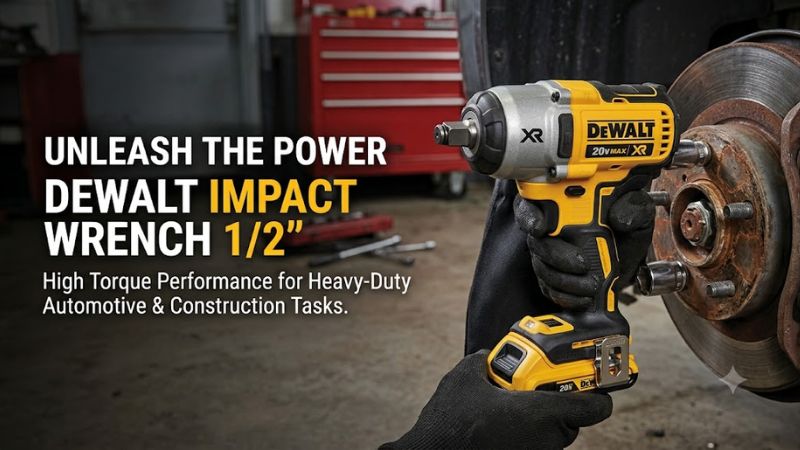
The 1/2-inch measurement refers to the square-drive size, not the bolt diameter, socket opening, or maximum fastener size.
Common applications include:
- Removing and installing automotive lug nuts.
- Loosening rusted or tightly secured bolts.
- Working on suspension components and other vehicle hardware where the tool is appropriate.
- Assembling metal structures and equipment.
- Handling larger fastening jobs in workshops and construction.
An impact wrench is different from an impact driver. An impact driver typically uses a 1/4-inch hex collet for driver bits, whereas a 1/2-inch impact wrench uses a square drive for sockets. Adapters exist, but they do not automatically make the tools interchangeable or suitable for every application.
How to Choose the Right DEWALT 1/2-Inch Impact Wrench
The right model depends on the work you perform most often. Before purchasing, check the exact model number rather than relying on a listing that says only “DEWALT 1/2 impact wrench.”
1. Match the torque rating to your work
Torque describes rotational force. DEWALT may publish several torque figures for a single impact wrench, and these figures are not interchangeable.
| Torque specification | What it generally means |
| Maximum fastening torque | A stated upper fastening capability under the manufacturer’s specified conditions |
| Breakaway or nut-busting torque | A claimed capability for loosening fasteners under specified conditions |
| Recommended tightening torque | The torque required for a particular fastener or application, usually determined by its service documentation |
| Actual installed-fastener torque | The torque achieved on a specific joint, influenced by the tool, fastener, joint, and operating conditions |
A higher advertised breakaway figure does not mean the wrench will tighten every bolt to a precise torque. Impact tools are not substitutes for a calibrated torque wrench when a joint requires a specified final torque.
For routine vehicle maintenance, choose a model with adequate capacity for the intended fasteners and a control system suited to the work. For frequent heavy equipment maintenance, compare the manufacturer’s stated capabilities for the exact models under consideration.
2. Understand the battery platform
Cordless DEWALT impact wrenches are available across different battery systems. The battery required depends on the exact tool model.
Before buying, verify:
- The tool’s specified voltage and battery platform.
- Which battery models the manufacturer lists as compatible.
- Whether the product is a bare tool or a kit.
- Whether a battery and charger are included.
- Whether the intended battery configuration is suitable for the tool’s expected workload.
Do not assume every DEWALT battery fits every DEWALT tool. Voltage families and battery interfaces differ, and physical fit alone is not proof of compatibility.
A bare tool may cost less upfront, but the total purchase cost can be higher if you also need a compatible battery and charger. If you already own DEWALT cordless equipment, check its exact platform before selecting a wrench.
3. Choose between a hog ring and detent pin anvil
The anvil retains the socket, and the retention mechanism affects how easily sockets can be changed.
| Feature | Hog ring | Detent pin |
| Socket retention | Spring ring grips the socket | Pin engages a matching socket hole |
| Socket changes | Generally quick push-on and pull-off | May require pressing the pin to remove the socket |
| Best suited to | Frequent socket changes | Users who prefer positive pin retention |
| Important limitation | Retention ring can wear | Pin and socket hole must align correctly |
Neither design is universally better. Consider how often you change sockets and whether your preferred impact sockets support the selected anvil.
Check the exact model suffix before ordering. DEWALT may offer similar impact wrenches with different anvil styles, so the family name alone is not enough to establish compatibility.
4. Consider size, weight, and access
A high-torque impact wrench can be useful for stubborn fasteners, but a large housing may be awkward around wheel wells, suspension components, or confined machinery.
Consider these factors together:
- Tool dimensions: A shorter tool may reach fasteners that are blocked by surrounding components.
- Weight: Compare tool-only weight with the complete weight after fitting the battery.
- Balance: A large battery can change how the tool feels when held at an angle.
- Speed and impact settings: Multiple settings can help manage fastening tasks that require different levels of control.
- Work duration: Frequent overhead or extended use makes weight and handling particularly important.
Do not select a wrench based on torque alone. A more powerful model may be unnecessary for routine maintenance, while a compact model may not provide enough capacity for demanding work.
DEWALT 1/2-Inch Impact Wrench Models: Understanding the Differences
Several DEWALT models illustrate the difference between mid-range and high-torque tools. The following specifications come from DEWALT’s US product information and are manufacturer claims, not independent comparative test results.
| Model | Manufacturer-stated maximum fastening torque | Maximum breakaway torque | General application |
| DCF891 | 600 ft-lb | 800 ft-lb | Mid-range fastening and demanding workshop jobs |
| DCF899 | 700 ft-lb | 1,200 ft-lb | High-torque applications |
| DCF900 | 1,030 ft-lb | 1,400 ft-lb | Heavy-duty fastening and stubborn fasteners |
Sources: DEWALT’s official product pages and product announcements.
These figures should not be treated as directly measured real-world performance under identical conditions. Battery configuration, fastener condition, joint characteristics, and operating technique can affect results.
DEWALT DCF891: A mid-range option
The DCF891 is a 20V MAX* XR brushless 1/2-inch impact wrench offered with a hog ring anvil. DEWALT specifies up to 600 ft-lb of maximum fastening torque and 800 ft-lb of maximum breakaway torque. The manufacturer also lists Precision Wrench control and multiple operating modes.
This model may suit users who need substantial fastening capability but want a mid-range tool rather than DEWALT’s highest-torque option.
Consider it if: You regularly work on vehicle hardware, equipment, or other demanding fastening tasks and value adjustable control.
Think carefully if: Your work routinely involves fasteners that exceed the model’s capabilities or requires a different drive size.
DEWALT DCF899: An earlier high-torque option
The DCF899B is a 20V MAX* XR brushless 1/2-inch impact wrench with a detent-pin anvil. DEWALT lists up to 700 ft-lb of maximum torque and 1,200 ft-lb of breakaway torque, along with three speed ranges.
It may be worth considering when available at an appropriate price, particularly for users who prefer its pin-retention system. Before purchasing, verify the precise variant and package, because similar model names and suffixes can indicate different configurations.
Consider it if: You need a high-torque tool and the exact model meets your requirements.
Think carefully if: A newer model’s additional control features, availability, or package configuration would be more useful for your work.
DEWALT DCF900: A high-torque option
The DCF900B is a 20V MAX* XR brushless 1/2-inch high-torque impact wrench with a hog ring anvil. DEWALT specifies up to 1,030 ft-lb of maximum fastening torque and 1,400 ft-lb of maximum breakaway torque. It also includes Precision Wrench control and four operating modes. The bare-tool package does not include a battery or charger.
This model is aimed at demanding work where substantial fastening and loosening capability is needed.
Consider it if: Your work regularly involves stubborn fasteners, heavy equipment, or demanding workshop applications.
Think carefully if: You mostly handle light automotive work, where a less powerful model may be easier to manage and less expensive to equip.
These models are examples, not a claim that every regional DEWALT lineup contains the same products. Confirm current availability and the exact manufacturer’s model number before purchasing.
What Accessories Do You Need?
A 1/2-inch impact wrench is only part of a usable setup. The right accessories protect the tool, improve access, and help prevent damage to fasteners.
Impact-rated sockets
Use sockets specifically rated for impact-wrench use. Ordinary chrome hand-tool sockets are not a safe substitute because they may crack or shatter under repeated impacts.
Choose sockets with:
- A 1/2-inch square-drive connection.
- The correct hex size for the fastener.
- A suitable impact rating and intended application.
- Appropriate clearance for the working area.
- A secure retention fit for the wrench’s anvil.
Inspect sockets for cracks, deformation, worn corners, and damaged retention holes before use.
Extensions and adapters
Extensions and adapters can change tool reach, clearance, and the way impact loads are transmitted. Use accessories rated for impact service and compatible with the tool’s drive and intended workload.
Avoid stacking multiple adapters unnecessarily. A compatible accessory does not guarantee that the complete setup will withstand every load.
Batteries and chargers
For cordless models, select only manufacturer-compatible batteries and chargers. Check the exact tool manual and battery documentation rather than assuming that a charger or battery from another DEWALT platform will work.
A larger amp-hour rating describes greater battery capacity, not a guaranteed increase in torque. Actual performance and runtime depend on the tool, battery design, load, temperature, and operating conditions.
How to Use a DEWALT 1/2-Inch Impact Wrench Safely
An impact wrench can loosen a fastener quickly, but incorrect use can damage threads, break sockets, or overtighten a joint. Follow the manual for your exact model and the service specifications for the fastener.
Step 1: Prepare the tool and work area
- Read the impact wrench’s instruction manual.
- Wear appropriate eye protection and hearing protection when required by the tool and working conditions.
- Secure the workpiece and ensure the tool has sufficient clearance.
- Remove the battery before installing or changing accessories.
- Inspect the anvil, socket, battery, and tool housing for visible damage.
Keep hands, clothing, and other objects away from rotating components. Do not use a damaged socket or operate the wrench if its controls, battery, or retention mechanism appear defective.
Step 2: Install the correct socket
Choose an impact-rated socket with a 1/2-inch square drive and the correct opening for the fastener. Attach it securely using the wrench’s specified retention mechanism.
Check that the socket is fully seated before inserting the battery and operating the tool.
Step 3: Select an appropriate operating mode
If your model offers multiple speeds or precision-control modes, consult the manual to understand what each setting does.
Start with a lower setting when appropriate, particularly when working with unfamiliar fasteners or delicate assemblies. Increase the setting only as needed and within the tool’s intended application.
Do not assume that a particular speed or mode produces a known tightening torque. Impact-wrench output depends on multiple variables.
Step 4: Loosen the fastener
- Confirm that the fastener is suitable for removal with the selected tool.
- Seat the socket squarely over the fastener.
- Select reverse rotation.
- Hold the wrench securely and apply controlled trigger pressure.
- Stop if the socket slips, the fastener deforms, or the tool behaves abnormally.
A fastener that remains stuck may be corroded, damaged, cross-threaded, or subject to a mechanical locking feature. More impact force is not always the correct solution.
Step 5: Tighten the fastener correctly
An impact wrench can run a fastener down, but it should not be relied upon to establish precise final torque unless an approved procedure specifically supports that use.
For automotive wheels and other torque-critical assemblies:
- Start the fastener by hand where the application permits, ensuring it is not cross-threaded.
- Use the impact wrench cautiously for initial fastening when appropriate.
- Finish with a calibrated torque wrench using the vehicle or equipment manufacturer’s specified torque and procedure.
- Follow any specified tightening sequence and additional requirements.
For wheel lug nuts, do not assume that a single torque value applies to all vehicles. Consult the applicable service documentation.
Step 6: Shut down and inspect
Release the trigger, allow the tool to stop completely, and remove the battery before changing sockets or performing inspections.
Check for unusual heat, damaged accessories, loose components, or abnormal operation. Stop using the tool if you identify a defect that could affect safe operation.
Common Mistakes to Avoid
| Mistake | Why it matters | Better practice |
| Choosing by drive size alone | Drive size does not indicate torque capacity | Compare the exact model’s specifications |
| Using ordinary chrome sockets | They may fail under impact loading | Use suitable impact-rated sockets |
| Assuming maximum breakaway torque equals tightening torque | The figures describe different capabilities | Read the manufacturer’s definitions |
| Using an impact wrench for final wheel torque without verification | Fasteners can be undertightened or overtightened | Finish according to the vehicle’s service procedure |
| Buying the wrong battery or charger | Platforms and electrical requirements differ | Verify compatibility for the exact model |
| Applying full power to every fastener | Excess force can damage threads and components | Use appropriate settings and controlled trigger pressure |
| Ignoring unusual noise, heat, or vibration | These may indicate damage or a developing fault | Stop and inspect according to the manual |
How to Maintain Your DEWALT Impact Wrench
Routine care helps preserve safe operation, but maintenance requirements vary by model.
- Clean the exterior: Remove dirt and debris with a method permitted by the manual. Keep liquid out of the tool.
- Inspect the anvil: Check for visible wear, damage, or a socket that no longer retains securely.
- Check the battery: Look for cracks, damaged contacts, swelling, or other signs of damage. Do not use a damaged battery.
- Keep sockets in good condition: Replace cracked, deformed, or excessively worn accessories.
- Store the tool properly: Protect it from moisture, extreme conditions, and accidental activation.
- Follow service guidance: Do not dismantle the impact mechanism or attempt repairs beyond the manufacturer’s instructions and your qualifications.
Do not apply lubricant to the anvil, hammer mechanism, or other internal components unless the manual specifies the correct product and procedure. Unapproved lubrication or disassembly can interfere with operation or service coverage.
If the wrench repeatedly cuts out, produces unusual noises, loses power, or fails to retain sockets correctly, discontinue use until the problem has been assessed.
Frequently Asked Questions
1. Is a DEWALT 1/2-inch impact wrench good for removing lug nuts?
Yes, a suitable DEWALT 1/2-inch impact wrench can remove many automotive lug nuts, provided its capabilities and socket are appropriate for the application. Corrosion, previous overtightening, and fastener condition can affect removal. Use the vehicle manufacturer’s procedure when reinstalling the wheels and verify final torque with a calibrated torque wrench.
2. What is the difference between the DEWALT DCF891 and DCF900?
The DCF891 is a mid-range 1/2-inch impact wrench rated by DEWALT for up to 600 ft-lb of maximum fastening torque and 800 ft-lb of breakaway torque. The DCF900 is a high-torque model rated for up to 1,030 ft-lb of fastening torque and 1,400 ft-lb of breakaway torque. The DCF900 is intended for more demanding applications, while the DCF891 may be sufficient for many workshop tasks. These are manufacturer-stated figures, not results from an identical-condition independent test.
3. Can I use regular sockets with a DEWALT 1/2-inch impact wrench?
You should use impact-rated sockets rather than ordinary hand-tool sockets. Impact-rated sockets are designed for the repeated loading produced by impact tools. Match the socket’s square drive, fastener size, and retention arrangement to your wrench.
4. Does a higher amp-hour battery make an impact wrench more powerful?
Not necessarily. Amp-hours indicate battery capacity, not a direct measure of torque. A larger-capacity battery may provide longer runtime under comparable conditions, but actual performance depends on the battery design, tool, workload, and operating conditions. Use a battery approved for the exact impact wrench.
Final Verdict
Choosing a DEWALT 1/2-inch impact wrench starts with the work you need it to perform. A mid-range model such as the DCF891 may suit many automotive and workshop tasks, while a high-torque model such as the DCF900 may be more appropriate for demanding fastening and loosening work.
Before buying, confirm the exact model, anvil type, battery compatibility, torque specifications, and package contents. Then pair the tool with impact-rated sockets and follow the applicable service procedures for torque-critical fasteners.
For most buyers, the sensible next step is to identify the hardest fasteners they routinely handle and choose a model with suitable capacity and control—not simply the highest advertised torque.


Write Your Review
No reviews yet. Be the first to share your experience!