
What's inside
- What Makes Hardened Steel Difficult to Drill?
- Best Drill Bit Materials for Hardened Steel
- How to Choose Drill Bits for Hardened Steel
- How to Drill Hardened Steel Step by Step
- Common Mistakes When Drilling Hardened Steel
- Safety Precautions When Drilling Hardened Steel
- Frequently Asked Questions
- Final Thoughts
- What Makes Hardened Steel Difficult to Drill?
- Best Drill Bit Materials for Hardened Steel
- How to Choose Drill Bits for Hardened Steel
- How to Drill Hardened Steel Step by Step
- Common Mistakes When Drilling Hardened Steel
- Safety Precautions When Drilling Hardened Steel
- Frequently Asked Questions
- Final Thoughts
As an Amazon Associate I earn from qualifying purchases. This post may contain affiliate links at no extra cost to you.
Drilling through hardened steel is more difficult than drilling ordinary metal because heat treatment increases the material’s resistance to cutting and wear. Standard high-speed steel (HSS) drill bits often become dull quickly, overheat, or simply spin against the surface without making meaningful progress. Choosing the right drill bits for hardened steel requires understanding the steel’s actual hardness, the drill bit’s material, and the stability of your drilling setup.
For moderately hardened steel, a suitable cobalt HSS drill bit, such as an M35 or M42 model, may work. For genuinely hard tool steel, hardened fasteners, and other high-hardness materials, a purpose-designed carbide drill may be necessary. However, carbide is considerably more brittle and requires better machine stability.
This guide explains how to identify the right drill bit, choose between cobalt and carbide, prepare your workpiece, and drill safely without unnecessarily damaging your tools.
What Makes Hardened Steel Difficult to Drill?
Hardened steel is steel that has undergone a heat-treatment process to increase its hardness, strength, and resistance to wear. Depending on its composition and treatment, the finished material can be significantly more difficult to machine than untreated steel.
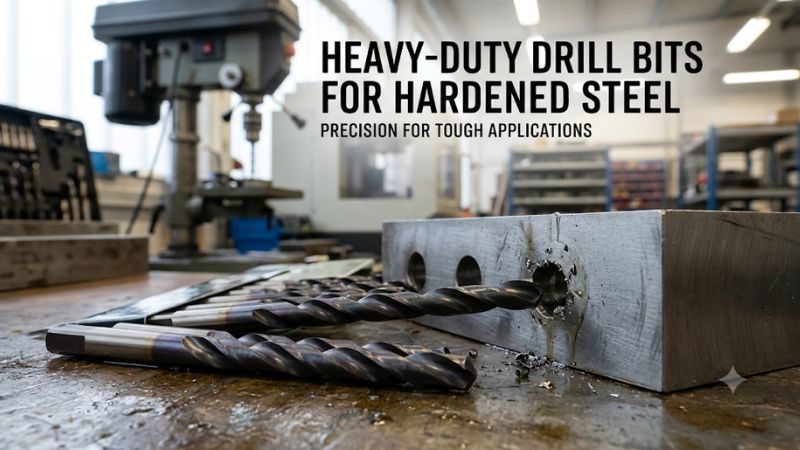
Common examples include:
- Hardened steel bolts and fasteners.
- Tool steel used in cutting tools and dies.
- Springs and hardened pins.
- Heat-treated steel plates.
- Bearing components and hardened shafts.
- Industrial machine components.
The main challenge is the difference between the hardness of the workpiece and the cutting capability of the drill bit.
A conventional HSS drill bit may work well on mild steel because its cutting edges can shear away the material. However, when the workpiece is substantially harder, the cutting edges may wear rapidly instead of maintaining an effective cutting action.
Heat creates another problem. Friction between a dull drill bit and the steel can increase temperatures around the cutting edge. This accelerates wear and can damage the bit.
The operator may respond by applying additional pressure, but excessive force does not solve the underlying problem. It can cause the bit to break, the drill to twist, or the workpiece to move unexpectedly.
The important distinction is that not all steel described as hardened requires the same drill bit. Material grade, hardness measurement, heat treatment, hole diameter, and drilling equipment all influence the correct choice.
Best Drill Bit Materials for Hardened Steel
Two major categories deserve attention: cobalt high-speed steel and carbide. They serve different applications, and neither should automatically be considered suitable for every hardened-steel job.
1. Cobalt Drill Bits: M35 and M42
Cobalt drill bits are made from high-speed steel alloyed with cobalt. Unlike a simple surface coating, cobalt is incorporated into the tool material itself.
This improves hot hardness and wear resistance, helping the cutting edges maintain their performance under demanding drilling conditions.
Two common grades are M35 and M42.
M35 cobalt drill bits
M35 generally contains approximately 5% cobalt. They offer a useful combination of heat resistance, cutting performance, and toughness.
They are commonly used for:
- Stainless steel.
- High-strength steel.
- Tough alloy steel.
- Some moderately hardened steel.
- General metalworking applications requiring improved wear resistance.
M35 is often a reasonable option for handheld drilling because it is generally less brittle than M42.
However, this does not mean every M35 drill bit can cut through fully hardened steel. Its suitability depends on the actual workpiece hardness and the manufacturer’s application specifications.
M42 cobalt drill bits
M42 generally contains approximately 8% cobalt. Its higher cobalt content provides greater hot hardness and wear resistance compared with typical M35 material.
Potential applications include:
- More demanding alloy-steel drilling.
- Heat-treated steel within the drill manufacturer’s supported application range.
- Stainless steel machining.
- Repeated drilling operations where cutting-edge durability matters.
M42 can be harder and more brittle than M35, so it benefits from accurate alignment and controlled drilling conditions.
For example, Guhring’s AeroX Series 1018 uses M42 high-speed cobalt steel, a 135-degree split point, and a bronze oxide finish. Its manufacturer classifies hardened steel as a secondary application rather than an optimal one. This illustrates why an M42 label alone does not guarantee suitability for every hardened component.
2. Carbide Drill Bits: For More Demanding Hardness
Carbide is a different tool-material category from cobalt HSS.
Solid carbide drill bits are made primarily from tungsten carbide with a metallic binder. Their high hardness makes them suitable for machining materials that may quickly wear conventional HSS cutting edges.
Purpose-designed carbide drills can be appropriate for:
- High-hardness tool steel.
- Hardened machine components.
- Certain hardened fasteners.
- Industrial components with demanding wear resistance.
- Production drilling where the machine can maintain precise alignment.
The major disadvantage is brittleness.
Unlike many HSS drill bits, carbide tools have limited tolerance for bending, vibration, and sudden sideways loading. If a carbide drill catches, tilts, or experiences excessive movement, its cutting edge can chip or the tool can fracture.
For this reason, solid carbide drills are generally better suited to rigid drill presses and properly configured machining equipment than ordinary handheld drills.
Carbide-tipped drills are another category. They combine a carbide cutting tip with a different supporting body. Their construction and application ratings vary, so do not assume that every carbide-tipped drill is suitable for hardened steel.
Cobalt vs. Carbide: Which Should You Choose?
| Feature | M35/M42 Cobalt HSS | Solid Carbide |
| Main advantage | Heat resistance and toughness | Very high hardness |
| Suitable applications | Tough and some moderately hardened steels | More demanding hardened materials |
| Brittleness | Generally lower | Higher |
| Handheld drill suitability | Depends on application and bit | Generally not recommended |
| Drill press suitability | Yes, when properly specified | Yes, with suitable rigidity |
| Sharpening | Conventional drill-bit sharpening equipment | Requires suitable carbide-grinding equipment |
| Main limitation | Cannot handle every hardness level | Sensitive to vibration and misalignment |
Practical recommendation: Start by identifying the workpiece hardness rather than buying the most expensive drill bit available. Consider cobalt HSS when the material and drill specifications support it. Move to a dedicated carbide drilling solution when the steel is too hard for the selected cobalt bit.
How to Choose Drill Bits for Hardened Steel
Selecting a drill bit involves more than checking whether the package says cobalt, titanium, or carbide.
Several technical factors determine whether the tool can complete the job.
1. Identify the Steel’s Actual Hardness
Rockwell hardness, particularly HRC, is commonly used to describe the hardness of heat-treated steel.
If the material documentation includes an HRC value, use that information as a starting point.
Also check:
- Steel grade and alloy composition.
- Whether the material is through-hardened or case-hardened.
- Whether only the surface has received heat treatment.
- The thickness of the hardened layer.
- Whether the component has been previously machined or work-hardened.
There is no universal HRC threshold that applies to every M35, M42, or carbide drill.
Different manufacturers design their drill series for different materials and operating conditions. Always compare the actual workpiece hardness with the manufacturer’s application data.
If hardness is unknown, consult the material supplier or use an appropriate hardness-testing service rather than assuming that every difficult-to-drill component has the same properties.
2. Check the Drill Point Angle
The point angle influences how a drill bit enters the material and forms chips.
Two common configurations are:
- 118-degree point: A common general-purpose geometry for conventional drilling applications.
- 135-degree split point: Often used for harder metals because the split-point geometry helps the bit start more accurately and reduces the tendency to wander.
A 135-degree split point is a useful feature to consider when selecting cobalt drill bits for demanding metalworking.
However, point angle alone does not determine whether a drill can cut hardened steel. The cutting material, edge geometry, and application rating remain important.
3. Choose the Correct Drill Diameter
Select a diameter appropriate for the finished hole and the operation.
For a larger hole, some applications benefit from drilling a smaller pilot hole before using the final-size bit. This can reduce the load on the larger drill.
However, pilot drilling is not automatically necessary for every carbide or cobalt drill. Follow the manufacturer’s recommendations for the specific drill geometry.
Also check the available flute length. A drill must have sufficient cutting depth to reach through the material without forcing the flutes to carry more chips than they can safely evacuate.
4. Consider the Drill’s Construction
Look beyond the material designation.
Important features include:
- Straight or reduced shank.
- Overall length.
- Flute length.
- Point geometry.
- Cutting-edge design.
- Coating or surface treatment.
- Manufacturer-approved material applications.
A shorter drill can provide better rigidity in some setups, while a longer drill may be necessary for deep holes.
Avoid choosing a long drill simply because it offers greater reach. Excessive tool length can increase deflection and reduce drilling accuracy.
5. Match the Bit to Your Drill
Your drill must accommodate the bit’s shank and operate within its intended conditions.
Check the following:
- Chuck capacity.
- Shank diameter.
- Maximum operating speed.
- Available speed control.
- Torque and kickback protection.
- Whether the machine can maintain the necessary alignment.
A drill press is generally preferable for hard-steel drilling because it provides better control over alignment and feed.
For difficult applications, a rigid industrial drilling machine may be necessary.
How to Drill Hardened Steel Step by Step
Drilling hardened steel requires preparation, suitable accessories, and controlled operation. The following procedure is intended for materials and drill bits whose manufacturers permit the proposed application.
Step 1: Prepare the Workpiece
Clean the steel surface and remove dirt, grease, loose scale, and other contaminants.
Mark the drilling location accurately.
For difficult materials, use an appropriate center-marking method if recommended for the selected drill. A conventional center punch can help locate a starting point, but aggressive punching may damage a brittle or specially treated component.
Secure the workpiece using a suitable vise, fixture, or mechanical clamp.
Never rely on your hand to hold a small steel component while drilling.
Step 2: Select and Inspect the Drill Bit
Choose a cobalt or carbide drill according to the actual material and manufacturer specifications.
Before installation, inspect the cutting edges.
Look for:
- Rounded or damaged cutting edges.
- Visible cracks.
- Chipped carbide tips.
- Excessive wear.
- Bent shanks.
- Contamination or corrosion.
A damaged bit should not be used for a demanding hardened-steel operation.
Install the bit securely and verify that it runs concentrically.
Step 3: Set the Correct Drilling Speed
Speed is one of the most important factors in metal drilling.
Excessive RPM can create unnecessary heat and accelerate cutting-edge wear. However, running a drill too slowly without an appropriate feed can also cause rubbing instead of effective cutting.
The correct spindle speed depends on:
- Drill diameter.
- Drill material.
- Workpiece hardness.
- Steel composition.
- Cutting geometry.
- Machine rigidity.
- Cooling conditions.
A general relationship used in machining is:
RPM=1000VcD
Where:
- RPM = spindle revolutions per minute.
- Vc = cutting speed in meters per minute.
- D = drill diameter in millimeters.
This formula calculates spindle speed; it does not provide a universal cutting-speed recommendation.
Obtain the appropriate cutting-speed value from the exact drill manufacturer’s technical documentation.
Do not copy ordinary mild-steel speed settings when drilling hardened tool steel.
Step 4: Apply Suitable Cutting Fluid
Cutting fluid or cutting oil can help reduce friction and manage heat during drilling.
Use a fluid compatible with the workpiece, drill material, and machining process.
Apply it according to the manufacturer’s instructions.
Do not assume that every carbide drill requires the same coolant arrangement. Some carbide tools are designed for particular dry or wet machining conditions, while others require controlled coolant delivery.
For a conventional cobalt drilling application, an appropriate cutting fluid can help maintain cutting performance and improve chip evacuation.
Step 5: Begin Drilling With Controlled Pressure
Position the drill perpendicular to the workpiece unless the machining operation requires another specified angle.
Start the drill using the recommended operating settings.
Apply steady, controlled feed pressure.
The bit should remove material rather than simply rub against the surface.
Avoid:
- Excessive downward pressure.
- Sudden changes in drilling direction.
- Sideways movement.
- Unnecessary vibration.
- Allowing chips to accumulate around the cutting edges.
If the drill stops producing chips, begins squealing, or shows signs of excessive heating, stop and inspect the operation.
Do not compensate by forcing the drill harder.
Step 6: Manage Chips and Drilling Depth
Metal chips can accumulate in the flutes, especially during deeper drilling operations.
Follow the drill manufacturer’s recommended chip-evacuation procedure.
Depending on the tool design and hole depth, this may involve controlled peck drilling or another chip-clearing method.
Stop the machine before removing accumulated chips.
Never use your fingers to clear sharp metal swarf.
For deep holes, confirm that the drill has sufficient flute length and that the machine can evacuate chips effectively.
Step 7: Finish and Inspect the Hole
As the drill approaches the opposite side of the workpiece, maintain control over the feed.
Avoid forcing the drill through the remaining material. Sudden breakthrough can cause grabbing, excessive torque, or damage to the cutting edge.
After drilling:
- Switch off the machine.
- Wait until all rotating components have stopped.
- Allow the workpiece to cool.
- Remove sharp burrs using an appropriate deburring tool.
- Inspect the hole for damage, irregularity, and dimensional accuracy.
If the hole will receive a threaded fastener, verify its diameter against the required tapping specifications.
Common Mistakes When Drilling Hardened Steel
Even a high-quality drill bit can fail when the operating conditions are unsuitable.
| Mistake | Why It Causes Problems | Better Approach |
| Using ordinary HSS | Cutting edges may wear rapidly | Select an application-rated cobalt or carbide drill |
| Choosing by cobalt percentage alone | Alloy composition does not establish application suitability | Check manufacturer hardness and material ratings |
| Running excessive RPM | Generates unnecessary cutting heat | Follow the drill manufacturer’s speed data |
| Applying too much pressure | Increases the risk of breakage and grabbing | Use controlled, consistent feed |
| Using a dull drill | Encourages rubbing instead of cutting | Inspect and replace or properly sharpen the bit |
| Allowing vibration | Can damage carbide cutting edges | Use a rigid setup and secure the workpiece |
| Ignoring chip buildup | Can interfere with cutting and damage the tool | Follow the appropriate chip-clearing procedure |
Why Does My Drill Bit Spin Without Cutting?
A drill bit that rotates without making meaningful progress may be unsuitable for the steel hardness, damaged, or incorrectly operated.
Possible causes include:
- The workpiece is harder than the bit can machine.
- The cutting edges are worn.
- The bit is not properly aligned.
- The speed and feed combination is unsuitable.
- The cutting edge is rubbing rather than shearing material.
Stop the machine and inspect the bit.
Continuing to run a dull drill against hardened steel can generate substantial heat without producing a useful hole.
Safety Precautions When Drilling Hardened Steel
Metal drilling involves rotating machinery, sharp chips, heat, and potentially significant reaction forces.
The correct protective equipment and workholding arrangements are essential.
Eye protection: Wear appropriate impact-rated safety glasses with side protection. A face shield may provide additional protection against flying chips but should not replace suitable eye protection.
Workpiece security: Clamp the steel securely. A drill bit can catch and cause an improperly supported workpiece to rotate violently.
Clothing: Avoid loose sleeves, jewelry, and unsecured long hair around rotating equipment.
Gloves: Do not wear gloves near exposed rotating drill bits or drill-press spindles because entanglement can cause severe injuries. Handle sharp chips only after the machine has stopped, using an appropriate safe handling method.
Hot surfaces: Drilling can leave the workpiece and chips hot. Allow them to cool before handling.
Kickback: Handheld drills can react violently when a bit catches. Use suitable side handles and manufacturer-provided anti-kickback features where available.
Cutting fluids: Follow the product safety information for skin contact, ventilation, and disposal. Clean spilled fluid promptly to prevent slipping.
If a carbide bit repeatedly chips or the machine cannot maintain stable alignment, stop the operation and use a more suitable machining setup.
Frequently Asked Questions
1. What is the best drill bit for hardened steel?
The best drill bit depends on the material’s actual hardness and the drilling equipment. M35 or M42 cobalt HSS can work on some harder steels, while purpose-designed carbide drills are more appropriate for demanding high-hardness applications.
2. Can cobalt drill bits drill through hardened steel?
Yes, cobalt drill bits can drill some hardened steels, but they cannot handle every heat-treated material. M35 and M42 offer improved heat resistance compared with conventional HSS, but the exact drill manufacturer’s hardness and application ratings should determine suitability.
3. Are titanium-coated drill bits suitable for hardened steel?
Not necessarily. Titanium nitride (TiN) is a surface coating that improves wear resistance under appropriate conditions. It does not transform an ordinary HSS drill into a dedicated hardened-steel cutting tool. A suitable cobalt or carbide drill is generally a better starting point for demanding applications.
4. Can I drill hardened steel with a cordless drill?
Yes, certain hardened-steel applications can be completed with a suitable cordless drill and an application-rated cobalt bit. However, the material hardness, bit specifications, drill stability, and available speed control must all be considered. Solid carbide drilling generally requires a more rigid setup than an ordinary handheld cordless drill can provide.
Final Thoughts
Choosing the right drill bits for hardened steel starts with identifying the material rather than relying on marketing labels or assumptions about cobalt content.
M35 and M42 cobalt HSS bits are useful options for many demanding metalworking applications, but their suitability depends on the actual steel hardness and manufacturer specifications. For more difficult hardened materials, a dedicated carbide drill may offer the cutting capability required, provided the machine can maintain sufficient rigidity and alignment.
For the best results, prioritize the correct bit material, appropriate cutting speed, controlled feed, suitable cutting fluid, and secure workholding.
Most importantly, recognize when a material exceeds the capabilities of your equipment. Selecting a suitable drilling machine and accessory is safer and more effective than forcing an unsuitable drill bit through hardened steel.
Related guides
More from Amazon
Programs that pair well with the guide above. Offers and eligibility are set by Amazon and may change.
A free business account with business pricing and bulk-buying tools for work, shop or home office.
Create a business accountFree shipping on eligible items, Prime Video and more. Eligible new members can start with a free trial.
Start a Prime free trialAudiobooks and podcasts to listen to on the go. Eligible new members can start with a free trial.
Try Audible freeAd-free music streaming. Eligible new subscribers can start with a free trial.
Try Music Unlimited freeAs an Amazon Associate we earn from qualifying purchases.



Write Your Review
No reviews yet. Be the first to share your experience!