What's inside
As an Amazon Associate I earn from qualifying purchases. This post may contain affiliate links at no extra cost to you.
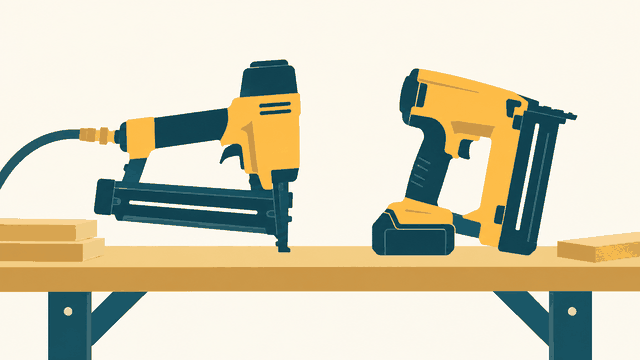
For hanging interior door trim, a cordless finish nailer is most useful when it can sink nails cleanly into both the casing and the jamb without constant depth adjustments. The main choice is between a 15-gauge angled nailer and a 16-gauge straight nailer. Either can do the job; the better fit depends on how often you install trim, what else you build, and which battery platform you already own.
As an Amazon Associate we earn from qualifying purchases at no extra cost to you.


Choose the gauge and nail length first
A 15-gauge nailer shoots thicker nails, usually at an angle, and leaves a larger hole to fill. That extra holding power is helpful for heavy casing or when fastening into a jamb with less-than-ideal bite. A 16-gauge nailer uses slightly thinner, typically straight nails. Its holes are smaller, and the tool is often a versatile choice for ordinary door and window casing.
For typical interior door trim, 1½- to 2½-inch nails cover most situations. Use shorter nails for thin casing and avoid driving long nails blindly near the edge of a jamb, where they can split the wood or emerge on the other side. Nail length should account for both trim thickness and the material underneath: aim for roughly ¾ to 1 inch of penetration into sound framing or the jamb where the assembly allows it. Check for wires, pipes, and the door opening before using longer fasteners.
15-gauge vs. 16-gauge for door casing
| Type | Best fit | Trade-off |
|---|---|---|
| 15-gauge angled finish nailer | Heavier casing, frequent trim work, stronger fastening | Larger holes; angled nails and magazines can cost more |
| 16-gauge straight finish nailer | Everyday casing and general finish carpentry | Less holding power than 15 gauge in some materials |
| 18-gauge brad nailer | Small, light moulding and delicate trim | Usually not the best sole tool for securing full-size door casing |
An 18-gauge brad nailer can tack a light piece in place, but its thinner fasteners are easier to pull out and may not hold substantial casing reliably. If you already own one, it can be useful for small mouldings; for a first cordless nailer intended for doors, choose 15 or 16 gauge instead.
Balance the tool against your battery platform
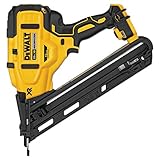
Cordless nailers are convenient for a small trim job: no compressor, hose, or extension cord to drag through a finished room. They are heavier and bulkier than pneumatic nailers, though, and their performance, weight, and balance vary by tool. Try the nailer in one hand if possible. A top-heavy tool gets tiring when fastening the head casing above shoulder height or working in a narrow hallway.
If you already have compatible batteries and a charger, staying on that platform can make the purchase considerably cheaper. Check that the nailer is compatible with your exact battery family; similar brand names do not guarantee cross-compatibility. A small battery may keep the tool lighter, while a larger pack can add weight without offering much practical benefit for a handful of doors. For a full-room project, battery capacity matters more, but most users should consider a spare pack before buying the largest one available.
Compare bare-tool and kit prices. A kit can be worthwhile if it includes a battery and charger you will use with other tools; it is poor value if you already own several compatible packs. Browse cordless 15-gauge finish nailers or cordless 16-gauge finish nailers by battery platform, then verify the gauge, nail-length range, and whether the listing is tool-only or a kit.
Features that matter in practice
Look for tool-free depth adjustment, a clear jam-release procedure, and a dry-fire lockout that prevents firing when the magazine is empty. A belt hook helps when fitting trim, but it is not a substitute for checking the tool’s balance. If you are comparing models, check how many fasteners the magazine holds and whether the manual supports the nail brand and sizes you plan to buy. A nailer that accepts 1¼-inch nails is not necessarily suitable for every casing installation.
Depth adjustment is particularly important because material density changes how a fastener seats. Test on scrap matching the trim and backing. The nail head should sit just below the surface, not leave a crater. If it stands proud, increase depth a little; if it buries too far or splits the wood, reduce depth, change nail length, or move the fastening point.
Avoid splits, proud nails, and jams
Before nailing, dry-fit the casing and use a level or reveal gauge to keep the gap around the jamb consistent. A finish nailer holds trim in place; it does not correct a twisted jamb or a badly cut mitre. Start with a few fasteners, check alignment, then continue. Keep nails several inches from the ends of narrow pieces and avoid driving them too close to an edge. On hard or brittle trim, a shorter nail or a shifted fastening point may prevent splitting.
Common problems have straightforward causes. Proud nails can result from low depth, a hard knot, or poor contact with the work. Overdriven nails can come from excessive depth or soft material. A jam may follow bent or incompatible nails, a magazine loaded incorrectly, or a fastener left in the nose. Disconnect or remove the battery before clearing a jam, following the manual’s procedure; never put fingers in the firing area. Wear eye protection, keep the nose pointed away from people, and use a nail set and filler for the occasional head that does not finish flush.
Which one should you buy?
For one or two doorways and a modest amount of ordinary casing, a 16-gauge cordless nailer on a battery platform you already own is usually the sensible choice. It leaves smaller holes and has enough capacity for common trim when paired with suitable nails and sound backing. Pay more for a 15-gauge tool if you regularly install heavier casing, want stronger fastening, or do enough finish carpentry to justify its larger holes and fasteners. If this is a single small project and you will not use the tool again, renting a nailer—or borrowing one—can cost less than buying a new battery and charger.
FAQ
Which one should you buy?
Related guides
- Longest Lasting Lawn Mower Battery: AGM vs Lithium vs Flooded Lifespan and Cost per Season
- Duralast Gold Lawn Mower Battery Review: U1 Fit, CCA and When to Pay for AGM
- Greenworks Pro 80V 21-Inch Mower Review: Runtime Math, Push vs Self-Propelled and Yard Fit
- Bosch High Pressure Washer Gun Replacement: Fittings, Adapters and What Fits Your Model