What's inside
As an Amazon Associate I earn from qualifying purchases. This post may contain affiliate links at no extra cost to you.
Why cordless circular saw cuts go wrong
A cordless saw can cut cleanly; rough edges usually come from the blade, setup, or feed rather than the battery alone. A dull or coarse blade tears veneer and splinters plywood. A misaligned guide lets the saw wander. Pushing too quickly can bog down the motor, while forcing the saw through a cut that is closing can pinch the blade.
Start with a sharp blade suited to the material, support the work so the offcut cannot sag, and keep the saw’s base plate firmly against a guide. These steps matter more than buying a larger battery for most ordinary cuts.
Choose the right blade for the material
Check the blade diameter and arbor size required by your saw before buying. Tooth count is a useful guide, but tooth shape and blade condition matter too. A general-purpose blade with roughly 24 teeth is fast for framing lumber, but can leave a rough edge across plywood. For cleaner plywood and melamine cuts, a sharp blade with around 40 to 60 teeth is often a better choice. More teeth usually mean a slower cut and more heat, so do not feed aggressively.
For occasional cuts in construction lumber, the blade supplied with the saw may be adequate if it is sharp and the edge need not be furniture-grade. For repeated sheet-good work, consider a fine-tooth finish blade that matches the saw. A premium blade is not a cure for poor support or a crooked cut, and it may be poor value if you only make a few rough cuts a year.
Set up the workpiece and saw
Support the sheet or board on a stable surface and plan where the offcut will fall. If the cut closes behind the blade, the work can pinch it; if the offcut drops, it can tear fibers at the end. For a full sheet of plywood, use rigid foam insulation under the panel or a well-arranged set of supports. The foam lets the blade pass slightly through the material without striking a support. Keep the panel stable, and never rest a large sheet on two narrow supports where the middle can sag.
Set the blade depth so its lowest tooth extends about 1/8 to 1/4 inch below the bottom of the work. Too much exposed blade increases tear-out and leaves more blade visible; too little can make the saw bind. Unplug the tool or remove its battery before adjusting it. Check that the lower guard moves freely and returns over the blade.
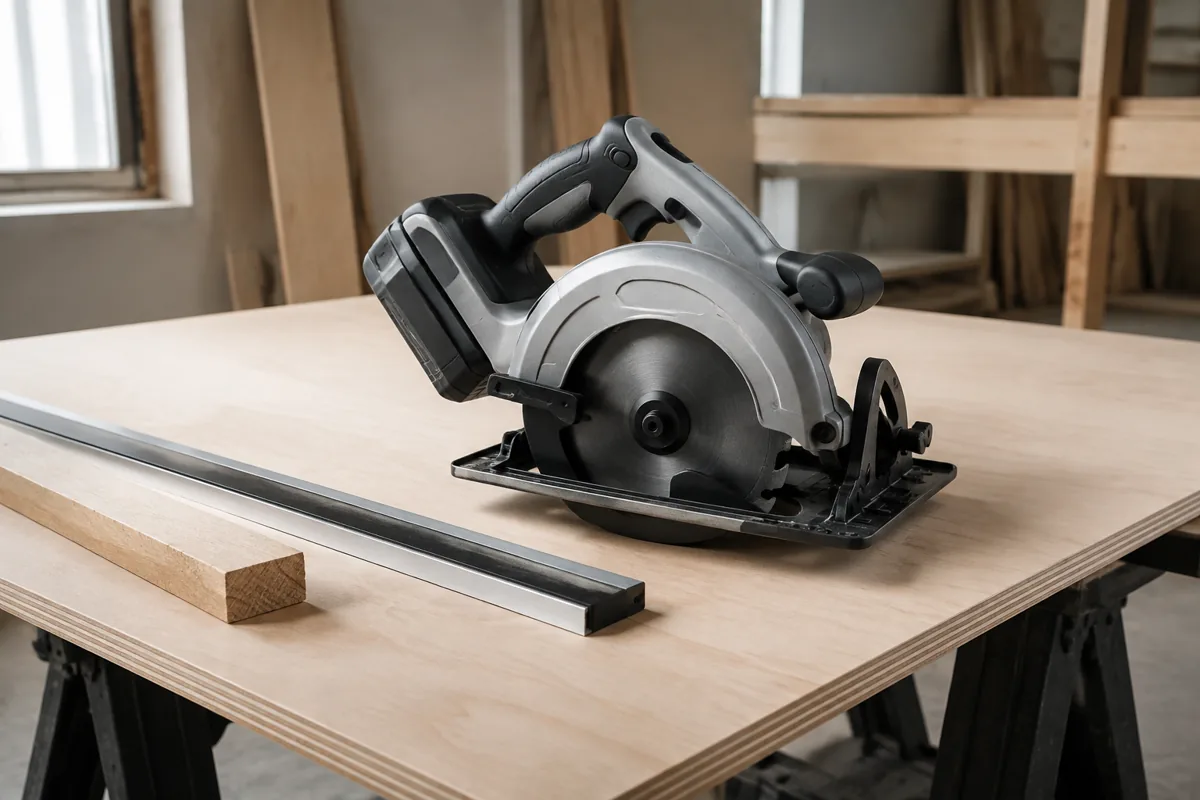
For a straight edge, clamp a straightedge or track securely to the work and account for the distance between the blade and the edge of the saw’s base. A clamp-on circular saw guide is a practical choice for occasional sheet cuts; a track system costs more but can be easier to align repeatedly. Confirm the guide is clamped outside the blade’s path.
Reduce tear-out on plywood and trim
On many circular saws, the blade exits the top face on a standard cut, so the top can splinter more than the underside. Put the show face down when that suits the cut direction and saw layout, then make a test cut on scrap: blade orientation and workpiece position can vary with the task. With a track saw or a saw whose blade geometry differs, verify which face gets the cleaner edge before cutting valuable material.
Painter’s tape over the cut line can help with light veneer splintering, but it will not rescue a dull blade. Score the line with a sharp knife for delicate veneer, taking care to follow the guide. A zero-clearance insert, if your saw accepts one, can support fibers near the blade, though many cordless circular saws do not offer this feature.
Feed steadily and manage the battery
Let the blade reach full speed before it meets the work. Advance at a steady pace: if the motor’s pitch drops sharply or the saw slows, ease off rather than forcing it. A feed rate that is too fast can leave a rough edge and strain the tool; an extremely slow feed can also burn wood. If the cut is long and the saw repeatedly bogs down, check blade sharpness, depth, and workpiece support before blaming the battery.
Battery capacity affects runtime, while voltage and tool design affect how well a saw sustains a demanding cut. A larger-capacity battery can add weight, which may make a saw harder to control during overhead or one-handed positioning. Use a charged, compatible battery that is in good condition. If you are buying into a platform, compare the saw’s bare-tool price and the batteries and charger you need, not just the tool price. A saw kit with battery and charger can be cheaper when you do not own compatible batteries; a bare tool is usually better value if you already have the right platform.
What to change first
| Problem | Likely cause | First fix |
|---|---|---|
| Splintered plywood edge | Coarse or dull blade; unsupported fibers | Try a sharp, higher-tooth blade and support the panel |
| Wandering cut | No reliable reference or loose guide | Clamp a straightedge and keep the base against it |
| Burn marks or slow cutting | Dull blade, overly slow feed, or blade pinch | Check blade condition and support before changing feed |
| Ragged end of cut | Offcut dropping or workpiece flexing | Support both sides without trapping the blade |
Make the cut safely
Wear eye and hearing protection, secure the work, and keep both hands positioned as the saw’s manual directs. Stand to one side of the blade’s line, not directly behind it. Do not reach underneath a sheet to catch an offcut, and wait for the blade to stop before setting the saw down. If the saw kicks back, binds, or the guard sticks, stop and find the cause before continuing. A cleaner cut is not worth a cut made with an unstable panel or a disabled guard.
Related guides
- Longest Lasting Lawn Mower Battery: AGM vs Lithium vs Flooded Lifespan and Cost per Season
- Duralast Gold Lawn Mower Battery Review: U1 Fit, CCA and When to Pay for AGM
- Greenworks Pro 80V 21-Inch Mower Review: Runtime Math, Push vs Self-Propelled and Yard Fit
- Bosch High Pressure Washer Gun Replacement: Fittings, Adapters and What Fits Your Model