What's inside
As an Amazon Associate I earn from qualifying purchases. This post may contain affiliate links at no extra cost to you.
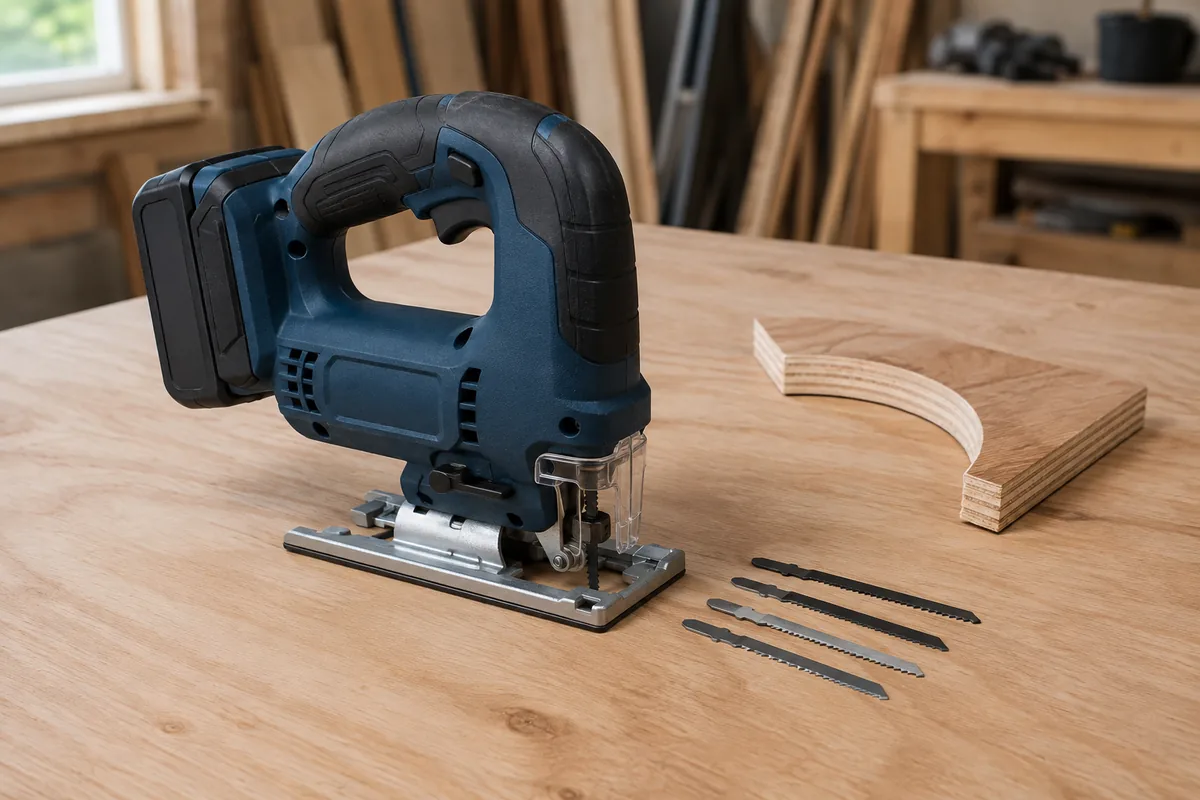
Curved cuts in plywood expose the weaknesses of a jigsaw quickly. A blade that bends off the cut line, a shoe that tips on a tight curve, or a battery that fades mid-cut can leave an edge that takes longer to fix than the cut took to make. For most DIY work, a compact cordless jigsaw with orbital action you can turn off, a stable shoe, and readily available batteries is a better buy than the fastest or most expensive tool.
As an Amazon Associate we earn from qualifying purchases at no extra cost to you.



What matters for curved plywood cuts
Blade choice and control matter more than maximum speed. For clean curves in 1/2-inch plywood, use a sharp, narrow jigsaw blade intended for wood and curves; a blade around 3/8 inch wide is easier to steer through tighter turns than a wide, fast-cutting blade. For cleaner faces, choose a down-cut blade or place the finished face down when using a conventional up-cut blade. Test the setup on a scrap of the same plywood first: veneers can splinter differently from one sheet to another.
Look for variable-speed control and a way to reduce or disable orbital action. Orbital movement speeds up rough cuts, but its more aggressive stroke tends to tear the top veneer and makes a tight curve harder to follow. Start with orbital action off and a moderate speed. Let the blade cut without forcing the saw; pushing sideways can flex it, leaving the underside of the cut out of square.
A broad, flat shoe helps keep the saw planted. A shoe that rocks on a small workpiece or catches on a clamp makes it difficult to hold a steady line. A tool-free blade clamp is convenient, but check that it holds the blade straight and securely. A dust blower or extraction port also helps you see the line, particularly on long curves.
Cordless jigsaw types compared
| Type | Best fit | Trade-off |
|---|---|---|
| Compact 12V jigsaw | Light plywood, short cuts, tight curves, and occasional DIY use | Less reserve power in thick material; smaller batteries can need recharging sooner |
| Brushless 18V/20V jigsaw | Regular shop use, longer cuts, and thicker plywood | Costs more and is often heavier; excess power does not compensate for a poor blade |
| Brushed 18V/20V jigsaw | Infrequent cuts when you already own compatible batteries | Usually less efficient and may have fewer control features, but can be good value |
Voltage labels are not a direct measure of cut quality. A well-controlled 12V saw can handle curves in 1/4- or 1/2-inch plywood, while a powerful 18V tool can still wander if you rush or use a dull blade. If you already own a battery platform, staying with it is usually the practical choice. Buying a bare tool can save money, but only if you have the right battery and charger.
What to buy for your battery platform
If you are starting from scratch and expect regular use, compare brushless jigsaws in the cordless platform you are likely to use for other tools. Check the bare-tool price against a kit that includes a battery and charger; a kit may be better value when you have no compatible batteries. For an occasional shelf, template, or craft project, a lower-cost brushed saw is often enough. Put the savings toward good blades and a spare battery rather than paying for features you will not use.
For a light, manageable saw for curves, compare 12V cordless jigsaws. If you make longer cuts or already use a full-size battery platform, look at brushless 18V cordless jigsaws. Compare the included controls and shoe design, not just the advertised stroke rate. If you only need a saw for occasional projects and want to keep the upfront cost down, a brushed cordless jigsaw can be a sensible buy.
Battery size is a weight-versus-runtime trade-off. A small pack makes it easier to steer a curve one-handed, though two hands are better for control and safety. A larger pack adds weight but is less likely to run out during repeated cuts. Match the battery to the job: for a few short curves in thin plywood, a charged compact pack is usually fine. For cutting several sheets or thicker stock, bring a charged spare.
How to keep the curve on line
Clamp the plywood flat on a stable surface, supporting both sides of the cut without putting a clamp in the saw’s path. Mark the curve clearly, then make a practice cut in scrap. If the curve is tight, drill a starter hole large enough for the blade to turn, or enter from an edge. Keep the shoe flat and guide the saw gradually; do not twist the handle to force the blade around a corner.
Watch for two common failures. If the blade drifts away from the line, it may be dull, too wide for the curve, or flexing because you are steering too hard. Slow down and try a narrower fresh blade. If the edge splinters, reduce orbital action, use a sharper fine-tooth blade, and support the veneer with masking tape if needed. Tape helps with minor tear-out but will not fix a blade that is cutting too aggressively.
For a clean finished edge, leave the cut slightly outside the line and sand or trim back to it. Expect to remove roughly 1/16 inch, adjusting for the blade and the curve. This is more reliable than trying to make the jigsaw produce a perfect finished edge in one pass.
Choose for the work you actually do
For occasional curved cuts in thin plywood, a basic cordless jigsaw on a battery platform you already own is generally enough. Frequent cutting justifies a better-controlled brushless model, especially if it has a stable shoe, variable speed, and orbital adjustment. In either case, a sharp narrow blade, supported plywood, and a patient feed rate will do more for the curve than buying the highest-powered saw.
Related guides
- Longest Lasting Lawn Mower Battery: AGM vs Lithium vs Flooded Lifespan and Cost per Season
- Duralast Gold Lawn Mower Battery Review: U1 Fit, CCA and When to Pay for AGM
- Greenworks Pro 80V 21-Inch Mower Review: Runtime Math, Push vs Self-Propelled and Yard Fit
- Bosch High Pressure Washer Gun Replacement: Fittings, Adapters and What Fits Your Model