Our Top Picks
 OlarHike Tire Inflator Portable Air Compressor6000 (Large Capacity)6.5 x 2.76 x 2.17 Inches1.9 poundsCheck on Amazon
 AstroAI AIRUN H Tire Inflator Portable Air CompressorLarge8.27 x 3.74 x 6.69 inches1.8 poundsCheck on Amazon
 DEWALT Tire Inflator Portable Air Compressor 20V MAXOne Size10.5 x 7.7 x 2.2 Inches6.39 PoundsCheck on Amazon
 OlarHike 12000mAh Heavy Duty Tire Inflator Portable AirTire InflationBattery Powered78 DecibelsCheck on Amazon


What's inside
- 1. The quiet 1-gallon: buy this first if you own a brad nailer
- 2. The 6-gallon pancake: the honest general-purpose choice
- 3. The twin-stack: the jobsite answer, not the homeowner answer
- 4. The cordless inflator: not a compressor, and that is the point
- 5. The wheeled 8 to 10 gallon: the edge of portable
- What to skip
- Frequently asked questions
- Related Guides
- 1. The quiet 1-gallon: buy this first if you own a brad nailer
- 2. The 6-gallon pancake: the honest general-purpose choice
- 3. The twin-stack: the jobsite answer, not the homeowner answer
- 4. The cordless inflator: not a compressor, and that is the point
- 5. The wheeled 8 to 10 gallon: the edge of portable
- What to skip
- Frequently asked questions
- Related Guides
As an Amazon Associate I earn from qualifying purchases. This post may contain affiliate links at no extra cost to you.
Most people buy the wrong portable air compressor because they shop by tank size. Six gallons sounds better than one gallon, so the six-gallon pancake goes in the cart, and then it sits in the garage because it weighs 32 pounds and screams at 90 decibels every time it cycles. The best portable air compressor is not the biggest one you can carry. It is the smallest one that keeps up with the tool you actually use most.
Air tools do not care about gallons. They care about CFM at 90 PSI, which is the sustained airflow the pump can deliver. A brad nailer sips about 0.3 CFM in real use. A framing nailer wants closer to 2.2. A die grinder or a DA sander wants 4 to 6 CFM continuously, which is a different machine entirely and usually not a portable one. So this ranking is ordered by the job each compressor unlocks, starting with the job most readers actually have.
As an Amazon Associate we earn from qualifying purchases at no extra cost to you.


| Rank & | type | Job it unlocks | Typical tank | What it will not do |
|---|---|---|---|---|
| 1. Quiet 1-gallon | Trim, brads, crown, inflation | 1-2 gal | Framing, sustained air | |
| 2. 6-gallon pancake | Roofing, framing bursts, general shop | 6 gal | Continuous sanding | |
| 3. Twin-stack 4-5 gallon | Two nailers at once, jobsite | 4-5 gal | Quiet operation | |
| 4. Cordless inflator | Tires, sports, bike, air mattress | None | Any air tool | |
| 5. 8-10 gallon wheeled | Impact wrench bursts, blowing out lines | 8-10 gal | True portability |
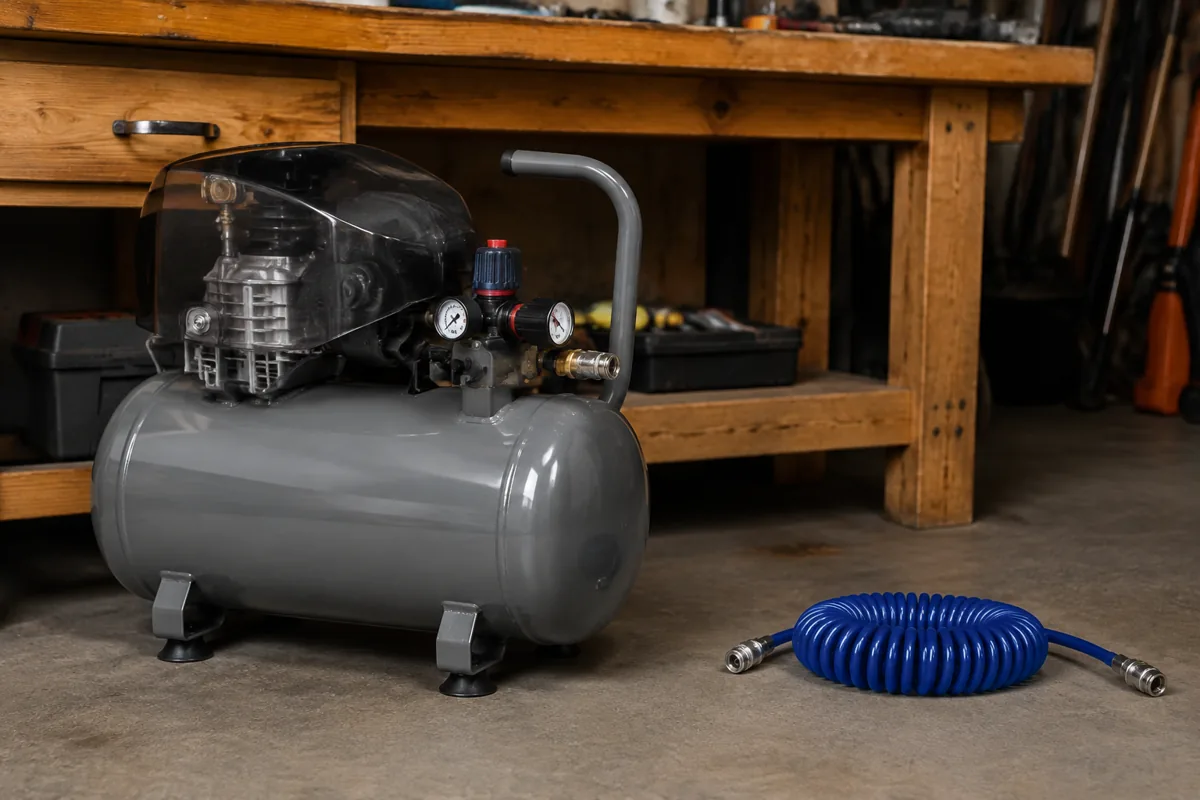
1. The quiet 1-gallon: buy this first if you own a brad nailer
This is the first pick because it matches the most common real use case. If your air tool list is a brad nailer, a finish nailer, a pin nailer, and occasional tire topping off, a quiet oil-free 1-gallon unit does the entire job and does it in a way that lets you work indoors without ear protection and without waking a sleeping kid upstairs.
The relevant number is not gallons, it is decibels. The quiet category sits in the high 50s to mid 60s dBA range, which is roughly conversation volume, compared to 85 to 92 dBA for a traditional pancake. That difference comes from a low-RPM induction motor instead of a screaming universal motor. The tradeoff is weight per gallon and a slower recovery time, which only matters if you are firing nails faster than the pump can refill. For trim work you are not.
What to look for: oil-free pump, 120 PSI maximum, a real regulator with a gauge you can read, and a rubber-footed base so it does not walk across the floor. Skip anything that does not publish a dBA rating, because that silence is the tell.
Quiet 1-Gallon Trim Compressor
The right first compressor for 80 percent of DIY buyers. It runs a brad or finish nailer all day, fits in a closet, and is quiet enough for interior work with the homeowner in the next room. Pay attention to the dBA number and the regulator quality rather than the tank size, and ignore any listing that brags about horsepower without stating CFM at 90 PSI.
2. The 6-gallon pancake: the honest general-purpose choice
The pancake is second, not first, because it is louder and heavier than most buyers need. But it is second rather than fourth because the stored air genuinely unlocks jobs the small tank cannot. Six gallons at 150 PSI gives you enough of a buffer to run a framing nailer through a wall section, drive a roofing nailer at a steady pace, or blast a deck clean with a blow gun before the pump has to catch up.
The 150 PSI cutoff matters more than the six gallons. Higher storage pressure means more usable air out of the same volume, which is why a 150 PSI six-gallon unit outperforms an older 125 PSI six-gallon unit on paper and in practice. Look for two regulated outlets with couplers so two people can work, and check the cold-start behavior if you work in an unheated garage in winter.
These are commodity products. The DeWalt, Bostitch, and Craftsman pancakes are all competent, and the price differences track brand and included hose kits more than pump quality. Buy whichever one is on sale in a kit with a hose and a nailer if you need both.
- ✔ 150 PSI storage gives real burst capacity for framing and roofing
- ✔ Flat stable base and a genuine carry handle
- ✔ Widely available, cheap to replace, easy to find parts
- ✔ Kits bundle hose and nailer for less than buying separately
- ✘ 85 to 92 dBA means hearing protection every time it cycles
- ✘ 25 to 35 pounds is a two-hand carry, not a one-hand grab
- ✘ Oil-free pumps wear out faster than oil-lubricated
- ✘ Still cannot run a sander or die grinder continuously
3. The twin-stack: the jobsite answer, not the homeowner answer
Twin-stack units run two 2 to 2.5 gallon tanks stacked in a roll cage. The reason they rank third is narrow: they exist for crews. Faster recovery than a pancake of similar volume, a frame that survives being thrown in a truck bed, and enough outlets to feed two nailers without one guy waiting on pressure.
If you are a homeowner, this is the wrong buy. It is louder, it is heavier, and you pay for durability you will never consume. If you are a trim carpenter or a punch-list contractor moving between houses every day, the roll cage is the entire value proposition, and the pancake you have been replacing every eighteen months is the reason to switch.
4. The cordless inflator: not a compressor, and that is the point
Fourth place goes to a tool that is not really in the category, because a large share of people searching for a portable air compressor only want to inflate things. Tires, a wheelbarrow, a soccer ball, an air mattress at a campsite. If that describes you, a battery inflator on the platform you already own, whether that is DeWalt 20V MAX, Milwaukee M18, Makita LXT, or Ryobi ONE+, is a better buy than any tank compressor.
These deliver high pressure at very low volume, which is exactly right for tires and exactly wrong for air tools. Look for a digital preset with auto shutoff, a high-pressure hose for tires plus a high-volume port for inflatables, and 12V and AC input options if you want roadside use. Do not expect to run a nailer. Nothing cordless in this class holds pressure long enough to be worth the attempt.
Cordless Battery Inflator
Buy this instead of a tank compressor if your list is tires, bikes, and pool toys. Pick the one matching the battery platform in your garage so you are not buying another charger. The digital auto-shutoff is the feature that justifies the price, and the dual-port models handle both tire pressure and air mattress volume.
5. The wheeled 8 to 10 gallon: the edge of portable
Last on the list because calling it portable is generous. These wheeled or vertical units store enough air to run an impact wrench in bursts, blow out sprinkler lines, or feed a small blast cabinet for short stretches. Many are oil-lubricated, which means quieter operation and a longer service life in exchange for checking the oil and keeping the unit level.
Buy one of these only if you have identified a specific tool that the six-gallon cannot feed. If you find yourself wanting continuous air for sanding or painting a whole car panel, you have left the portable category and you want a stationary 60-gallon two-stage on a 240V circuit. Buying a 10-gallon portable as a compromise usually satisfies neither goal.
What to skip
Skip anything advertised by peak horsepower. Peak HP is a marketing number measured at stall. If the listing does not state CFM at 90 PSI, the pump is probably weak and the seller knows it.
Skip 12V cigarette-lighter compressors with a tank. They are slow, they overheat, and the duty cycle is measured in minutes. A cordless inflator does the same job faster.
Skip 3-gallon hotdog compressors as a first buy. They fall between the quiet 1-gallon and the 6-gallon pancake without beating either. Louder than the first, less capable than the second.
Skip the bundled coil hose. Recoil hoses drag tools sideways and kink. Spend fifteen dollars on a 50-foot straight hybrid polymer hose and the whole system feels better.
Skip air-powered impact wrenches and ratchets for home use. A brushless cordless impact in the DeWalt XR, Milwaukee FUEL, or Makita LXT lines beats an air tool fed by any portable tank, and does not need a hose.
Frequently asked questions
What size portable air compressor do I actually need? Add up the CFM at 90 PSI of the tools you run at the same time, then add roughly 30 percent headroom. Trim nailers land under 1 CFM total, so a 1-gallon quiet unit is enough. Framing and roofing want a 6-gallon at 150 PSI. Sanders and grinders need 4 to 6 CFM continuously and belong on a stationary compressor.
Is oil-free or oil-lubricated better? Oil-free is lighter, needs no maintenance, and is the right call for anything you carry. Oil-lubricated runs cooler and quieter and lasts substantially longer, which matters for a wheeled unit that lives in one spot. For a portable, oil-free wins on convenience.
Do I have to drain the tank after every use? Yes, and it takes ten seconds. Compressing air condenses water inside the tank, and standing water rusts the steel from the inside out. Open the bottom petcock while there is still some pressure to push the moisture out, then leave it open in storage. A rusted tank is the most common reason a compressor dies early and the failure mode is not gentle.
The short version: match the machine to the tool you use most, weight the decision toward noise and portability rather than gallons, and only step up when a specific job forces you to. Prices across these categories move a lot with seasonal sales, so check current listings before committing.
Check prices on Amazon →