Key takeaways
- A quiet air compressor review ranked by what to buy first, from ultra-quiet 1-gallon units to isolated 20-gallon verticals, with a blunt list of what to skip.
What's inside
As an Amazon Associate I earn from qualifying purchases. This post may contain affiliate links at no extra cost to you.
Most compressors marketed as quiet are only quiet next to a pancake unit shrieking three feet from your ear. That is a low bar, and it is why this quiet air compressor review is organized by the job each machine unlocks instead of by the decibel number on the box. Whether you can run your tool, in your space, at the hour you actually get shop time, is the real question.
The order below is buy order, not price order. Every position is earned by the work it makes possible. Follow the sequence and you will not end up owning a compressor that cannot feed the tool on your bench.
As an Amazon Associate we earn from qualifying purchases at no extra cost to you.
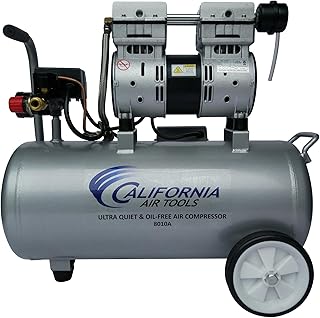

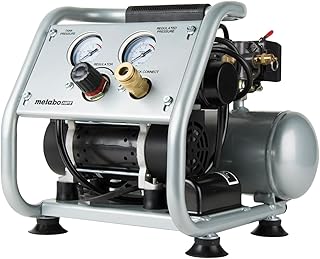


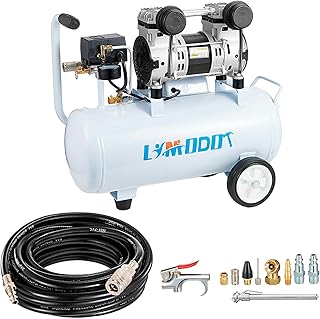

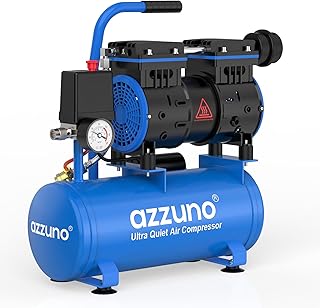
| Class | Job it unlocks | What you give up |
|---|---|---|
| Ultra-quiet 1-2 gallon | Brads, pins, staples, indoor air at night | Seconds of continuous air, slow recovery |
| Quiet 4-6 gallon twin stack | Framing bursts, siding, small HVLP | Weight and floor space |
| Quiet dual-piston 8-10 gallon | Two hoses at once, all-day trim | Cost and bulk |
| 20-30 gallon vertical | Sanders, impacts, blasting, spraying | Loud pump, permanent location, dedicated circuit |
| Battery inflator | Tires and sports gear | Runs no air tool at all |
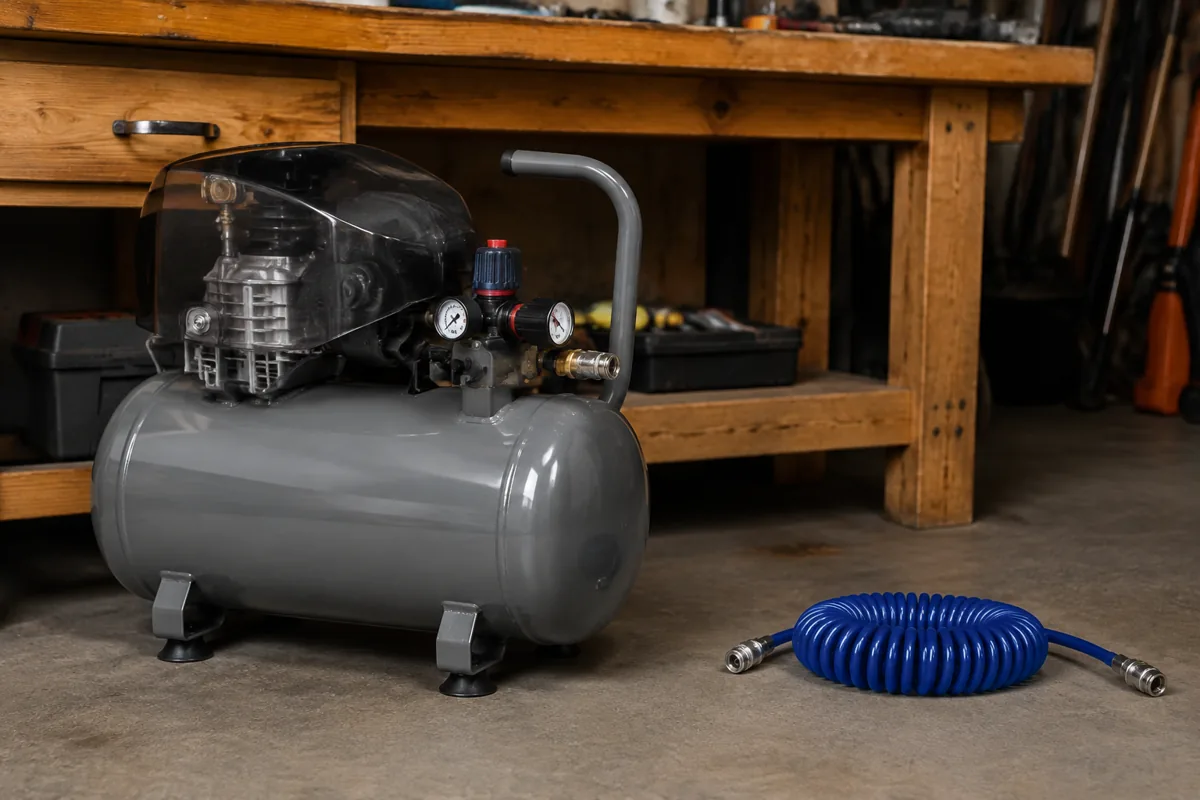
Quiet Air Compressor Review: The Buy Order
1. Ultra-quiet 1 to 2 gallon hand-carry
First, because it is the only class you can run in a finished basement at nine at night without an argument. The quiet is mechanical, not cosmetic: these pumps turn a fraction of the rpm of a standard oil-free direct-drive unit, and slow pistons make less noise. Quoted figures usually land in the high 50s to mid 60s dB range, which in practice means you can hold a conversation beside one. California Air Tools built the category, and Metabo HPT, Makita and Rolair all sell credible quiet machines.
The job it unlocks is finish work: brad and pin nailing, narrow crown staples, blowing out a router table, topping off tires. All intermittent, so a small tank costs you nothing. Ask it to feed a sander and it will run nonstop, get hot, and still starve the tool.
- ✔ Usable in an attached garage or basement shop after hours
- ✔ Slow-turning pumps typically outlast screaming direct-drive units
- ✔ Light enough for a one-hand carry up a staircase
- ✘ Tank capacity measured in seconds of continuous air
- ✘ Will not run rotary air tools
- ✘ Costs more than a loud pancake of the same tank size
Ultra-Quiet 1-2 Gallon Compressors
If your work is trim, cabinets or general household air, start here. Filter for a stated decibel figure with a measurement distance, an oil-free twin-piston pump, and a real regulator with two couplers. Ignore max psi bragging.
2. Quiet 4.5 to 6 gallon twin stack
Second, because it is the first quiet unit that can be your only unit. Past roughly 2 CFM at 90 psi you can drive a framing nailer at a working pace, a siding or roofing gun, an upholstery stapler and small HVLP touch-ups. Twin-stack tanks add burst capacity without a vertical footprint. Read the labels hard here, because plenty of compressors this size are badged quiet while sitting in the 70s dB range. That is better than a screamer and still not living-room friendly.
Quiet 4-6 Gallon Twin Stack and Pancake
The sweet spot for a one-compressor garage. Prioritize CFM at 90 psi over tank gallons, and favor oil-lubricated or slow-speed pumps with replaceable service parts over the cheapest oil-free option.
3. Quiet dual-piston 8 to 10 gallon wheeled
Third, because it fixes one specific problem: two hoses running at once. A finish nailer plus a framing gun, or two people on a trim job, will empty a 6 gallon tank faster than a small pump recovers. Dual-piston units in this size keep up, so nobody stands around waiting on the motor. They are also heavy enough that wheels stop being a marketing feature and start being the reason the tool gets used.
Quiet Dual-Piston and Wheeled Compressors
Worth the premium only if you regularly run two air tools or work with a partner. Check the rated duty cycle and whether the pump is serviceable before you pay up.
4. A 20 to 30 gallon vertical, isolated rather than quiet
Fourth on purpose. Nothing this size is genuinely quiet at the pump, even a slow belt-drive cast-iron unit. What it unlocks is continuous draw: DA sanders, cutoff tools, half-inch impacts, media blasting, full-panel spraying. If that is your work, you do not buy quiet, you build it. Park the compressor in a closet, an outside enclosure or the far corner of the garage and hard-pipe air to the bench. Location beats every decibel rating in this article.
5. Battery inflator or 12V pump
Last, and only because many people shopping for a quiet compressor actually wanted this. If tires, bikes and sports gear are the whole use case, buy an inflator on the battery platform you already own and skip the compressor.
What the Decibel Number Hides
Decibels are logarithmic. Roughly every 10 dB reads as twice as loud to your ear, so a 60 dB machine is not a few percent quieter than a 90 dB pancake, it is in a different world. That also makes the small print matter. A figure measured at one meter in open air is not the figure you get in a two-car garage with bare drywall and a concrete floor bouncing sound back at you.
Two things the number leaves out. Pitch: high-rpm oil-free pumps produce a whine that grates more than a low-rpm rumble at the same reading. And run time: a quiet pump takes longer to fill a tank, so total noise exposure is closer than the spec implies.
Settle the CFM Question First
CFM at 90 psi is the spec that decides whether a tool works at all. Tank gallons only buy burst time before the pump has to catch up. Rough planning ranges: finish nailers well under 1 CFM, framing nailers around 2 to 2.5 at a steady pace, half-inch impact wrenches in the 4 to 5 range continuous, random-orbit and DA sanders 6 to 9, and HVLP guns often 8 and up. Check the plate on your own tool, since these vary by model.
Two related mistakes follow from ignoring that. Treating a 175 psi max rating as a substitute for airflow buys you seconds, not capability. And feeding a high-CFM tool through 1/4 inch or coil hose makes the hose the restriction. Move to 3/8 inch for anything above about 3 CFM.
What to Skip
- ✘ Decibel claims with no measurement distance, no brand history and no service parts
- ✘ Ultra-quiet 1 gallon units bought to run sanders, grinders or impact wrenches
- ✘ Plastic quick couplers and toy regulators, whatever the pump cost
- ✘ Two-stage 240V machines for a homeowner with no dedicated circuit and no daily run time
- ✘ Sealing a compressor inside an airtight cabinet, which cooks the pump
- ✘ Ignoring the tank drain, which rusts the tank and puts water in your finish
One more: paying a premium for quiet and then bolting the machine to a hollow plywood shelf, which turns the cabinet into a soundboard. Set it on rubber isolation pads, leave clearance for cooling air, and if you enclose it, build a baffled intake and exhaust path.
Quiet Air Compressor FAQ
How quiet is quiet enough for indoor use? Look for figures in the high 50s to mid 60s dB range with a stated measurement distance. That band lets you talk over the machine and work in a finished space without hearing protection.
Is oil-free or oil-lubricated quieter? Oil-lubricated pumps generally run slower, quieter and longer, at the cost of oil checks and the risk of a drip. Modern ultra-quiet oil-free designs close much of the gap by cutting rpm instead of adding oil.
Can a quiet compressor run a paint sprayer? Small HVLP touch-up guns, yes, from the 4 gallon class upward. Full-size guns and long continuous passes need the airflow of a 20 gallon or larger machine, quiet or not.
Buy for the work you do most often, get the decibel figure and its measurement distance in writing, and put the leftover money into 3/8 inch hose and decent couplers instead of tank gallons.
Check prices on Amazon →