What's inside
As an Amazon Associate I earn from qualifying purchases. This post may contain affiliate links at no extra cost to you.
What matters in a cordless grease gun
A cordless grease gun is useful when you service several machines, work away from an air compressor, or regularly grease fittings that are awkward to reach. For occasional maintenance on one lawn tractor, a manual lever gun is cheaper, lighter, and less likely to waste grease. For daily fleet or equipment work, cordless operation can save time and hand fatigue—but only if the gun suits the fittings and grease you use.
Compare maximum pressure, delivery rate, hose length, grease capacity, and battery platform. Maximum pressure is not the same as useful output: a gun may advertise 10,000 psi, but blocked fittings, damaged couplers, and cold, stiff grease can still stop the job. A common working range is roughly 1–3 ounces per minute, though actual delivery depends on the grease, temperature, and backpressure. A higher flow rate speeds up service but makes it easier to over-grease small bearings.
As an Amazon Associate we earn from qualifying purchases at no extra cost to you.


Compare the main options
| Option | Best for | Trade-offs |
|---|---|---|
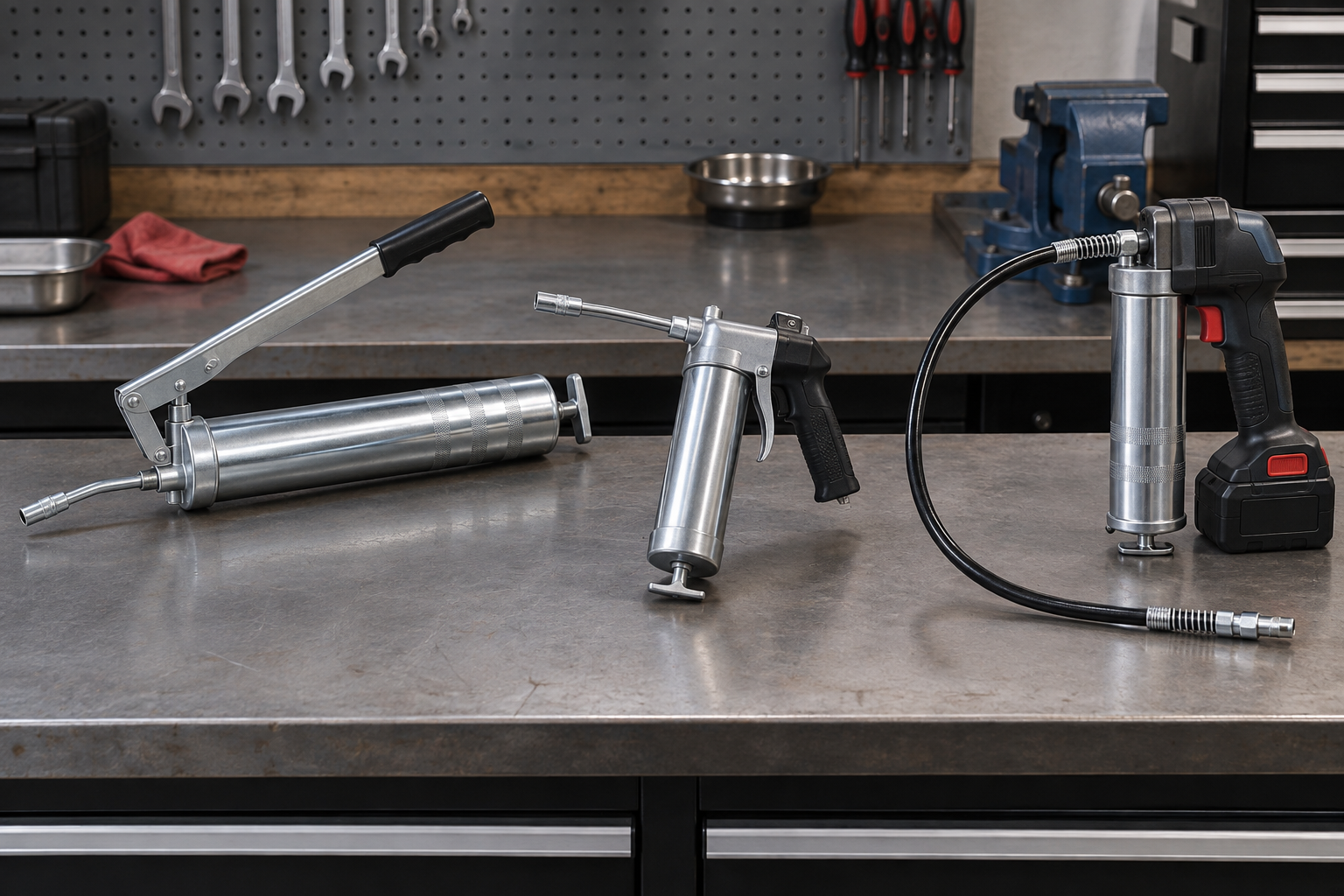
| Manual lever gun | Occasional jobs and a small number of fittings | Low cost and simple to maintain; slower and tiring during a long service round |
| 12V or compact cordless gun | Home equipment and lighter-duty maintenance | Usually easier to carry; may have lower capacity or less output than full-size tools |
| 18V/20V-class cordless gun | Frequent work, multiple machines, or stiff grease | More capable and often compatible with a work-tool battery system; heavier and more expensive |
Voltage labels are not directly comparable across every brand, and a bigger battery does not automatically mean more pressure. Check the tool’s stated output and whether the kit includes a battery and charger. If you already own batteries in a compatible platform, a bare tool can make financial sense. If not, compare the complete kit price with a manual gun or a smaller cordless option.
Choose by workload and battery platform
For occasional maintenance, a manual lever grease gun is often the sensible buy. It needs no charging, has fewer electrical failure points, and is easy to keep as a backup. The trade-off is effort: pushing stiff grease through a resistant fitting can take repeated strokes, and one-handed operation is difficult.
If you already use cordless tools, consider a cordless grease gun that matches your battery platform. Shared batteries and chargers reduce clutter and avoid paying twice for a kit. Before buying, confirm compatibility: batteries within a brand are not always interchangeable across voltage classes or product generations. Also check the tool’s weight with the battery installed. A heavy gun and a long hose can be tiring when you are holding it overhead or reaching underneath a machine.
For frequent equipment service, prioritize a flexible hose and a reliable coupler as much as raw pressure. A hose around 30–36 inches gives useful reach on many machines; a longer hose can help in cramped positions but is easier to snag. A coupler that locks securely reduces the chance of grease escaping around the fitting. A full-size cordless grease gun kit may be a good fit for this workload, especially if the kit includes a battery and charger you need. For a shop already invested in that platform, the bare tool is often the better value.
Capacity, loading, and common failures
Most grease guns use either a standard cartridge or bulk loading; some support both. Cartridge loading is clean and straightforward, but the tube must match the gun’s specified size and be installed correctly. Bulk loading can reduce cartridge waste for a busy shop, but it is easier to introduce air or contamination. Follow the tool’s priming instructions after loading. Air in the barrel can cause uneven flow or make the gun appear to have failed.
When a gun stops delivering grease, do not assume it needs more pressure. Check that the cartridge follower is released and engaged as instructed, the gun is primed, and the coupler is seated. A blocked fitting can require cleaning or replacement; forcing the trigger against a blockage can damage seals or the fitting. Grease leaking around the barrel may indicate a loose connection or damaged seal. Keep grease and grit out of the coupler, and wipe fittings before attaching it—dirt pushed into a bearing can do more harm than a missed shot.
Use it carefully
Use the equipment maker’s lubrication schedule and quantity rather than greasing every fitting until grease appears. Some sealed bearings should not be greased, and too much grease can damage seals or build heat. If a fitting will not accept grease, stop and inspect it rather than holding the trigger longer. Grease guns can develop very high pressure; never put your hand near a suspected leak or try to find one by touch. A high-pressure grease injection injury is an emergency, even if the puncture looks small.
Finally, keep the battery and charger suited to the tool’s platform, and store the gun where dust cannot collect around the coupler or loading end. For a few fittings each month, manual is usually enough. For repeated service rounds, cordless is worthwhile when its battery compatibility, hose reach, and controllable output fit the work—not simply because it has a high pressure rating.
Related guides
- Longest Lasting Lawn Mower Battery: AGM vs Lithium vs Flooded Lifespan and Cost per Season
- Duralast Gold Lawn Mower Battery Review: U1 Fit, CCA and When to Pay for AGM
- Greenworks Pro 80V 21-Inch Mower Review: Runtime Math, Push vs Self-Propelled and Yard Fit
- Bosch High Pressure Washer Gun Replacement: Fittings, Adapters and What Fits Your Model