What's inside
As an Amazon Associate I earn from qualifying purchases. This post may contain affiliate links at no extra cost to you.
The best bass shakers for deep, immersive sound depend on your seat or platform, amplifier, and room size: choose a compact 50-watt transducer for one chair, a Dayton Audio BST-1 or AuraSound AST-2B-4 Pro for a small platform, and a ButtKicker LFE-class unit when you need high-output tactile bass across a sofa, riser, or large room.
A bass shaker does not produce much audible sound by itself. It converts an amplifier’s low-frequency signal into mechanical vibration, which travels through a chair, couch, gaming rig, bed frame, or wooden platform. The most important buying decisions are therefore not just the shaker’s wattage, but its frequency range, impedance, mounting surface, amplifier headroom, and how many people or seats must feel the effect.
As an Amazon Associate we earn from qualifying purchases at no extra cost to you.


Our Top Picks


Best bass shakers by situation
| Situation | Recommended type | Why it fits | Typical amplifier requirement |
|---|---|---|---|
| One office chair or gaming seat | 50–100 W, 4-ohm compact transducer | Affordable, easy to conceal, and less likely to overpower a lightweight frame | 50–100 W RMS into 4 ohms |
| One recliner or sturdy cockpit | Dayton Audio BST-1 or similar 50 W unit | Good low-frequency impact without requiring a large enclosure or platform | 50–100 W RMS into 4 ohms |
| Two- to three-seat sofa | Two 4-ohm shakers, or one higher-output unit | Spreads vibration more evenly and reduces the need to drive one unit into its limits | 100–300 W total, depending on the model |
| Large wooden riser or home-theater platform | ButtKicker Concert, ButtKicker LFE, or multiple high-output units | More moving mass and amplifier capacity for a broad, forceful response | 300–1,000 W, matched carefully to impedance |
| Music listening with subtle tactile detail | Wide-response tactile transducer with adjustable crossover | Better control over kick drums and bass guitar without constant rumbling | Clean amplifier with gain and low-pass controls |
Head-to-head: the strongest practical choices
Dayton Audio BST-1: best value for a single seat
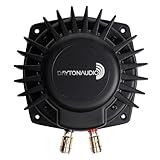
The Dayton Audio BST-1 is a popular compact tactile transducer rated at approximately 50 watts RMS, with a 4-ohm load and a published response commonly listed around 15–17,000 Hz depending on the specification source. In actual use, its useful tactile output is concentrated in the bass region rather than the entire audible range.
Its compact cylindrical design suits the underside of a chair, recliner, couch frame, or simulator cockpit. A solid wooden mounting rail is preferable to thin upholstery because the rail distributes the force. For a single seat or a small platform of roughly 1.5 by 2 metres, one unit can be effective; two units are a better choice when the platform flexes or carries several people.
The BST-1 is a sensible first purchase because replacement cost is relatively low, typically in the broad $40–$70 range for the transducer alone. Its limitation is output: it can sound and feel strained if asked to energize a large, heavy sofa or a room-wide riser.
AuraSound AST-2B-4 Pro: a versatile mid-power option
The AuraSound AST-2B-4 Pro is a 4-ohm tactile transducer commonly specified at about 50 watts nominal and 100 watts maximum, with a frequency range often quoted near 20–200 Hz. That narrower stated range is not a disadvantage for its intended purpose; most movie effects, game impacts, and musical bass that you want to feel are below 200 Hz.
The unit’s mounting flange makes it convenient for fastening to a wood frame. It works well under a recliner, on a gaming cockpit, or on a compact couch platform. Its practical coverage is similar to the BST-1: one unit for one strongly coupled seat, or two units for a wider sofa or platform.
Choose the AuraSound when you want a straightforward bolt-on design and controlled bass effects rather than maximum subwoofer-like force. Market pricing is generally in the same broad budget-to-midrange bracket as other 4-ohm, 50-watt shakers.
ButtKicker Gamer PRO: best for a dedicated gaming rig
The ButtKicker Gamer PRO is built around a larger electromagnetic motion system than compact puck-style transducers and is intended for gaming seats, simulator cockpits, and rigid frames. It is sold as a high-output system with a dedicated amplifier, rather than simply a small passive shaker.
This approach costs more—often several hundred dollars for the complete system—but simplifies matching the amplifier to the transducer. It is a strong choice for racing and flight simulators where engine vibration, road texture, gear changes, and impacts need to remain distinct during long sessions.
One Gamer PRO is normally aimed at one seat or one rigid cockpit. It can energize a sturdy frame, but it is not automatically the best solution for a whole sectional sofa. Multiple independently mounted units give better left-right or front-rear separation than trying to make one shaker cover every seating position.
ButtKicker Concert and LFE: for platforms and large rooms
The ButtKicker Concert and ButtKicker LFE occupy the high-output end of the category. Their larger moving assemblies and high power handling make them suitable for theater risers, heavy platforms, studio furniture, and substantial seating. Depending on the exact model and amplifier, published power figures can extend from several hundred watts into the 1,000-watt range.
These units are excessive for a lightweight office chair. On a rigid platform of about 2.5 by 4 metres, however, one high-output transducer can provide much more convincing low-frequency movement than a small 50-watt unit driven beyond its comfort zone. Large rooms still require sensible placement: the shaker transfers force through the structure, so a weak or isolated frame can waste much of its output.
Frequency response, strength, and amplifier matching
Frequency response figures need careful interpretation. A shaker advertised as reaching 15 Hz may not deliver equal tactile strength at 15 Hz, and a unit listed to 200 Hz does not need to be run that high. For movie effects and games, start with a low-pass crossover between 40 and 80 Hz. For music, 50–100 Hz often preserves kick-drum impact while reducing unwanted vibration from vocals, guitar, or room noise.
Amplifier power should be matched to the shaker’s impedance and continuous rating. A 4-ohm, 50-watt transducer can be damaged by excessive gain even if the amplifier is rated for it. Conversely, an underpowered amplifier may clip; clipped output can create heat and harsh mechanical behavior.
For two identical 4-ohm shakers:
- Wire them in parallel only if the amplifier safely supports a 2-ohm load.
- Wire them in series for an 8-ohm load when lower current demand is more important than maximum output.
- Use separate amplifier channels when you want independent left-right or seat-by-seat control.
As a practical calculation, two 50-watt shakers require about 100 watts of continuous capacity at their combined load, with additional headroom for peaks. A clean 150–200 watt amplifier is a reasonable target when its impedance rating supports the wiring arrangement. Avoid choosing an amplifier solely by its largest advertised peak number.
Mounting determines how much bass you feel
Mount the shaker to a rigid structural member, not to loose fabric, a thin decorative panel, or a hollow plastic shell. A hardwood or plywood mounting block spreads force and prevents the fasteners from tearing out. Use washers, thread-locking compound where appropriate, and locknuts on frames that vibrate frequently.
For a wooden platform, mount the transducer near a structural rail rather than at the exact center of a flexible sheet. On a sofa, attach it to the main hardwood or metal frame and keep the mounting hardware clear of moving recliner mechanisms. Rubber isolation feet under a platform can prevent energy from disappearing into the floor, but too much isolation can make the platform unstable.
Durability and ownership realities
The first parts to suffer are usually mounting hardware, loose frame joints, amplifier connectors, and suspension components—not the metal body itself. Check bolts after the first few hours and periodically thereafter. Keep sawdust, pet hair, and debris away from exposed vents and amplifier cooling paths; this matters particularly in a woodworking or workshop environment.
Common mistakes include mounting to a flexible panel, setting the crossover too high, using excessive gain to compensate for poor contact, and placing a single small shaker under a large sectional. Mechanical rattles can also masquerade as bass detail. Tighten the furniture, isolate noisy hardware, and test at modest volume before increasing power.
Bottom line
For the lowest-cost single-seat installation, the Dayton Audio BST-1 or AuraSound AST-2B-4 Pro is usually the right starting point. For a dedicated gaming cockpit with stronger output and simpler amplifier matching, choose the ButtKicker Gamer PRO. For a heavy theater riser, large sofa platform, or room where deep impact matters more than compact size, step up to a ButtKicker Concert or LFE-class system with a properly matched amplifier. In every case, a rigid mount and correctly set crossover will improve immersion more than simply buying the highest wattage.