What's inside
As an Amazon Associate I earn from qualifying purchases. This post may contain affiliate links at no extra cost to you.
A cordless grease gun saves time when a machine has dozens of fittings or the service point is far from an air compressor. The useful choice is not simply the gun with the highest advertised pressure. For fleet and equipment work, match the tool to the grease, fitting condition, daily volume, and battery platform already in your shop.
As an Amazon Associate we earn from qualifying purchases at no extra cost to you.


What matters in a fleet grease gun
Check three specifications first: maximum pressure, grease output per minute, and grease capacity. Many cordless guns advertise pressure around 10,000 psi, but that figure is a maximum—not a promise of fast flow at that pressure. A plugged fitting can still resist grease, and forcing it risks damaging a seal or hose. Flow rate matters more for routine work across many open, working fittings; pressure capability matters when grease is cold or a fitting is difficult.
Most models take a standard 14-ounce grease cartridge, or can be bulk-filled. Cartridges are cleaner and quicker to change; bulk filling can cost less in a high-volume shop but requires a compatible loading method and careful handling to avoid air pockets. A trapped air pocket can make the gun stop pumping even though the motor runs. Follow the tool’s priming procedure before assuming it has failed.
Compare the main options
| Option | Best fit | Trade-off |
|---|---|---|
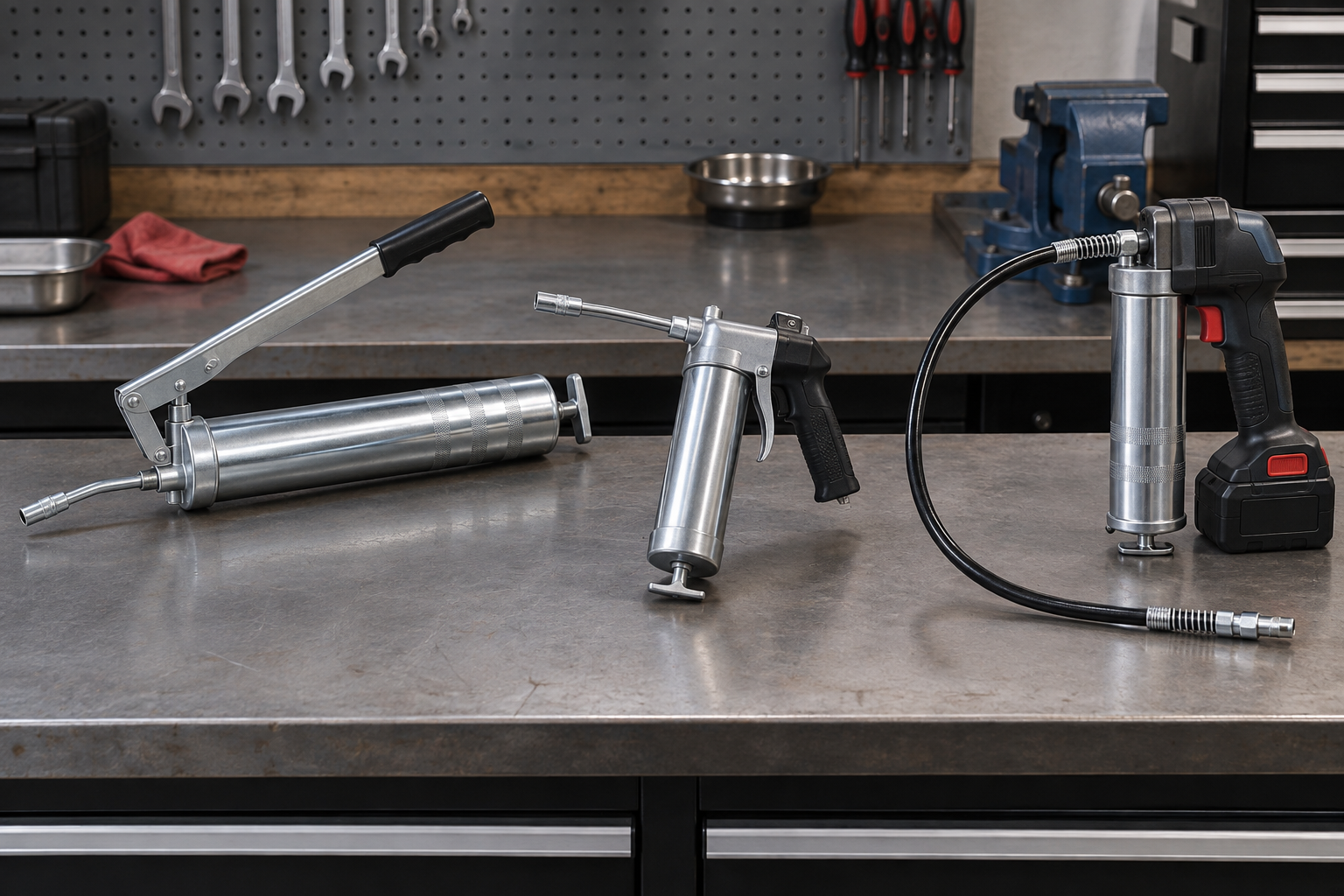
| 18V or 20V cordless gun | Daily fleet service, construction equipment, and shops already using that battery platform | Higher purchase cost and a larger battery to keep charged |
| 12V cordless gun | Light or occasional greasing where compact size matters | May be slower under sustained work; check runtime and output specs |
| Manual lever gun | A few fittings, roadside backup, or a tight budget | Slower, tiring over many fittings, and harder to control consistently |
| Pneumatic gun | A fixed shop with reliable compressed air | Requires an air hose and compressor access; less convenient away from the bay |
Choose around your battery platform
If your crew already owns compatible batteries and chargers, staying on that platform usually makes the most sense. It avoids another charger and spare-battery inventory, and a shared pack can be swapped in during a long service route. Verify compatibility carefully: batteries that look alike may not fit across voltage classes or tool generations. Some brands sell the grease gun as a bare tool, so compare the total cost of the tool, battery, and charger—not just the advertised tool price.
For shops choosing a platform from scratch, a common 18V/20V line can be a practical base because it also covers impacts, lights, and other cordless service tools. Compare pack availability and local replacement cost, not only the gun’s specs. A compact pack keeps the tool lighter, but a larger-capacity pack can reduce mid-shift swaps. For regular fleet work, consider a cordless grease gun bare tool if you already own batteries in the matching system.
Which gun suits the workload?
For a mechanic greasing multiple trucks or machines every day, prioritize a variable-speed trigger, a hose long enough to reach fittings safely, a vent or priming valve, and a useful way to carry the hose. A flexible hose around 30 inches is a common practical length, though crowded equipment may call for more reach. A shoulder strap helps when moving around a machine, but it does not replace stable footing or keeping the hose clear of moving parts.
For weekly maintenance on a small fleet, a midrange gun on the battery platform you already own is often enough. Paying extra for higher output may save time across many fittings, but it does little for an occasional job. If you grease only a few points each month, a quality manual lever gun remains a sensible, cheaper option. Browse manual lever grease guns if portability and low cost matter more than speed.
Pressure, fittings, and failure modes
Use the grease type and service interval specified by the equipment maker. Mixing incompatible greases can cause thickening or separation, while using the wrong lubricant may shorten bearing or joint life. Wipe the coupler and fitting before connecting them; grit pushed into a joint is a preventable source of wear.
If grease does not flow, stop and diagnose rather than holding the trigger against a blocked fitting. Check cartridge installation, prime the gun, inspect the hose for damage, and try a known-good fitting. A stuck or clogged zerk may need replacement. Never loosen a hose or fitting while the system is pressurized. Grease injection injuries can look like small punctures but require urgent medical care; keep hands away from the outlet and use cardboard—not a finger—to check for leaks.
Variable speed is useful because it helps control delivery and reduces the chance of over-greasing when the correct amount is small. More pressure is not automatically better: excess grease can damage seals or force contamination into a joint. A model with a pressure gauge can help diagnose resistance, but the gauge does not make an obstructed fitting safe to force.
A practical buying checklist
Before ordering, confirm the tool’s battery compatibility, cartridge size, bulk-fill method if needed, maximum pressure, stated output rate, hose length, and warranty. Check whether a battery and charger are included. If your shop rotates several greasing tools, labeling guns by grease type helps prevent cross-contamination. For a mixed-brand fleet, a complete kit may be more convenient than adding another battery ecosystem; compare cordless grease gun kits with battery and charger against the bare-tool price.
For most busy maintenance teams, the best buy is a cordless gun that matches the batteries already on hand, has enough hose reach, and can be primed easily. Spend more when daily volume makes the time savings meaningful. For occasional service, a manual gun—or a basic cordless model on an existing platform—can do the job without paying for capacity you will rarely use.
FAQ
Which gun suits the workload?
Related guides
- Longest Lasting Lawn Mower Battery: AGM vs Lithium vs Flooded Lifespan and Cost per Season
- Duralast Gold Lawn Mower Battery Review: U1 Fit, CCA and When to Pay for AGM
- Greenworks Pro 80V 21-Inch Mower Review: Runtime Math, Push vs Self-Propelled and Yard Fit
- Bosch High Pressure Washer Gun Replacement: Fittings, Adapters and What Fits Your Model