What's inside
As an Amazon Associate I earn from qualifying purchases. This post may contain affiliate links at no extra cost to you.
Pressure-treated deck boards are not difficult to cut, but they are hard on saws. The wood is often wet, heavy, abrasive, and slightly warped. A cordless saw needs enough power to maintain blade speed through dense sections without turning a simple cut into a battery-draining struggle. The best choice depends on whether you are making repeated crosscuts, trimming boards in place, or breaking down long boards before installation.
As an Amazon Associate we earn from qualifying purchases at no extra cost to you.


What to look for in a cordless saw
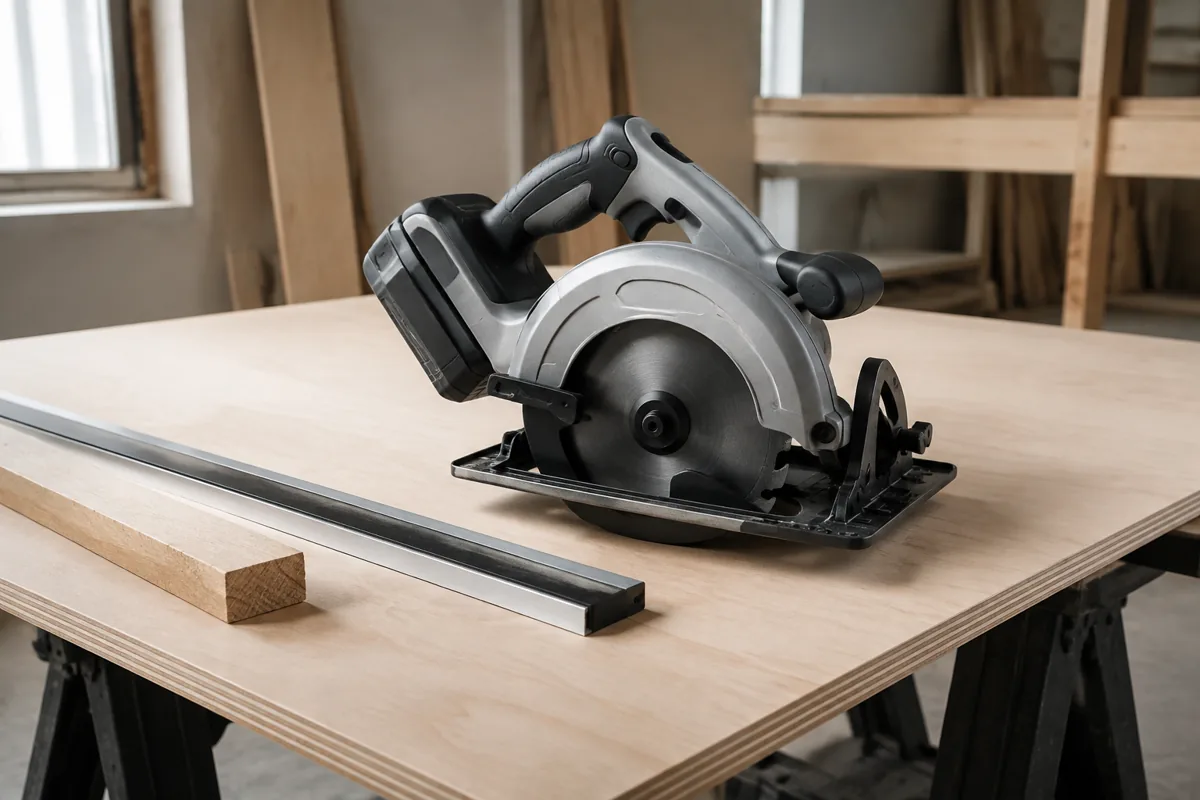
For most deck work, a 6-1/2-inch or 7-1/4-inch cordless circular saw is the main tool. A 6-1/2-inch saw can cut a standard 5/4 deck board in one pass, weighs less, and is easier to control from a ladder or kneeling position. A 7-1/4-inch saw is usually the better choice for framing lumber, doubled boards, stair parts, and occasional 2-by stock.
Brushless motors are worth paying for if you build more than one small deck or already own batteries in that platform. They run cooler, deliver better sustained power, and generally use battery capacity more efficiently than brushed saws. A brushed saw can still be a good buy for a one-time repair, particularly if it includes a battery and charger at a low price.
Look for a metal shoe, a smooth bevel adjustment, a positive 45-degree stop, and a blade guard that retracts without catching on rough lumber. A rafter hook is useful when working from joists. An electric brake is not essential, but it stops the blade quickly after the trigger is released.
The best cordless saw type for each job
| Saw type | Best use | Main advantage | Limitation |
|---|---|---|---|
| 6-1/2-inch circular saw | Crosscutting 5/4 deck boards and general framing | Light, compact, usually one-pass capacity | Less capacity for thick stock |
| 7-1/4-inch circular saw | Heavy construction and repeated cuts | More power and cutting depth | Heavier and more expensive |
| Reciprocating saw | Cutting out damaged boards, notches, and demolition | Handles awkward access and embedded fasteners | Slow, rough cuts; difficult to keep straight |
| Oscillating tool | Small notches, flush cuts, and detail work | Very controllable in tight spaces | Too slow for normal board cutting |
For a new deck, buy a circular saw first. A reciprocating saw earns its place when you need to remove old pressure-treated boards around screws, joist hangers, or posts. It is a poor replacement for a circular saw because its blade tends to wander and leaves a rougher edge.
Choosing a battery platform
Battery compatibility matters more than a small difference in saw specifications. A bare tool is only a bargain if you already own the correct batteries and charger. If you are starting from zero, compare the cost of a kit, a second battery, and a charger—not just the saw’s advertised price.
Compact 18-volt and 20-volt-class systems are sufficient for most deck boards. A 4.0Ah or 5.0Ah battery is a practical minimum for repeated cutting. A small 1.5Ah or 2.0Ah pack keeps the saw light, but it may run out after roughly 30 to 60 typical crosscuts depending on board thickness, blade sharpness, temperature, and how long the cuts take. A high-output 5.0Ah or 6.0Ah pack usually maintains cutting speed better in wet treated lumber.
Higher-voltage systems make sense for production work, thick timbers, or contractors who already use that platform. They are not automatically better for a homeowner cutting a few dozen boards. The larger batteries add weight and can cost more than the saw itself.
If you need a complete setup, compare brushless 6-1/2-inch cordless circular saw kits with the batteries you already own. For heavier framing, search brushless 7-1/4-inch cordless circular saw kits. Stay within one battery family when possible; a shared charger and interchangeable packs are worth more than a minor discount on a different brand.
Blade choice and cutting performance
The included blade may cut treated lumber, but a sharp carbide blade with around 24 teeth is usually the better production blade. It removes material quickly and is less likely to bog down than a fine-finish blade. Use a 40-tooth or higher blade when the visible edge needs to be cleaner, accepting slower cutting and increased battery use.
Pressure-treated lumber often contains grit and mineral deposits. That dulls blades quickly, especially when cutting old boards or material that has been dragged across soil. A dull blade produces several warning signs: the saw needs to be pushed harder, the cut starts burning, the motor pitch drops, or the blade exits with splintered edges. Stop and change the blade instead of forcing the saw. For a large deck, keeping a spare blade on hand is inexpensive insurance; consider carbide circular-saw blades for treated lumber.
Do not cut with the board unsupported at both ends. As the offcut drops, it can pinch the blade and kick the saw backward. Support long boards at least every 2 to 3 feet, keep the kerf open, and let the saw reach full speed before entering the wood. A guide rail or straightedge improves accuracy, but a properly marked line and a stable stance are enough for ordinary crosscuts.
Pressure-treated lumber safety
Wear safety glasses and hearing protection, and use a dust mask or respirator rated for nuisance dust when making many cuts. Do not burn scraps, and do not use treated-lumber offcuts for cooking or indoor firewood. Collect sawdust rather than blowing it around the work area.
Keep both hands on the saw when practical, with the battery clear of the cut line and the blade fully stopped before setting the tool down. Inspect boards for hidden screws and nails, particularly during repairs. A reciprocating saw with a demolition blade is safer than a circular saw when fasteners cannot be located, but expect a rough cut and slower progress.
Which one should you buy?
For most homeowners, a brushless 6-1/2-inch circular saw on an established 18-volt or 20-volt platform is the best balance of weight, price, and capability. Choose the 7-1/4-inch version if you regularly cut 2-by lumber, want maximum depth, or are building more than one deck. A cheaper brushed kit is fine for a short repair if its battery, charger, and warranty cost less than entering a new ecosystem.
Add a reciprocating saw only for demolition and awkward cuts. Spend the remaining budget on a sharp spare blade, a second 4.0Ah-or-larger battery, and a stable work support. Those accessories usually improve the job more than paying extra for a slightly faster saw.
FAQ
Which one should you buy?
Related guides
- Longest Lasting Lawn Mower Battery: AGM vs Lithium vs Flooded Lifespan and Cost per Season
- Duralast Gold Lawn Mower Battery Review: U1 Fit, CCA and When to Pay for AGM
- Greenworks Pro 80V 21-Inch Mower Review: Runtime Math, Push vs Self-Propelled and Yard Fit
- Bosch High Pressure Washer Gun Replacement: Fittings, Adapters and What Fits Your Model