Our Top Picks
 DEWALT 20V MAX XR Brushless Cordless 7-1/4 in.STANDARD15.35 x 9.4 x 9.6 inches9.88 PoundsCheck on Amazon


What's inside
- 1. Brushless Hammer Drill and Driver Kit: The Only Non-Negotiable
- 2. Impact Driver: The Tool That Saves Your Wrists
- 3. Reciprocating Saw: The Demolition Unlock
- 4. Oscillating Multi-Tool: The Problem Solver
- 5. Cordless Circular Saw: When You Start Building Back
- What to Skip
- Best Cordless Tools For Home Renovation: FAQ
- Where to Start This Weekend
- Related Guides
- 1. Brushless Hammer Drill and Driver Kit: The Only Non-Negotiable
- 2. Impact Driver: The Tool That Saves Your Wrists
- 3. Reciprocating Saw: The Demolition Unlock
- 4. Oscillating Multi-Tool: The Problem Solver
- 5. Cordless Circular Saw: When You Start Building Back
- What to Skip
- Best Cordless Tools For Home Renovation: FAQ
- Where to Start This Weekend
- Related Guides
As an Amazon Associate I earn from qualifying purchases. This post may contain affiliate links at no extra cost to you.
Most renovation tool lists are really price lists. They put the cheapest thing first and the most expensive thing last, which tells you nothing about what to buy on a Saturday morning when the drywall is already off the wall. The better question is which tool unlocks the next stage of the job. Buy in that order and every purchase pays for itself before the next one arrives.
This is a ranked list of the best cordless tools for home renovation, ordered by what to buy first. Rankings assume a single battery platform, because mixing platforms is the most expensive mistake in DIY. Pick one system, buy bare tools after the first kit, and your cost per tool drops sharply. The platform matters less than the commitment: DeWalt 20V MAX XR, Milwaukee M18 FUEL, Makita 18V LXT, and Ryobi ONE+ HP all cover renovation work. Ryobi trades some power and durability for a much lower entry cost, and the pro platforms trade cost for runtime and service networks.
| Rank | Tool | Job it unlocks | Buy it when |
|---|---|---|---|
| 1 | Brushless hammer drill/driver kit | Anchors into masonry, joist boring, general assembly | First purchase, always |
| 2 | Impact driver | Deck screws, ledger boards, lag bolts, subfloor | Same kit if possible |
| 3 | Reciprocating saw | Demolition, stud removal, pipe and nail cutting | Before you open a wall |
| 4 | Oscillating multi-tool | Flush cuts, door casing trim, grout, plunge cuts in place | Trim and flooring stage |
| 5 | Circular saw (6-1/2 in or 7-1/4 in) | Sheet goods, subfloor, stud stock | Framing or flooring stage |
| 6 | Compact router or brad nailer | Trim installation and finish carpentry | Final stage only |
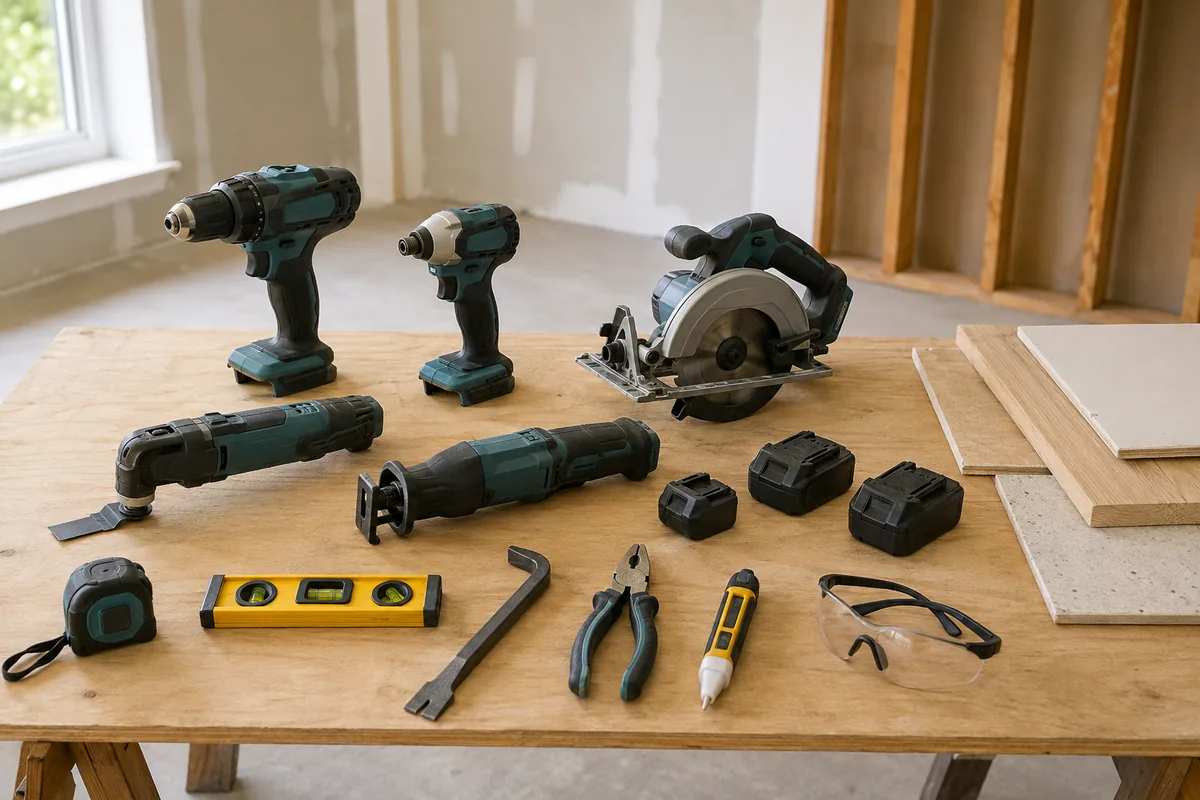
1. Brushless Hammer Drill and Driver Kit: The Only Non-Negotiable
Everything downstream depends on this. Layout, anchoring a ledger, mounting a cabinet rail, boring joists for electrical runs, driving concrete screws into a basement wall. A two-tool combo kit with a hammer drill and an impact driver is the correct first purchase in almost every case, because it is cheaper than the two tools bought separately and it comes with the batteries you will use for the next five years.
Insist on brushless. On a renovation, the difference is not marketing. Brushless motors hold torque under load, run cooler through long driving sessions, and pull noticeably less battery per hole. The hammer function matters if your house has any masonry, brick, or a concrete slab, and most American homes older than 1980 have at least one of the three.
What to look for: a metal chuck rather than plastic, a belt hook, an all-metal gear case, and at least one 4.0 Ah or 5.0 Ah battery in the kit. Two compact 2.0 Ah batteries look generous on the box but will leave you charging in the middle of a job.
Brushless Cordless Hammer Drill and Impact Driver Combo Kit
Spend your largest single tool budget here, because the batteries and charger in this kit set your platform for years. A mid-tier combo from a major brand with at least one higher-capacity battery beats a five-tool bargain kit with five small batteries every time. Ignore accessory bit sets bundled in as filler; they wear out fast and better bits are cheap.
2. Impact Driver: The Tool That Saves Your Wrists
If your combo kit did not include one, buy it next as a bare tool. A drill can drive screws, but it fights you. An impact driver uses rotational hammering to sink long fasteners without cam-out, without stripping heads, and without twisting your arm when the bit catches. Subfloor screws, ledger boards, deck framing, structural screws, and lag bolts all move from miserable to routine.
Practical note: buy impact-rated bits. Standard bits shatter under impact and the fragments travel. A cheap set of impact-rated Phillips, square drive, and Torx bits plus a socket adapter turns one tool into three.
3. Reciprocating Saw: The Demolition Unlock
This is where the ranking diverges from most lists. A recip saw ranks above a circular saw for renovation specifically, because renovation starts with removal. Cutting out studs, notching a wall for a new opening, cutting galvanized pipe, slicing through nail-embedded lumber, taking out old cabinets, trimming roots and branches outside. Cordless models genuinely replaced corded ones here, since demolition cuts are short bursts rather than continuous runs.
Look for tool-free blade changes, an orbital setting if available, and a shoe that pivots. Then spend real money on blades. Blade selection matters more than saw brand: a demolition blade with 8 to 10 TPI and thick stock for nail-embedded wood, a bimetal 14 to 18 TPI for metal and pipe, and a longer 9 to 12 inch blade for reaching between studs. Buying a premium saw with bargain blades is backwards.
- ✔ Cuts material in place, no disassembly required
- ✔ Handles wood, nail-embedded lumber, pipe, and conduit with a blade swap
- ✔ Compact cordless models fit between studs and inside cabinet boxes
- ✔ Cheap to run once you buy the right blades
- ✘ Rough, uncontrolled cuts; never a finish tool
- ✘ Aggressive vibration is fatiguing over long sessions
- ✘ Easy to cut through something you did not intend, including wiring
- ✘ Blade cost adds up on heavy demo
4. Oscillating Multi-Tool: The Problem Solver
Ranked fourth because it earns its place only once you hit trim, flooring, and repair work, and then it becomes indispensable. Undercutting door casing so new flooring slides beneath it. Flush-cutting a nail or a protruding screw. Plunge-cutting a rectangle in drywall for an outlet box. Removing old grout or caulk. Trimming a sliver off a stubborn jamb.
The critical spec is the blade attachment. Universal or OIS-style interfaces let you buy affordable third-party blades in bulk, which you will, because oscillating blades dull quickly. A proprietary quick-change system is convenient but locks you into expensive replacements. Variable speed and a tool-free blade clamp are both worth having; brushless is nice but less transformative here than on a drill.
5. Cordless Circular Saw: When You Start Building Back
A circular saw ranks fifth, not because it is unimportant, but because plenty of renovations get to demolition and repair before anyone needs to break down a sheet of plywood. Once you are installing subfloor, sheathing, or framing a new wall, it moves to the front of the bench.
Two decisions matter. First, blade size: 6-1/2 inch cordless saws are lighter and more battery-efficient and will cut through 2x material at 90 degrees, while 7-1/4 inch models give full depth for beveled cuts through 2x and handle thicker stock. Second, rear-handle versus sidewinder: rear-handle saws feel like the corded worm-drive saws many people learned on and rip sheet goods more comfortably, at a weight penalty. For most homeowners, a 6-1/2 inch brushless sidewinder plus a good 40-tooth blade and a straightedge covers the work.
Brushless Cordless Circular Saw (Bare Tool)
Once you own a platform, buy this as a bare tool and skip the redundant charger. Pair it with a high-capacity battery, because circular saws pull more current than any other tool on this list and a compact pack will sag under a long rip. Replace the stock blade before your first real cut; the included blade is almost always the weakest part of the saw.
What to Skip
Blunt version, because this is where money leaks out of a renovation budget.
Skip the eight-piece bargain combo kit. You get a flashlight, a radio, and two undersized batteries alongside three tools you will replace within a year. The batteries are the real product and they are the weakest part of the bundle.
Skip a second battery platform. Buying one Milwaukee tool because it was on sale while you own DeWalt batteries means a second charger, a second set of packs, and a permanently split kit. Stay on one system unless you have a genuinely specialized need.
Skip the cordless angle grinder early on. It is a fantastic tool with a narrow renovation use case, and it drains batteries faster than anything else you will own. Rent or buy later.
Skip the cordless jigsaw as a priority buy. Between a recip saw and an oscillating tool, most renovation curves and cutouts are already covered. A jigsaw is a comfort purchase, not an unlock.
Skip brushed tools if the price gap is small. When brushless costs 15 to 25 percent more, take it. When it doubles the price on a tool you will use twice a year, the brushed version is defensible.
Skip stacking batteries you cannot use. Two mid-size packs and one high-capacity pack cover almost any weekend. A shelf of compact batteries is not a runtime strategy.
Best Cordless Tools For Home Renovation: FAQ
How many batteries do I actually need? Three is the practical answer for a whole-house project: two mid-capacity packs in rotation and one high-capacity pack for the circular saw and recip saw. Two is workable for weekend jobs if you have a fast charger. The failure mode is not total capacity, it is having every pack empty at once.
Is cordless powerful enough to replace corded tools for renovation? For drilling, driving, demolition, and cutting sheet goods, yes, and it has been for several years now. The remaining corded holdouts are tools that run continuously under heavy load, like a large table saw, a big miter saw doing all-day trim production, or a dust extractor. For everything you carry room to room, cordless wins on convenience by a wide margin.
Should I buy a kit or bare tools? Buy exactly one kit, the drill and impact combo, because you need its batteries and charger. After that, buy bare tools. Bare-tool pricing is typically a large discount over kitted versions, and you avoid a drawer full of duplicate chargers. The exception is a holiday promotion where a kit with a free extra battery costs less than the bare tool plus that battery separately, which does happen.
Where to Start This Weekend
If you own nothing, buy the brushless hammer drill and impact driver combo, add a recip saw with good blades, and start the demolition you have been putting off. If you already own a drill, the recip saw is your next purchase and it will change what feels possible in your house. The oscillating tool and circular saw follow naturally as the project moves from tearing out to building back.
Check prices on Amazon →