What's inside
As an Amazon Associate I earn from qualifying purchases. This post may contain affiliate links at no extra cost to you.
The best shop vacuum for most woodworking shops is the Makita VC4210L, while the Festool CT 26 is the best quieter premium dust extractor, the Bosch VAC090AH is the strongest value for tool hookups, and the DeWalt DXV16P is the best high-capacity garage vacuum. The right choice depends less on peak horsepower than on airflow, sealed suction, filtration, hose size, noise, and how often you will empty the tank.
As an Amazon Associate we earn from qualifying purchases at no extra cost to you.


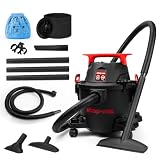
Best shop vacuums at a glance
| Rank and model | Airflow | Sealed suction | Tank | Noise | Best for |
|---|---|---|---|---|---|
| 1. Makita VC4210L | 148 CFM | 92 in. water lift | 11 gal | 60 dB | Frequent woodworking and large power tools |
| 2. Festool CT 26 | 137 CFM | 97 in. water lift | 6.9 gal | 62 dB | Quiet, portable premium extraction |
| 3. Bosch VAC090AH | 150 CFM | 97 in. water lift | 9 gal | Approximately 76 dBA | Value and automatic tool activation |
| 4. DeWalt DXV16P | 116 CFM | Approximately 66 in. water lift | 16 gal | Approximately 76 dBA | Garage cleanup and high-volume debris |
| 5. Fein Turbo I | 151 CFM | Approximately 98 in. water lift | 6 gal | Approximately 66 dBA | Compact professional dust extraction |
Manufacturers measure airflow and water lift under different conditions, so these figures are useful for comparison rather than laboratory-equivalent rankings. CFM describes the volume of air moved; sealed suction, usually listed as water lift, describes how strongly the motor pulls against resistance. For a sander or saw connected through a hose, both numbers matter.
Our picks by shop situation
Best overall: Makita VC4210L
The VC4210L combines high airflow, strong suction, an 11-gallon container, and relatively low noise. Its L-class filtration and automatic filter-cleaning system make it well suited to repeated use with routers, track saws, sanders, and portable table saws. It is larger than a small jobsite vacuum, but the capacity reduces interruptions when several tools are used in one session.
Choose it if woodworking is a regular activity and you want one extractor for both fine dust and ordinary shop debris. It is less attractive when storage space is tight or the vacuum must be carried up stairs frequently.
Best premium quiet extractor: Festool CT 26
The Festool CT 26 is a refined choice for a small professional or serious hobby shop. Its 137 CFM and 97-inch water lift provide strong performance through a 27 mm or 36 mm hose, while the compact 6.9-gallon design is easier to position beside a workbench. Festool’s tool-trigger system, variable suction control, and integrated hose storage are especially convenient for sanding and track-saw work.
The trade-off is ownership cost. Replacement bags, filters, and accessories are generally more expensive than universal shop-vac consumables. It earns its price when low noise, compact storage, and a polished hose-and-tool ecosystem matter more than maximum tank volume.
Best value for power-tool connections: Bosch VAC090AH
The Bosch VAC090AH delivers approximately 150 CFM and 97 inches of water lift, with a nine-gallon tank and automatic power-tool activation. It is a strong match for a router, miter saw, circular saw, or sander when you want the vacuum to start as the tool starts. Its included adapters and flexible suction control reduce setup friction.
This vacuum is louder than the quietest premium extractors, and its automatic filter cleaning can be noticeable in a small room. For a mixed-use garage where price and tool compatibility matter most, that is often a reasonable compromise.
Best large garage vacuum: DeWalt DXV16P
The DXV16P’s 16-gallon tank is the practical choice for garage floors, vehicles, renovation debris, and occasional woodworking. Its large capacity means fewer emptying trips, and it handles chips, offcuts, and wet cleanup better than a compact dust extractor.
It is not the best dedicated fine-dust extractor in this group. Its lower water-lift figure and large, commonly supplied hose favor general cleanup rather than maintaining maximum suction through narrow tool ports. Use a suitable fine-dust filter and bag when collecting wood dust.
Best compact high-performance option: Fein Turbo I
The Fein Turbo I pairs high airflow and water lift with a six-gallon footprint. It is useful where floor space is limited but the vacuum still needs to support sanders and saws. Fein’s vacuums are known for robust construction and straightforward professional use.
The smaller tank fills quickly during general cleanup, so it makes more sense for tool extraction than for clearing a whole garage. Check the included hose diameter and adapter set before buying; the connection system is part of the value.
How much CFM and suction do woodworking tools need?
| Application | Useful target | Recommended hose | Why |
|---|---|---|---|
| Random-orbit sander | 90–130 CFM; strong water lift | 1 to 1-1/4 in. | Fine dust needs steady suction through a small port |
| Router or track saw | 120–150 CFM | 1-1/4 to 1-1/2 in. | Chips and fine dust require a balance of speed and volume |
| Miter saw | 120 CFM or more | 1-1/2 to 2-1/2 in. | Large open shrouds leak air and need more volume |
| Portable table saw | 120–150 CFM | 2-1/2 in. | The larger port carries heavier chips efficiently |
| Floor and garage cleanup | 100–150 CFM | 1-1/4 to 2-1/2 in. | Capacity and durability often matter more than peak suction |
A larger hose is not automatically better. A 2-1/2-inch hose can move more debris, but it may not seal well to a sander and can be awkward near a handheld tool. Conversely, a very narrow hose creates resistance and loses airflow over long runs. For most portable woodworking tools, a flexible 1-1/4-inch or 1-1/2-inch hose is the useful middle ground.
Decision matrix: which shop vacuum fits your situation?
- Budget under roughly $250: choose a durable 12- to 16-gallon general-purpose vacuum, then add a quality fine-dust filter, collection bag, and tool adapter.
- Frequent sanding or cabinetmaking: prioritize filtration, sealed suction, automatic filter cleaning, and a 1-1/4-inch or 1-1/2-inch antistatic hose over a huge tank.
- Small shop or shared workspace: choose the Festool CT 26 or Fein Turbo I, where compact dimensions and lower noise are valuable.
- One vacuum for woodworking and vehicles: choose the DeWalt DXV16P or another 12- to 16-gallon model with wet/dry capability.
- Occasional hobby use: a mid-size general-purpose vacuum is adequate; spend the savings on proper filtration and a better-fitting hose.
- Professional daily use: choose a dust extractor with automatic tool switching, durable casters, replaceable bags, and readily available filters.
Setup details that determine real-world performance
Connect the shortest practical hose, remove unnecessary reducers, and seal loose joints with compatible rubber adapters. A vacuum rated at 150 CFM can perform poorly if a 1-1/4-inch hose is kinked, the tool port is partly blocked, or the filter is loaded with dust.
For a simple sizing example, suppose a sander produces 0.5 gallons of dust per hour and a 9-gallon vacuum’s usable bag capacity is approximately 6 gallons after allowing space for the filter and airflow. The theoretical interval is 6 ÷ 0.5 = 12 hours of sanding. In practice, expect less because bags compact unevenly and filters restrict airflow as they load. This is why filter condition is more important than tank size for fine dust.
Ownership realities: what wears out first?
- Filters: fine wood dust clogs pleated filters quickly. Clean them according to the manual; striking or washing a filter that is not washable can damage it.
- Bags: disposable bags preserve airflow and simplify disposal, but they add recurring cost. Do not wait until a bag is completely packed before replacing it.
- Hoses: dragging a vacuum by its hose causes cracks at the cuffs. Store the hose in a wide loop rather than a sharp bend.
- Casters and latches: these often suffer more abuse than the motor. Avoid pulling the vacuum over cords, thresholds, and piles of debris.
- Wet/dry conversion: remove the paper collection bag before wet pickup and reinstall the correct filter afterward. Never assume a dry-dust filter is suitable for liquid.
For woodworking, the best shop vacuum is the one that maintains airflow at the tool, not the one with the largest horsepower label. Match the hose to the tool, use a genuine fine-dust filter or a compatible high-efficiency replacement, and select tank capacity based on how much cleanup you actually perform. For most dedicated shops, the Makita VC4210L is the most balanced choice; for a quiet compact setup, choose the Festool CT 26; and for broad garage duty, choose the DeWalt DXV16P.