What's inside
- Top 3 Picks
- Quick Comparison
- How We Chose
- 1. Camco TastePURE 2-Pack – Best for Most RVers
- 2. GLACIER FRESH RV/Marine 2-Pack – Best Budget Inline Pick
- 3. Hourleey 2-Pack with 2 Hose Protectors – Best for Maximum Hardware Per Dollar
- 4. GLACIER FRESH GFRVWP03 3-Stage System – Best Premium Canister System
- 5. RVGUARD Inline 4-Pack – Best for Stocking a Full Season
- 6. Stokk 2-Pack with Hose Protector, NSF Certified – Best Budget Pick With Certification
- 7. AQUA CREST RV Inline Water Filter – Best for Dual Home and Road Use
- 8. Hourleey 4-Pack with 2 Hose Protectors – Best Bulk Value
- 9. Camco TastePURE 20-Micron Wide-Body Inline – Best for Higher Flow and Longer Life
- 10. Camco TastePURE XL with Hose Protector – Best Middle Ground
- 11. OKBA External Dual Water Filter System – Best for Heavy Water Use
- 12. lifeegrn Inline Water Filter with Hose Protector – Best Cheapest Single Filter
As an Amazon Associate I earn from qualifying purchases. This post may contain affiliate links at no extra cost to you.
The best water filter for most RVers is an inline GAC/KDF cartridge — the Camco TastePURE two-pack is the practical default — because it threads straight onto a standard 3/4-inch garden hose fitting, needs no mounting hardware or tools, and costs little enough that replacing it once a season is a routine purchase rather than a decision. It suits weekend campers, travel trailer owners, and anyone filling a fresh tank from a spigot they don’t fully trust. If you want a lower upfront cost per cartridge, the GLACIER FRESH two-pack and the Stokk NSF-certified pair are the budget standouts. If you’re a full-timer or you’re dealing with genuinely poor source water, step up to a canister system like the GLACIER FRESH GFRVWP03 three-stage or the OKBA dual-canister, both of which use replaceable cartridges and hold far more media. And if your goal is removing dissolved solids rather than just chlorine and sediment, nothing on this page does that — reverse osmosis is a different category, covered in the How to Choose section below.
Our Top Picks
 Camco Tastepure RV Water Filter 2-pk2 Count (Pack of 1)3 x 3.88 x 12.19 Inches1.85 poundsCheck on Amazon
 GLACIER FRESH RV/Marine Water Filter with 1 FlexibleRV 2 Count3 x 0.5 x 1.2 inches1.76 poundsCheck on Amazon
 GLACIER FRESH GFRVWP03 3-Stage RV Water Filtration System3-Stage System1 x 1 x 1 inchesCheck on Amazon
 Stokk RV Water Filter with Flexible Hose Protector2 Pack6.3 x 2.2 x 10.5 inches1.7 PoundsCheck on Amazon


Top 3 Picks
Best overall: Camco TastePURE 2-Pack. The safest universal recommendation. GAC and KDF media in a 20-micron inline body, 3/4-inch garden hose threads on both ends, made in the USA, and sold as a pair so you always have a spare. It fits every RV city water inlet and fresh tank filler without an adapter, which is the single most common compatibility problem with inline filters.
Best budget: GLACIER FRESH RV/Marine 2-Pack with hose protector. Nearly the same job for less money, and it includes a flexible hose protector — a small spring-like strain relief that stops the weight of the hose from kinking the filter body at the fitting. That protector matters more than most buyers expect, because a filter hanging unsupported off a spigot is the most common failure point in the whole setup.
Best premium: GLACIER FRESH GFRVWP03 3-Stage RV Water Filtration System. A mounted, multi-stage canister system with replaceable cartridges rather than a disposable inline tube. More contact time, better sediment handling, and a far lower cost per gallon over a long season. This is the pick for full-timers, seasonal-site owners, and anyone whose water source is a private well rather than treated municipal supply.
Quick Comparison
| Product | Best for | Type | Key specs | Price tier |
|---|---|---|---|---|
| Camco TastePURE 2-Pack (GAC & KDF) | Most RVers; universal fit | Inline | 20-micron class; GAC + KDF; 3/4 in. GHT; 2-pack; made in USA | Mid-range |
| GLACIER FRESH RV/Marine 2-Pack | Budget buyers who want a hose protector included | Inline | 20-micron class; GAC + KDF; 3/4 in. GHT; 2 filters + 1 protector | Budget |
| Hourleey 2-Pack with 2 hose protectors | Lowest cost per filter with two protectors | Inline | 20-micron class; GAC + KDF; claims fluoride reduction; 2 filters + 2 protectors | Budget |
| GLACIER FRESH GFRVWP03 3-Stage System | Full-timers and poor source water | Canister (mounted) | 3 stages; sediment + carbon stages; replaceable cartridges; hose-thread in/out | Premium |
| RVGUARD Inline 4-Pack | Stocking a whole season at once | Inline | 20-micron class; GAC + KDF; 3/4 in. GHT; 4-pack | Mid-range |
| Stokk 2-Pack with hose protector | Buyers who want third-party certification | Inline | NSF-certified claim; 20-micron class; 2 filters + 1 protector | Budget |
| AQUA CREST Inline (garden hose & camper) | Dual use at home and on the road | Inline | 20-micron class; GAC; 3/4 in. GHT; single or multi-pack | Mid-range |
| Hourleey 4-Pack with 2 protectors | Cost per filter at volume | Inline | 20-micron class; GAC + KDF; 4 filters + 2 protectors | Premium |
| Camco TastePURE 20-Micron Wide-Body | Higher flow and longer service life | Inline (wide body) | 20-micron nominal; GAC + KDF; oversized body; more media volume | Premium |
| Camco TastePURE XL with hose protector | Longer trips without a mid-season change | Inline (extended body) | 20-micron class; GAC + KDF; XL body; protector included | Mid-range |
| OKBA External Dual Water Filter System | Full-timers, wells, heavy water use | Canister (dual, mounted) | Two-stage external; replaceable cartridges; high capacity; hose-thread connections | Premium |
| lifeegrn Inline with hose protector | Cheapest single-season spare | Inline | 20-micron class; GAC; 3/4 in. GHT; protector included | Budget |
How We Chose
This roundup is built from published product specifications and established category engineering, not from bench work or field trials. The criteria were deliberately narrow, because RV water filtration is a compatibility problem before it is a purification problem. First, hookup: a filter that doesn’t thread onto a 3/4-inch garden hose fitting without an adapter is a filter that will leak, so fitting standard and included hardware carried heavy weight. Second, media and rating: what the cartridge actually contains (GAC, KDF, carbon block, sediment stages) and what nominal micron class it filters to, because “removes chlorine” and “removes sediment” are different jobs. Third, service life and consumable cost: a disposable inline cartridge and a replaceable canister cartridge have very different economics over a two-year horizon. Fourth, category fit: whether the product is genuinely the best expression of its type — inline, canister, or bulk-pack value — rather than a compromised middle. Fifth, upgrade path: how the product behaves if your usage changes from weekend trips to full-time, since the right answer at 20 nights a year is not the right answer at 200. Products were only included if they’re currently listed and match their stated type. We have not tested, benchmarked, or owned any of these items.
1. Camco TastePURE 2-Pack – Best for Most RVers
As an Amazon Associate we earn from qualifying purchases at no extra cost to you.
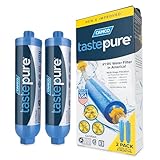
This is the cartridge most RVers should buy first. The Camco TastePURE two-pack is the reference point for inline RV filtration: a GAC and KDF cartridge that screws onto standard 3/4-inch garden hose threads, hangs between the campground spigot and your city water inlet, and costs little enough per unit that replacing it once a season is a routine purchase rather than a decision. It suits weekend campers, travel trailer and fifth-wheel owners, and anyone filling a fresh tank from a spigot whose history they don’t know.
Key specs at a glance
| Spec | Detail |
|---|---|
| Type | Inline, hose-threaded cartridge |
| Media | Granular activated carbon (GAC) plus KDF |
| Nominal rating | 20-micron class |
| Connection | 3/4 in. GHT, no adapter required |
| Typical flow | 2-3 GPM at 40-60 PSI supply |
| Pack size | 2 cartridges |
| Service life | Roughly one camping season of normal use |
| Origin | Made in the USA |
The two media do different jobs, and knowing which is which tells you what you’re actually buying. Granular activated carbon adsorbs chlorine, taste and odor compounds, and a range of organics — it’s the reason campground water stops smelling like a swimming pool. KDF is a copper-zinc alloy that removes chlorine and some dissolved metals through an electrochemical reaction, and it also helps suppress bacterial growth inside the cartridge between trips. Neither is a sterilizer. Neither removes dissolved solids, and neither will make biologically unsafe water safe. A 20-micron nominal rating means the cartridge captures the sediment, rust, and grit that would otherwise end up in your faucet aerators and water heater anode.
The practical strength here is fit. Garden hose thread is the lingua franca of RV water systems — city water inlets, fresh tank fillers, spigots, Y-splitters, and pressure regulators all speak it. That means no adapters, no thread tape, no plumber’s tape workaround, and no leaking joint at the most inconvenient possible moment. Two cartridges in the pack means one goes in the bay as a spare, which matters because inline cartridges tend to fail at the worst time: mid-trip, on a long weekend, with no cell signal and no hardware store for forty miles.
Pros
- Universal 3/4-inch garden hose thread fits every standard RV inlet without an adapter
- GAC and KDF together handle chlorine, taste, odor, sediment, and some dissolved metals
- Two-pack pricing works out to a low cost per cartridge
- Made in the USA, with a well-established replacement supply chain
- No mounting, no tools, no separate housing to winterize
Cons
- No flexible hose protector included — buy one separately or support the hose
- Disposable: the whole body goes in the trash at the end of its life
- 20-micron nominal class won’t address fine turbidity or dissolved solids
- Service life is short compared with a canister system’s replaceable cartridges
- Can be a restriction point if your supply pressure is already marginal
How it compares with the nearest alternative. The Camco TastePURE XL is the direct sibling: same media and same threads, but a longer body holding more carbon, which extends service life and reduces flow restriction slightly. If you take two or three long trips a season rather than a dozen weekends, the XL is the better single purchase. Against the budget GLACIER FRESH and Stokk pairs, the Camco costs more per cartridge but includes the KDF media stage and the made-in-USA supply chain. Against a canister system like the GLACIER FRESH GFRVWP03, this is a disposable product with a seasonal lifespan; the canister wins decisively on cost per gallon if you camp more than about six weeks a year.
2. GLACIER FRESH RV/Marine 2-Pack – Best Budget Inline Pick

The GLACIER FRESH RV/Marine two-pack is the value play: two inline cartridges plus one flexible hose protector, at a price point that makes the “replace it early” strategy genuinely painless. It suits first-time RV owners, renters, and anyone running a small trailer or pop-up where a single filter serves one faucet and a shower. If you’re not sure whether inline filtration is worth bothering with, this is the cheapest way to find out.
Key specs at a glance
| Spec | Detail |
|---|---|
| Type | Inline, hose-threaded cartridge |
| Media | GAC plus KDF class |
| Nominal rating | 20-micron class |
| Connection | 3/4 in. GHT both ends |
| Typical flow | 2-3 GPM at normal campground pressure |
| Pack size | 2 cartridges, 1 flexible hose protector |
| Service life | About one season, or sooner in heavy sediment |
| Application | RV and marine |
The included hose protector is the detail worth paying attention to. It’s a coiled strain-relief sleeve that slides over the hose end and prevents the hose’s weight from pulling the filter sideways at the fitting. Inline filters fail most often at that exact joint — not because the media wears out, but because a stiff hose hanging off a rigid plastic body puts a permanent bending load on the threaded connection. A two-dollar piece of coiled plastic prevents a mid-trip leak. On a budget filter, that inclusion is more useful than an extra micron of filtration.
Performance expectations should be realistic. This is a sediment-and-chlorine cartridge. It will noticeably improve the taste and smell of treated municipal water, catch rust flakes and grit from older park plumbing, and protect your faucet screens. It will not remove dissolved solids, and it will not help much with sulfur, iron, or the mineral-heavy taste of some well water. Flow is adequate for a single RV fixture at a time; running a shower and kitchen faucet simultaneously on a low-pressure supply will feel the restriction.
Pros
- Lowest-cost way to add inline filtration to a small RV
- Hose protector included, addressing the most common failure point
- Standard garden hose thread on both ends — no adapters
- Two cartridges means an immediate spare
- Small and light enough to store in a bay without a thought
Cons
- No independent certification claim on the listing
- Short service life; heavy sediment will shorten it further
- Disposable body — no replaceable cartridge option
- Not a solution for wells, sulfur, or high-iron water
- Restriction becomes noticeable on already-low supply pressure
How it compares with the nearest alternative. The closest competitor is the Stokk two-pack with hose protector, which makes an NSF certification claim — that’s the one thing this filter lacks, and if third-party certification matters to you, Stokk is the upgrade at the same tier. Against the Camco TastePURE two-pack, this one is cheaper per cartridge and includes the protector, but gives up the made-in-USA supply chain and the KDF media stage. If you camp four or five weekends a year, the difference is marginal; if you’re on the road for months, the Camco or a canister system is the better economics.
3. Hourleey 2-Pack with 2 Hose Protectors – Best for Maximum Hardware Per Dollar

Hourleey’s two-pack is aimed squarely at buyers who want the accessories bundled rather than bought separately: two inline cartridges and two flexible hose protectors in one box. It suits the RVer who runs a Y-splitter at the spigot — one leg to the RV, one to an outdoor shower or a black tank flush — because two protectors means both hose runs get strain relief. It’s also a sensible first purchase for a new trailer where the previous owner left nothing behind.
Key specs at a glance
| Spec | Detail |
|---|---|
| Type | Inline, hose-threaded cartridge |
| Media | GAC plus KDF class |
| Nominal rating | 20-micron class |
| Connection | 3/4 in. GHT both ends |
| Pack size | 2 cartridges, 2 flexible hose protectors |
| Listed reductions | Bad taste, odors, rust, and a fluoride reduction claim |
| Service life | About one season of typical use |
On the fluoride claim, set expectations honestly. Granular activated carbon and KDF are excellent at chlorine, taste, odor, and sediment, but fluoride is a small, highly soluble ion that standard carbon media does not bind efficiently. Meaningful fluoride reduction generally requires activated alumina media or a reverse osmosis membrane. The listing’s fluoride language should be read as a secondary marketing benefit rather than a performance guarantee. If fluoride removal is your actual goal, an inline cartridge is the wrong category and you should be looking at RO — see the How to Choose section.
What this filter does do well is the ordinary job. It catches rust — the visible orange flakes that come out of older campground plumbing and get stuck in aerators — and it strips the chlorine taste that makes park water unpleasant to drink straight. Two protectors in the box is genuinely useful for the dual-hose setup, and it means you’re not buying a five-dollar accessory separately later.
Pros
- Two hose protectors included, not one — useful for split hose runs
- Standard garden hose thread, no adapters
- Addresses taste, odor, rust, and chlorine at a budget price
- Lightweight and easy to store as a spare pair
- Good fit for trailers with an outdoor shower or tank-flush line
Cons
- Fluoride reduction claim is not realistic for GAC/KDF media — treat it as secondary
- No certification claim on the listing
- Short service life relative to canister cartridges
- Not appropriate for well water with sulfur or iron
- Disposable body with no cartridge replacement option
How it compares with the nearest alternative. The direct sibling is the Hourleey four-pack with two protectors, which trades a higher upfront cost for a much lower cost per filter — the right call if you know you’ll burn through four cartridges in a season. Against the GLACIER FRESH two-pack, this one gives you an extra protector and a broader stated reduction list; the GLACIER FRESH gives you the same core media with a simpler claim set. Against the Camco TastePURE, both Hourleey packs give up the made-in-USA supply chain in exchange for the bundled hardware.
4. GLACIER FRESH GFRVWP03 3-Stage System – Best Premium Canister System

This is where RV filtration stops being a consumable and becomes equipment. The GLACIER FRESH GFRVWP03 is a three-stage, externally mounted canister system: water enters through a hose thread, passes through multiple media stages in series, and exits to your RV inlet. It suits full-timers, seasonal-site owners, and anyone whose water source is a private well or a park with inconsistent treatment. If you spend more than a couple of months a year connected to a spigot, the economics change in this product’s favor quickly.
Key specs at a glance
| Spec | Detail |
|---|---|
| Type | Multi-stage canister system, external mount |
| Stages | Three, typically sediment followed by carbon stages |
| Cartridges | Replaceable — the housing stays, the media is swapped |
| Connection | Hose-thread inlet and outlet |
| Typical flow | Adequate for simultaneous fixtures at normal supply pressure |
| Mounting | External, brackets or hanging hardware depending on kit |
| Service life | Determined by cartridge capacity, not by a seasonal calendar |
Why three stages matters. A single-stage inline cartridge has one media bed and one contact time. When it’s loaded with sediment, its carbon is effectively blinded — water channels around the clogged media rather than passing through it, and the cartridge fails early. A staged system separates the jobs: a sediment stage catches the grit first, then carbon stages handle chlorine and taste with media that isn’t being fouled. The result is more consistent performance across the cartridge’s life and a much better cost per gallon over a long season.
The practical trade-offs are real. You need somewhere to mount it and somewhere to store it when traveling. You need to drain it before a hard freeze — a canister full of water that freezes will crack, and that’s the single most common way these systems die. And you need to track cartridge intervals rather than just swapping a tube at the start of each season. In exchange, you get filtration quality that no disposable inline cartridge can match, and a per-gallon cost that falls below inline pricing once you’re using real volume.
Pros
- Three stages deliver far better contact time and sediment handling than inline
- Replaceable cartridges — the housing is a one-time purchase
- Best cost per gallon of any option on this page over a long season
- Handles turbid or inconsistent source water that would blind an inline cartridge
- Right answer for well water, seasonal sites, and full-time living
Cons
- Highest upfront cost of the non-RO options
- Requires mounting space and setup time at each stop
- Must be drained and stored properly before freezing temperatures
- Overkill for a few weekends a year
- Cartridge replacement is a scheduled task, not a set-and-forget
How it compares with the nearest alternative. The OKBA external dual system is the other mounted canister option here, with two stages rather than three and a heavier build aimed at high-volume users. The GLACIER FRESH three-stage gives you an extra media stage for finer polishing; the OKBA gives you two large canisters and more total media volume, which extends intervals between changes. For a couple in a travel trailer, the three-stage is the more proportionate choice. For a family of five in a fifth wheel running laundry and showers, the dual-canister’s capacity wins.
5. RVGUARD Inline 4-Pack – Best for Stocking a Full Season
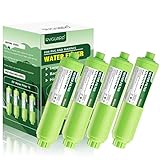
RVGUARD’s four-pack is a supply-chain purchase rather than a filtration upgrade. It’s the same class of inline GAC/KDF cartridge as the two-packs above, sold four at a time so you’re not reordering mid-season. It suits owners who know their consumption pattern — a family that camps most weekends from May through September, or a snowbird who replaces the cartridge at every monthly stop.
Key specs at a glance
| Spec | Detail |
|---|---|
| Type | Inline, hose-threaded cartridge |
| Media | GAC plus KDF class |
| Nominal rating | 20-micron class |
| Connection | 3/4 in. GHT both ends |
| Pack size | 4 cartridges |
| Service life | Roughly one season per cartridge in normal use |
| Best use | Volume buyers and multi-trip seasons |
Buying inline filters in bulk is a rational response to how they actually degrade. A cartridge doesn’t fail on a schedule; it fails when its carbon is exhausted or its sediment bed is loaded. Chlorine demand varies enormously by park — a heavily chlorinated municipal supply will exhaust carbon far faster than a lightly treated well. Having four on hand means you swap when the water starts tasting like pool water again, instead of rationing a single cartridge through a trip that’s already gone flat.
The counterargument is storage and shelf life. Activated carbon cartridges do have a shelf life; sealed and kept dry they’ll hold for a few years, but they shouldn’t sit in a hot, damp bay for a decade. Four cartridges is about the right quantity for a serious seasonal camper and about three too many for someone who camps twice a year. There’s no hose protector in this pack, so budget for one — it’s the cheapest insurance against a leaking joint at the spigot.
Pros
- Lowest per-cartridge cost of the mid-range inline options
- Four cartridges cover a full camping season for most households
- GAC plus KDF media at a standard 20-micron class
- Universal garden hose thread — fits everything without adapters
- Removes the mid-season reorder problem entirely
Cons
- No hose protectors included
- Higher upfront spend than a two-pack
- Cartridges have a finite shelf life if stored damp or hot
- No benefit over a two-pack if you camp only a few times a year
- Still a disposable body, still a 20-micron ceiling
How it compares with the nearest alternative. The Hourleey four-pack is the obvious rival: same cartridge count, but it throws in two hose protectors and carries a broader stated reduction list, at a higher tier. If you already own protectors, RVGUARD is the leaner buy. Against a canister system like the GLACIER FRESH GFRVWP03, four inline cartridges will always cost more per gallon of filtered water — the bulk pack wins on convenience, not on economics. Against the Camco TastePURE two-pack, you’re trading a known made-in-USA brand for a lower unit price.
6. Stokk 2-Pack with Hose Protector, NSF Certified – Best Budget Pick With Certification

Stokk’s two-pack is the budget option for buyers who care about third-party verification. The listing carries an NSF certification claim, which in this category usually means the cartridge has been evaluated against a recognized drinking-water treatment standard rather than simply self-declared by the manufacturer. It suits cautious first-time buyers, and anyone buying filtration for a rig that carries children or guests.
Key specs at a glance
| Spec | Detail |
|---|---|
| Type | Inline, hose-threaded cartridge |
| Certification | NSF certification claim on the listing |
| Media | GAC plus KDF class |
| Nominal rating | 20-micron class |
| Connection | 3/4 in. GHT both ends |
| Pack size | 2 cartridges, 1 flexible hose protector |
| Service life | About one season of typical use |
What certification actually buys you. NSF/ANSI standards for drinking water treatment units are written around specific contaminant reduction claims — a filter certified for chlorine reduction has been tested to a defined protocol for that claim. That’s meaningfully different from a listing that simply says “reduces bad taste and odor” with no verification behind it. It doesn’t mean the cartridge removes everything; certification is claim-specific. But it does mean someone independent looked at the performance claim rather than the manufacturer asserting it alone.
Everything else about this filter is standard budget inline territory. It threads onto garden hose fittings, it filters to a 20-micron nominal class, and it should be replaced roughly once a season. The included protector handles the strain-relief problem. Where it stands apart from other budget options is simply that it gives a skeptical buyer something concrete to point at.
Pros
- NSF certification claim gives third-party backing to the performance statements
- Hose protector included — addresses the most common failure point
- Standard garden hose thread, no adapter needed
- Budget pricing, so early replacement isn’t a financial decision
- Reassuring choice for rigs carrying children or guests
Cons
- Certification is claim-specific — it doesn’t make the cartridge comprehensive
- Still a 20-micron class filter; no dissolved-solids reduction
- Short seasonal service life
- Disposable body, no replaceable cartridge
- Not a solution for wells, sulfur, or iron
How it compares with the nearest alternative. The GLACIER FRESH two-pack is the closest match — same pack structure, same included protector, same tier — and the deciding factor is whether the certification claim matters to you. If it does, Stokk is the pick. Against the Camco TastePURE two-pack, Stokk is cheaper and carries a certification claim, but gives up the made-in-USA origin and Camco’s broader RV-specific ecosystem. Against the lifeegrn single-filter option, Stokk costs more but gives you two cartridges and a protector in one box.
7. AQUA CREST RV Inline Water Filter – Best for Dual Home and Road Use
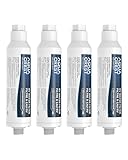
AQUA CREST’s inline filter is marketed for both garden hose and camper use, and that dual framing is its real advantage. It suits RVers who want one cartridge type for the trailer, the garden spigot at home, the pressure washer feed, and the pet water bowl — a single SKU that covers everything. It’s also a reasonable choice for boaters and marine users, who face the same hose-thread compatibility question.
Key specs at a glance
| Spec | Detail |
|---|---|
| Type | Inline, hose-threaded cartridge |
| Media | Granular activated carbon class |
| Nominal rating | 20-micron class |
| Connection | 3/4 in. GHT both ends |
| Stated uses | RV, camper, garden hose, marine |
| Service life | About one season, shorter in heavy sediment |
| Pack options | Single and multi-pack configurations |
The case for a general-purpose cartridge is simplicity. If you keep one model in the garage, you always have a spare for the trailer, and you’re not maintaining two separate filter inventories. Garden use is legitimate too: watering a vegetable bed or filling a pet bowl from a chlorinated municipal spigot is exactly the application a GAC cartridge handles well. The carbon strips chlorine, which is the main taste complaint in municipal water.
The trade-off is that a general-purpose filter is optimized for nothing in particular. It doesn’t include a KDF stage in the same way the Camco and Hourleey cartridges do, so its dissolved-metal handling is narrower. It doesn’t have a wide body, so its media volume and service life are ordinary. And it doesn’t ship with a hose protector in most configurations, which means the spigot-end joint is unsupported. None of that is disqualifying — it’s just a reminder that “works everywhere” and “best anywhere” aren’t the same claim.
Pros
- One cartridge type covers RV, garden hose, and marine use
- Standard garden hose thread on both ends
- Carbon media handles chlorine and taste effectively
- Available in single and multi-pack configurations
- Useful as a universal spare to keep in the garage or bay
Cons
- No KDF stage, so narrower dissolved-metal handling
- Usually no hose protector included
- Ordinary media volume means ordinary service life
- Not a specialist RV filter — no RV-specific mounting or hardware
- Won’t address wells, sulfur, or iron
How it compares with the nearest alternative. The Camco TastePURE wide-body is the step up in the same inline category: a much larger media bed, KDF included, and longer service life, at a premium tier. If your only use is the RV, the wide-body is the better filter. AQUA CREST wins on versatility and on being the one cartridge you can also use at home. Against the RVGUARD four-pack, AQUA CREST gives you a dual-purpose product but a higher per-cartridge cost.
8. Hourleey 4-Pack with 2 Hose Protectors – Best Bulk Value

Hourleey’s four-pack is the volume version of its two-pack, and it’s the cheapest way on this page to get four GAC/KDF cartridges plus two hose protectors in a single purchase. It suits households that run a full camping season plus shoulder trips, and anyone who has learned the hard way that running out of filters on a Saturday afternoon in a small town is a genuine inconvenience.
Key specs at a glance
| Spec | Detail |
|---|---|
| Type | Inline, hose-threaded cartridge |
| Media | GAC plus KDF class |
| Nominal rating | 20-micron class |
| Connection | 3/4 in. GHT both ends |
| Pack size | 4 cartridges, 2 flexible hose protectors |
| Listed reductions | Bad taste, odors, rust, and a fluoride reduction claim |
| Service life | Roughly one season per cartridge |
The arithmetic is straightforward: four cartridges plus two protectors at a bulk price is the lowest cost per usable season of any inline configuration here, provided you’ll actually use them before the media degrades on the shelf. The two protectors cover a split-hose setup — one at the spigot Y-splitter feeding the RV, one on the second run. For a rig with an outdoor shower or a dedicated black tank flush line, that’s exactly the right accessory count.
The fluoride caveat applies here as it does to the two-pack: carbon and KDF media don’t meaningfully remove fluoride, and buyers who need that should be looking at reverse osmosis instead. What this pack does deliver is the routine work — chlorine removal, sediment capture, rust interception — at the lowest unit cost of any inline product in this roundup, with enough spares that a clogged cartridge never ends a trip early.
Pros
- Lowest cost per cartridge of any inline option here
- Two hose protectors included — covers a split hose run
- GAC plus KDF media at a standard 20-micron class
- Enough cartridges to cover a full season without reordering
- Fits every standard RV inlet without adapters
Cons
- Fluoride reduction claim isn’t realistic for this media class
- Highest upfront spend among the inline options
- Four cartridges is more than a casual camper will use in a season
- Carbon shelf life means storage conditions matter
- Still disposable bodies with a 20-micron ceiling
How it compares with the nearest alternative. The RVGUARD four-pack is the direct competitor: same cartridge count, no protectors, slightly lower tier. If you already own strain-relief sleeves, RVGUARD is the leaner purchase; if you don’t, Hourleey’s included pair closes the gap. Against the Camco TastePURE two-pack, this is a volume play — better economics per cartridge, but no made-in-USA origin and the same fundamental 20-micron limitation. Against the GLACIER FRESH three-stage canister, four inline cartridges still cost more per gallon over a long season.
9. Camco TastePURE 20-Micron Wide-Body Inline – Best for Higher Flow and Longer Life

The wide-body Camco is the inline filter for people who have already discovered that standard cartridges clog too fast. It uses the same GAC and KDF media chemistry as the standard TastePURE, but in a substantially larger housing that holds more carbon and offers more surface area to the water stream. It suits longer trips, higher-flow setups, and RVers whose spigot supply carries visible sediment.
Key specs at a glance
| Spec | Detail |
|---|---|
| Type | Inline, wide-body housing |
| Media | GAC plus KDF |
| Nominal rating | 20 micron |
| Body | Oversized relative to standard inline cartridges |
| Connection | 3/4 in. GHT, no adapter required |
| Applications | RVs, boats, trailers |
| Service life | Longer than standard-body inline cartridges |
Why body size matters more than the marketing suggests. A filter cartridge is a fixed volume of media. Water passing through it has a defined contact time, and the media has a defined capacity before it’s exhausted. Increase the housing volume and you increase both. A wide-body cartridge holds more granular carbon, which means more chlorine capacity and a longer interval before breakthrough; it also presents a larger cross-section to the flow, which reduces pressure drop. For an RV running a shower and a kitchen faucet at the same time, that lower restriction is noticeable.
The trade-off is physical. A wide-body cartridge is bulkier to store and heavier when wet, and it doesn’t tuck into a tight bay as neatly as a slim inline tube. It also costs more per unit than standard inline cartridges, though it lasts longer, so the cost per gallon of filtered water is often lower in practice. For anyone replacing a cartridge mid-season because flow has dropped off, the wide-body usually pays for itself within one season.
Pros
- Larger media bed means longer service life than standard inline cartridges
- Lower pressure drop — better for simultaneous fixtures
- GAC plus KDF media chemistry from a well-established RV brand
- Handles sediment-heavy sources better than slim cartridges
- Universal garden hose thread, no adapters
Cons
- Bulky to store and heavier when wet
- Higher unit cost than standard inline cartridges
- Still a 20-micron class filter — no dissolved-solids reduction
- Disposable body
- Unnecessary if your source water is already clean and low-chlorine
How it compares with the nearest alternative. The Camco TastePURE XL is the same idea in a less extreme form: an extended body with more media than standard, plus a hose protector, at a mid-range tier. The wide-body goes further on both media volume and flow, which is why it sits a tier higher. Against the AQUA CREST inline, the wide-body is the more capable RV filter and the AQUA CREST is the more versatile household one. Against a canister system, both remain disposable products with a seasonal horizon.
10. Camco TastePURE XL with Hose Protector – Best Middle Ground

The XL is Camco’s extended-body TastePURE with a flexible hose protector included, and it occupies the most comfortable spot in the inline category: more media than the standard cartridge, less bulk than the wide-body, and the accessory that prevents the most common leak already in the box. It suits RVers who take several long trips a year and want one cartridge to last a full season without mid-trip replacement.
Key specs at a glance
| Spec | Detail |
|---|---|
| Type | Inline, extended-body cartridge |
| Media | GAC plus KDF |
| Nominal rating | 20-micron class |
| Connection | 3/4 in. GHT both ends |
| Included | Flexible hose protector |
| Body | Extended relative to the standard TastePURE cartridge |
| Origin | Made in the USA |
The XL’s positioning is a response to a specific complaint about standard inline cartridges: they run out at inconvenient moments. Because the body is longer, it holds more granular carbon, which extends the interval before chlorine breakthrough. If you’ve ever noticed the water in your rig tasting fine on day three and like a swimming pool by day twelve, that’s carbon exhaustion — and more media delays it.
The included protector is the other half of the value. A flexible sleeve at the hose end absorbs the bending load that would otherwise be carried by the threaded joint, and it’s the difference between a filter that survives a season of being hung off a spigot and one that develops a slow drip at the connection. On a mid-range product, bundling that accessory is a genuine convenience rather than a filler item.
Pros
- Extended body holds more carbon than the standard TastePURE cartridge
- Hose protector included — prevents the most common failure point
- GAC plus KDF media with a 20-micron nominal rating
- Made in the USA with a reliable replacement supply chain
- Less bulky than the wide-body while still outlasting standard cartridges
Cons
- Costs more per unit than the standard two-pack
- Longer body is slightly less convenient in tight hose bays
- No dissolved-solids reduction — still a 20-micron class filter
- Disposable body with no replaceable cartridge
- Not appropriate for well water with sulfur or iron
How it compares with the nearest alternative. Against the standard Camco TastePURE two-pack, the XL trades a higher unit price for longer service life and an included protector — worth it if you take trips longer than a week. Against the wide-body TastePURE, the XL is the more portable of the two but gives up some media volume and flow capacity. Against the GLACIER FRESH three-stage canister, the XL is easier to live with on short trips and worse economics on long ones.
11. OKBA External Dual Water Filter System – Best for Heavy Water Use
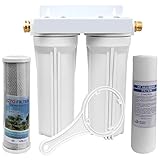
The OKBA dual system is the heavy-duty end of RV water filtration: two external canisters in series, mounted outside the rig, with replaceable cartridges rather than disposable bodies. It suits full-timers, large families, and anyone drawing from a private well or a park with variable water quality. If your rig runs a washing machine, a dishwasher, or two showers a day, this is the capacity class you need.
Key specs at a glance
| Spec | Detail |
|---|---|
| Type | Dual-canister external system |
| Stages | Two canisters in series |
| Cartridges | Replaceable — housing is reusable |
| Connection | Hose-thread inlet and outlet |
| Mounting | External to the RV |
| Applications | RV, camper, boat, marine |
| Service life | Cartridge-capacity based rather than seasonal |
Two canisters in series is a meaningful step up from a single-stage system, because the first canister can be dedicated to sediment while the second handles carbon. That separation protects the carbon media from being blinded by grit, which is the single biggest cause of premature cartridge failure in RV filtration. A carbon cartridge that’s shielded from sediment by an upstream stage will deliver its full rated capacity instead of a fraction of it.
Physical realities come with the territory. Two canisters need mounting space on the side of the rig, they’re heavy when full of water, and they must be drained before freezing weather — a frozen canister cracks, and that’s the most common way an external system is destroyed. Setup takes longer at each stop than threading on a single inline tube. In exchange, you get filtration that doesn’t need to be replaced mid-season, and a per-gallon cost that drops well below inline pricing once you’re using real volume. For a rig that’s parked for months at a time, the setup cost is amortized to nothing.
Pros
- Two stages in series — sediment protection upstream of the carbon media
- Replaceable cartridges make the housing a one-time purchase
- Best option here for high-volume households and full-time living
- Handles inconsistent or turbid source water that would blind inline cartridges
- Suitable for RV, camper, and marine applications
Cons
- Highest upfront cost of any non-RO option
- Requires external mounting space and setup time at each stop
- Heavy when filled, and must be drained before freezing
- Disproportionate for short trips and small rigs
- Cartridge intervals must be tracked deliberately
How it compares with the nearest alternative. The GLACIER FRESH GFRVWP03 three-stage is the direct rival: three stages instead of two, which gives it finer polishing at the outlet, while the OKBA gives you two larger canisters and more total media volume. For most couples, the three-stage is the better-proportioned system. For a family of five running laundry and long showers, OKBA’s capacity is the deciding advantage. Against any inline cartridge on this page, both canister systems win decisively on cost per gallon beyond roughly six weeks of annual use.
12. lifeegrn Inline Water Filter with Hose Protector – Best Cheapest Single Filter

The lifeegrn inline filter is the simplest, cheapest entry point on this page: one blue inline cartridge with a hose protector included. It suits renters, pop-up and teardrop owners, and anyone who wants to try inline filtration on a single trip before committing to a multi-pack. It’s also a sensible emergency spare to leave in the bay for the trip when the primary cartridge gives out.
Key specs at a glance
| Spec | Detail |
|---|---|
| Type | Inline, hose-threaded cartridge |
| Media | Granular activated carbon class |
| Nominal rating | 20-micron class |
| Connection | 3/4 in. GHT both ends |
| Included | Flexible hose protector |
| Service life | About one season, less in heavy sediment |
| Color | Blue housing |
What you get at this price is the core function and nothing else. Carbon media strips chlorine and the taste and odor compounds that come with it; the 20-micron class captures rust, grit, and sediment before it reaches your aerators. The included protector handles the strain-relief problem at the spigot joint. That’s the whole feature set — no KDF stage, no wide body, no certification claim, no multi-pack economy.
That’s not a criticism so much as a description of the category floor. If you camp two or three weekends a season in a small trailer, this cartridge does everything you need and costs less than a tank of fuel. If you camp twenty nights a year,