What's inside
As an Amazon Associate I earn from qualifying purchases. This post may contain affiliate links at no extra cost to you.
The best RV water filters for drinking water depend on whether you need a lightweight taste-and-sediment filter for campground hookups, a high-capacity inline cartridge for frequent travel, or a multi-stage system for questionable municipal water; for most RV owners, a 20-micron inline carbon filter is the simplest starting point, while frequent travelers benefit from a replaceable-cartridge system with a pressure regulator and dedicated drinking-water hose.
As an Amazon Associate we earn from qualifying purchases at no extra cost to you.


Quick picks by RV water situation
- Occasional weekend trips: Choose a standard inline carbon-and-sediment filter rated around 20 microns. It is inexpensive, compact, and adequate for improving taste, odor, and visible sediment from treated campground water.
- Frequent campground use: Choose a larger 10-inch cartridge housing with a replaceable sediment filter followed by a carbon block. It costs more initially but usually provides better capacity and less plastic waste.
- Full-time RV living: Choose a two- or three-stage system with separately replaceable cartridges, a pressure gauge, and a bypass. This makes maintenance easier and lets you use a finer drinking-water filter without restricting every faucet.
- Low-pressure hookups: Use a coarse sediment filter, roughly 20 to 30 microns, rather than an extremely fine cartridge at the inlet. Fine filters can reduce flow rapidly when campground water pressure is already weak.
- Private wells or visibly dirty sources: Add a washable or replaceable sediment prefilter before carbon. A carbon cartridge that catches all the silt will clog quickly and waste its adsorption capacity.
What filtration claims actually mean
A filter’s micron rating describes the size of particles it is designed to capture, but the number is not a complete measure of performance. A 20-micron sediment filter is useful for sand, rust flakes, and larger debris. A 5-micron filter catches smaller particles, but it can also reduce flow more quickly. “Absolute” filtration is a more demanding claim than “nominal”: absolute ratings indicate a specified capture performance at or above the stated size, while nominal ratings are broader estimates.
Carbon improves chlorine taste and odor and can reduce some organic compounds. It does not automatically make unsafe water safe to drink. Standard RV carbon filters should not be treated as a reliable solution for every bacterium, virus, parasite, heavy metal, or chemical contaminant. If a source is under a boil-water notice, has a known contamination problem, or comes from an untested private well, use current local water guidance and consider professional water testing rather than relying on a recreational filter.
Look for separate claims instead of a vague “purifies water” label:
- Sediment reduction: identifies particle filtration and the rated micron size.
- Chlorine and taste reduction: usually indicates activated carbon.
- NSF/ANSI certification: check the specific standard and contaminant claim; certification to one standard does not mean removal of every contaminant.
- Capacity: expressed in gallons, but actual life depends on source-water quality and flow.
- Maximum pressure and temperature: important for preventing leaks or cartridge damage.
Head-to-head comparison of practical RV filter styles
| Filter style | Typical filtration | Typical capacity | Typical flow | Best use | Main compromise |
|---|---|---|---|---|---|
| Compact inline carbon filter | 20 microns; carbon plus sediment media | 400–1,000 gallons or about 3 months | 1.0–2.5 gallons per minute | Weekend trips and basic taste improvement | Cannot inspect or replace the internal cartridge |
| 10-inch single-housing cartridge | 5–20 microns, depending on cartridge | 1,000–10,000 gallons | 2–5 gallons per minute | Frequent use with moderate sediment | One cartridge must handle both dirt and taste reduction |
| Two-stage housing | 5-micron sediment plus carbon block | 1,000–10,000 gallons | 2–4 gallons per minute | Full-time use and variable campground water | More fittings, space, and replacement cost |
| Three-stage drinking-water system | Sediment, carbon, and fine carbon or specialty stage | 500–5,000 gallons, depending on cartridges | 0.5–2 gallons per minute at the drinking faucet | Dedicated kitchen drinking water | Usually too restrictive for the entire RV inlet |
These are useful planning ranges rather than guarantees. Cartridge material, water pressure, temperature, and sediment load can produce substantially different results. Always compare the exact replacement cartridge specification with the housing’s port size and pressure rating.
Notable products and where they fit
Camco TastePURE inline filters
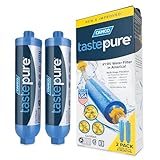
Camco’s TastePURE line is a familiar choice for occasional RV use. Models such as the 40043 are commonly sold as 20-micron inline filters with carbon media and a limited-use replacement interval. Their strengths are low cost, simple hose-to-hose installation, and minimal storage space. They are most suitable for treated campground water when the goal is better taste and basic sediment reduction, not comprehensive contaminant treatment.
Culligan RVF-10
The Culligan RVF-10 is a larger inline RV filter commonly specified at 10 microns, with a carbon-based design and a rated capacity often listed around 10,000 gallons. The larger body can provide more media than a small disposable inline filter, but the published capacity should not be interpreted as a fixed calendar life. A muddy hookup, iron-heavy water, or a filter left connected between trips can shorten useful life considerably.
ClearSource RV systems
ClearSource sells multi-stage RV systems designed for owners who want replaceable cartridges rather than disposable inline bodies. These systems are a better match for full-time use, especially when a sediment cartridge can be changed independently from the carbon cartridge. Their larger housings require a storage plan and careful hose management, and the finest available stages may reduce flow if installed on the entire RV inlet.
For any named product, verify the current cartridge rating, capacity, included fittings, and replacement availability before buying. Manufacturers sometimes change bundles or sell several versions under similar names.
Hookup style matters as much as the filter
An inline filter attaches between the campground spigot and the RV’s potable-water hose. It is the fastest setup, but the filter remains exposed to sun, freezing weather, and accidental knocks. A canister system usually sits on the ground or inside a protective box and uses standard garden-hose connections. It is more serviceable, but every additional connection is another possible leak.
A practical hookup order is:
- Campground spigot.
- Shutoff valve or pressure regulator.
- Sediment prefilter.
- Carbon or specialty filter.
- Potable-water hose.
- RV city-water inlet.
Many owners put the pressure regulator at the spigot so the filter and RV hose are protected from excessive pressure. Use a regulator that matches the RV manufacturer’s recommended range; a fixed regulator can protect the plumbing, while an adjustable gauge model helps diagnose low-flow problems. Keep the filter out of standing water and support its weight so it does not pull sideways on the spigot.
How to choose capacity without overbuying
Estimate your usage from the water that actually passes through the filter, not the RV’s tank size. Suppose two travelers use 8 gallons per day through the kitchen, shower, toilet, and cleaning. A 1,000-gallon filter has a theoretical life of 125 days:
1,000 gallons ÷ 8 gallons per day = 125 days.
That result is only a ceiling. If the campground water contains substantial sediment, the filter may clog long before reaching its advertised gallon rating. For occasional use, replace an inline filter at the manufacturer’s time limit even if its gallon estimate has not been reached. Stagnant, wet media can develop odor and is not worth preserving to save a small replacement cost.
Ownership realities: what wears out first
- O-rings and hose washers: These often leak before the filter media is exhausted. Keep spare potable-water washers and lubricate compatible O-rings with food-grade silicone grease.
- Sediment cartridges: They usually clog first. A brown or visibly loaded cartridge is a maintenance signal, not proof that the carbon stage is still fresh.
- Carbon media: Taste can worsen gradually, so calendar-based replacement is important. Do not wait for an obvious odor.
- Plastic housings: Sun exposure, freezing, and overtightening can cause cracking. Drain and store the system indoors when frost is possible.
- Connections: Hand-tighten filter fittings first, then add only a small additional turn if needed. Excessive wrench force can damage plastic threads.
Bottom line
For most RV owners using treated campground hookups, a 20-micron inline carbon filter is the best low-effort choice. Choose a 10-micron or staged system when sediment and taste are recurring problems, and choose a replaceable two- or three-stage setup when you travel continuously and have room for maintenance equipment. Prioritize the specific contaminant claim, realistic flow rate, replacement cost, pressure rating, and hookup protection over a large gallon number printed on the box.