What's inside
As an Amazon Associate I earn from qualifying purchases. This post may contain affiliate links at no extra cost to you.
High-torque cordless impact drivers can deliver far more twisting force than a standard drill. That power is useful for structural screws, long timber fasteners, and small automotive hardware—but it also exposes weak or poorly fitted bits quickly. Choosing the right impact driver bits is less about buying the largest set and more about matching the bit to the fastener, the tool, and the job.
Start With Impact-Rated Bits
Do not use ordinary drill-driver bits in an impact driver unless the manufacturer specifically rates them for impact use. Standard bits are usually hardened for drilling or light screwdriving, but they are often too brittle for the repeated torsional shocks produced by an impact mechanism. They can twist, chip, or snap at the hex shank.
Impact-rated screwdriver bits are made with a tougher steel treatment and commonly include a torsion zone. This section flexes slightly under sudden load instead of transferring all the stress to the tip or shank. It does not make a bit indestructible, but it greatly improves survival in a high-torque cordless tool.
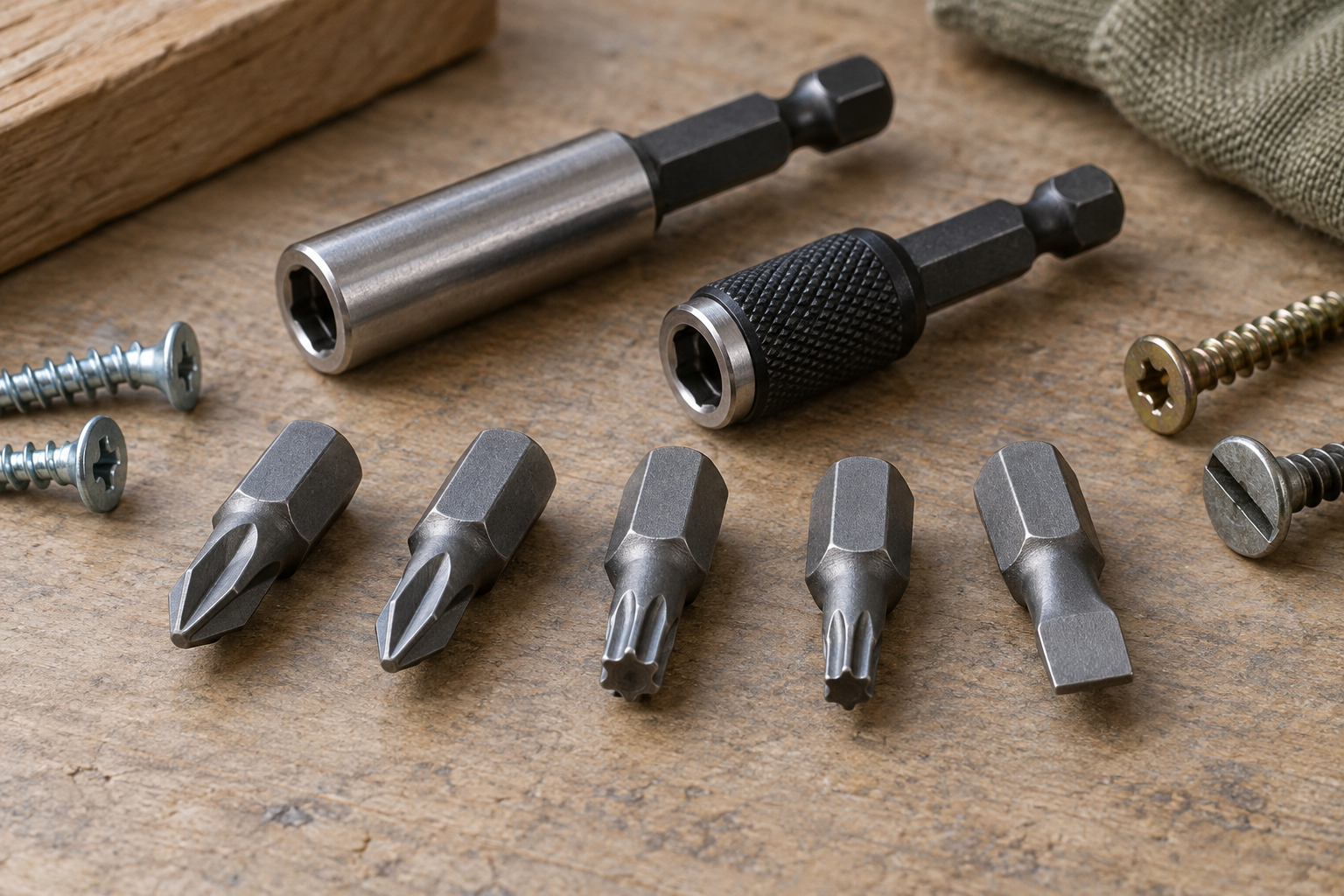
A useful starting point is a 1/4-inch hex impact bit set containing the Phillips, square-drive, and Torx sizes you use most. A cheap impact-rated set is adequate for occasional household work. If you drive hundreds of screws, buy fewer bits from a better line rather than a large assortment filled with sizes you will never use.
Match the Bit to the Fastener
Correct geometry matters more than brand. A bit that fully fills the screw recess resists cam-out and reduces damage to both the fastener and the bit. Phillips screws are particularly prone to cam-out, especially when driving long screws into hard wood. Use the exact size—usually PH2 for common construction screws—and keep the tool aligned with the screw.
Square-drive and Torx fasteners generally hold the bit more securely. Torx sizes are not interchangeable: a T25 bit in a T30 screw may feel usable at first, then round the recess under impact. For exterior construction, confirm the bit size printed on the screw box rather than guessing from appearance.
| Fastener type | Typical bit choice | Common failure | Best practice |
|---|---|---|---|
| Phillips construction screw | PH2 or PH3 impact bit | Cam-out and stripped recess | Use the correct size and steady pressure |
| Square-drive screw | Robertson bit matching the screw | Bit wear or poor engagement | Replace a rounded bit early |
| Torx or star screw | Matching T-size impact bit | Recess rounding from undersized bits | Use a fully seated bit, especially at high speed |
| Hex-head lag screw | Impact socket, not a screwdriver bit | Socket adapter breakage | Use a dedicated impact socket where possible |
Choose Length and Holder Style
The standard 1-inch insert bit is the most economical choice when used in a magnetic bit holder or quick-change holder. It is easy to replace and usually provides the best value. A 2-inch bit is more convenient for shallow recesses, while 3-inch and longer bits improve access around brackets, cabinet edges, and other obstructions.
Long bits are not automatically stronger. The extra length increases flex and can make the tip wobble under load. Use the shortest bit that gives you a clear line to the fastener. For repeated work, a bit holder with a strong magnet or locking sleeve can be faster than changing individual long bits.
Check the holder as well as the bit. A worn collet may allow the bit to move several millimeters, causing poor engagement and premature wear. If bits fall out, bind, or sit noticeably off-center, replace the holder rather than blaming every new bit.
Know When a Bit Is the Wrong Tool
For hex-head lag screws, nuts, and bolts, use a 1/4-inch hex-to-square-drive adapter with an impact socket, or use an impact-rated nut setter. Do not put a chrome hand-tool socket directly on an impact driver. Chrome sockets can crack or shatter because they are not designed for impact loading.
Adapters are convenient for occasional repairs, but they are a wear point. A high-torque impact driver can twist a small adapter until the square drive or retaining groove fails. If you regularly install structural lags or work on vehicles, buy dedicated impact socket accessories rather than relying on one inexpensive adapter.
Keep the tool’s limits in mind. Many compact impact drivers produce roughly 1,200 to 1,800 inch-pounds of claimed fastening torque, while high-output models can exceed that figure. A bit that survives a small 12-volt tool may fail quickly in an 18- or 20-volt high-torque model. Claimed torque is not a direct measure of real fastening force, but it is a warning that premium bits and sockets become more worthwhile as tool output rises.
Consider Material, Coating, and Wear
Most quality impact bits use alloy steel with a hardened tip and a tougher body. Titanium or black oxide coatings may improve corrosion resistance and reduce friction, but the coating alone does not determine durability. A brightly colored bit is not necessarily better than an uncoated one.
Replace a bit when the tip is rounded, twisted, visibly chipped, or no longer seats firmly. Continuing to use it transfers more force to the screw recess and increases the chance of a sudden slip. Keep a fresh bit nearby for repetitive work; stopping to change one is cheaper than extracting a stripped screw.
Buy for the Work, Not Just the Battery Platform
Bits are generally universal across cordless brands because they use a standard 1/4-inch hex interface. Your battery ecosystem—whether the tool is 12, 18, or 20 volts—does not require matching-brand bits. Spend your platform loyalty on batteries, chargers, and tool bodies; choose bits based on fit and durability.
For occasional furniture assembly or light repairs, a modest impact-rated Phillips and Torx bit assortment is enough. For decking, framing, or daily maintenance, buy duplicate PH2, T25, T30, and square-drive bits, plus a reliable holder. If you use a high-output impact driver for large fasteners, add dedicated impact sockets and avoid the cheapest adapters.
Finally, control the tool when the job allows it. Use the lowest useful speed, keep the bit straight, and stop once the fastener seats. Even the best impact bit has a limited life when driven at full power against a seized or overlong fastener.
Related guides
- Longest Lasting Lawn Mower Battery: AGM vs Lithium vs Flooded Lifespan and Cost per Season
- Duralast Gold Lawn Mower Battery Review: U1 Fit, CCA and When to Pay for AGM
- Greenworks Pro 80V 21-Inch Mower Review: Runtime Math, Push vs Self-Propelled and Yard Fit
- Bosch High Pressure Washer Gun Replacement: Fittings, Adapters and What Fits Your Model