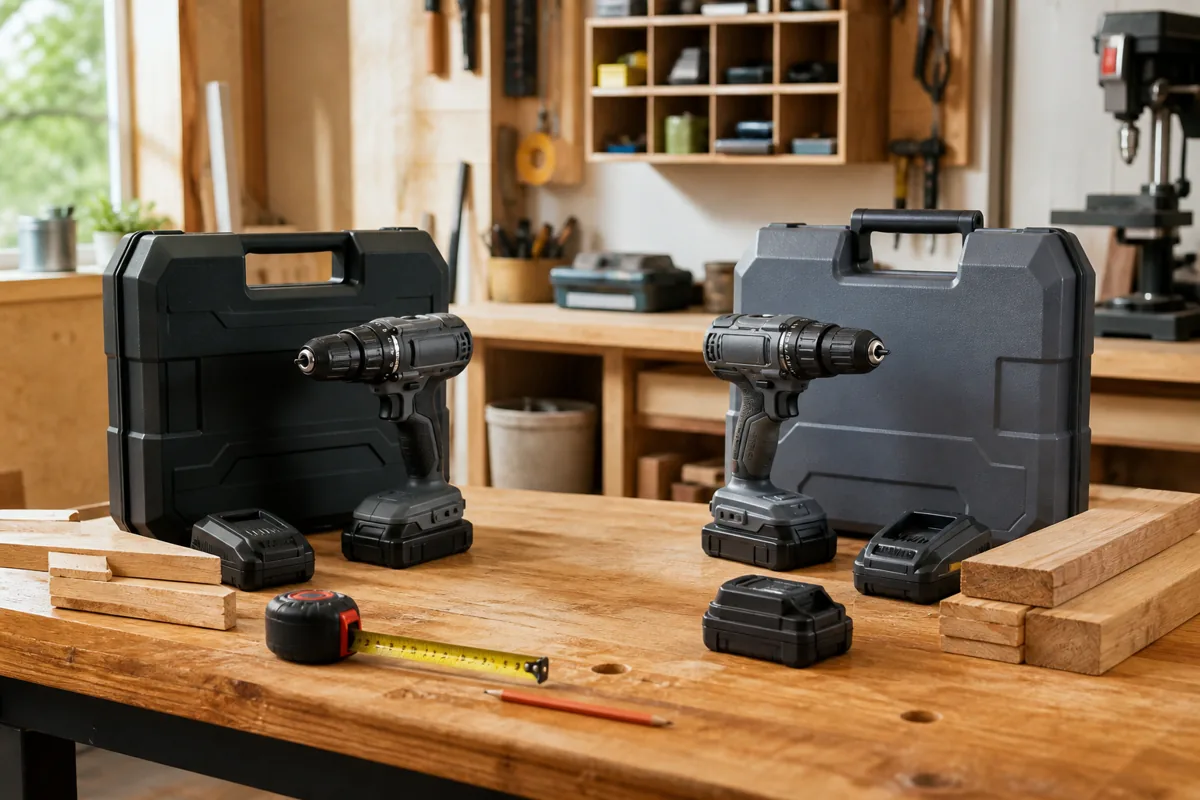
What's inside
As an Amazon Associate I earn from qualifying purchases. This post may contain affiliate links at no extra cost to you.
A cordless tool kit can look like a bargain until you discover that the batteries are small, the charger is slow, or the “complete” kit contains tools you will rarely use. Evaluate the contents as a working system, not as a box count. The right kit supplies enough runtime, useful tools, compatible batteries, and a charging setup that fits the jobs you actually do.
As an Amazon Associate we earn from qualifying purchases at no extra cost to you.


Start With the Work, Not the Tool Count
List the jobs you expect to handle over the next year. Installing shelves may require a drill, driver, bits, and one battery. Deck building may justify a drill, impact driver, circular saw, reciprocating saw, and several higher-capacity batteries. Occasional household repairs rarely need a six-tool kit.
Count useful tools rather than advertised pieces. A kit described as “20 pieces” may include a bag, charger, blade, and several small accessories. Those items can be useful, but they do not equal 20 power tools. Check the contents line by line and identify which tools are bare-tool versions, meaning they do not include a battery or charger.
If you need a basic starting set, a cordless drill kit with battery and charger is often a better purchase than a large mixed kit. Add tools as your jobs demand them.
Compare Battery Capacity and Runtime
Battery voltage alone does not tell you how long a tool will run. Capacity is usually listed in amp-hours (Ah). A 2.0-Ah battery stores roughly half the energy of a 4.0-Ah battery within the same platform, although actual runtime varies with the tool and workload.
| Battery size | Best use | Main advantage | Main drawback |
|---|---|---|---|
| 1.5–2.0 Ah | Drills, drivers, lights, light assembly | Light and less tiring | Shorter runtime under heavy load |
| 3.0–4.0 Ah | General saws, outdoor work, remodeling | Good balance of runtime and weight | Heavier and slower to recharge |
| 5.0 Ah and larger | Circular saws, grinders, blowers, extended work | Longest runtime and better sustained output | Expensive, bulky, and tiring in handheld tools |
One 2.0-Ah battery may be adequate for driving cabinet screws, but it can be frustrating in a reciprocating saw or blower. For demanding tools, two medium batteries are often more practical than one very large battery: one can work while the other charges. Check whether the kit includes one battery or two, and whether both are the same capacity.
Runtime claims are not standardized. Cutting thin lumber is easier than cutting pressure-treated posts, and drilling softwood is easier than drilling masonry. Treat manufacturer runtime figures as optimistic comparisons, not a guaranteed number of minutes.
Check Platform Compatibility
Batteries usually work only within a brand’s voltage platform, and sometimes only within a particular battery generation. A battery labeled for a 20-volt system may not fit a 12-volt tool from the same manufacturer. Some brands also divide consumer and professional lines or use physically different connectors.
Before buying, confirm that every included tool uses the same battery family. Then look at the platform’s broader lineup. A good starter kit should leave you room to buy a cordless impact driver bare tool, oscillating tool, sander, or outdoor tool later without purchasing another charger and battery set.
Battery availability matters more than a low introductory price. Search for replacement batteries, chargers, and common bare tools before committing. If batteries are frequently out of stock or cost nearly as much as a new kit, the platform may be a poor long-term value.
Inspect the Charger and Charging Setup
A basic charger may take several hours to refill a high-capacity battery. That is acceptable for occasional weekend work, but inconvenient when several tools share one battery. Faster chargers reduce downtime but can cost more and may generate more heat.
Check whether the charger is single-port or dual-port, whether it charges batteries sequentially or simultaneously, and whether it includes temperature or fault indicators. A charger that stops because the battery is too hot is protecting the battery, not failing. Avoid charging batteries in direct sun, in a freezing garage, or immediately after heavy use if they are hot to the touch.
If the kit includes only one battery and one charger, identify your work pattern. For short tasks, the cheaper option is fine. For several hours of cutting or fastening, budget for a second battery before buying extra tools.
Match Tools to Battery Size
Small batteries make drills and impact drivers easier to control overhead. Large batteries can improve performance in saws, grinders, and blowers, but they also add noticeable weight. A heavy battery on a drill can turn a comfortable tool into an awkward one.
Look for brushless motors if the price difference is reasonable. They generally offer better efficiency, longer service life, and improved performance under load. Brushed tools can still be sensible for occasional DIY use, especially when the kit is substantially cheaper and replacement tools are readily available.
Do not assume more speed settings automatically mean better control. Check for a mechanical clutch on a drill, a variable-speed trigger, an electric brake where appropriate, and a comfortable grip. These features affect the quality of the work more than a high no-load RPM figure.
Find the Hidden Costs
Price the kit as a working setup: tools, batteries, charger, blades, bits, and likely replacements. A circular saw without a suitable blade is technically usable but may perform poorly with the included general-purpose blade. A reciprocating saw without demolition or pruning blades may need an immediate accessory purchase.
Also check the warranty terms and battery warranty separately. Batteries often have different coverage periods from tools. Keep receipts and record the purchase date, especially if the brand requires registration.
Use a Simple Buying Test
Reject a kit if it fails any of these checks: it lacks the battery capacity your hardest job requires; the charger cannot keep up with your work; the tools use a platform with few future options; or half the included tools duplicate equipment you already own.
Choose the kit with the best balance of useful tools, usable batteries, and future compatibility. A smaller kit with two 4.0-Ah batteries can outperform a larger kit with four tools and one undersized battery. If outdoor maintenance is part of the plan, compare a cordless leaf blower kit with battery and charger separately; outdoor tools can consume batteries much faster than drills.
Finally, buy for the task that will push the system hardest, not the task that appears most often. That decision prevents the most common failure: owning several compatible tools but stopping work because the only battery is empty.
Related guides
- Longest Lasting Lawn Mower Battery: AGM vs Lithium vs Flooded Lifespan and Cost per Season
- Duralast Gold Lawn Mower Battery Review: U1 Fit, CCA and When to Pay for AGM
- Greenworks Pro 80V 21-Inch Mower Review: Runtime Math, Push vs Self-Propelled and Yard Fit
- Bosch High Pressure Washer Gun Replacement: Fittings, Adapters and What Fits Your Model