What's inside
As an Amazon Associate I earn from qualifying purchases. This post may contain affiliate links at no extra cost to you.
Do finish nailers need an air compressor?
Usually, no. Most finish nailers sold today are cordless: they run on a battery and use either a small flywheel or a sealed gas-and-air system to drive the nail. They do not need a separate compressor, hose, or pneumatic air tank. That makes them easier to carry from room to room and quicker to set up for trim work.
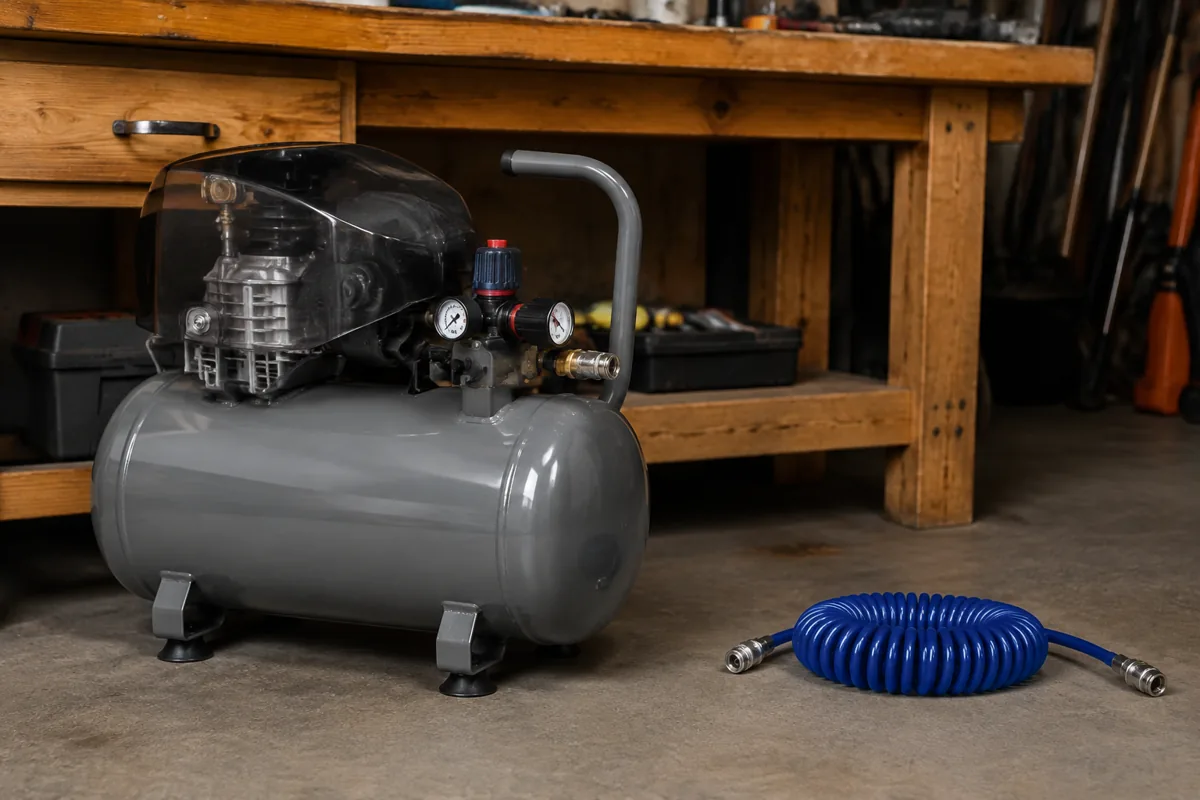
If you already own a pneumatic finish nailer, though, a cordless compressor can run it. The right choice depends on the nailer’s air consumption, how many nails you fire in a minute, and how much weight you want to carry. A compressor that keeps up with occasional baseboard work may struggle during a long run of crown molding.
As an Amazon Associate we earn from qualifying purchases at no extra cost to you.


The numbers that matter
Check the nailer manual for its operating pressure and air consumption. Many pneumatic finish nailers work around 70–100 PSI and use roughly 0.3–0.5 cubic feet of air per minute (CFM) at a stated duty cycle. Those figures vary, so use your tool’s specifications rather than treating them as universal.
Compressor CFM is commonly measured at 90 PSI. Compare that rating with the nailer’s requirement at the same pressure; tank size alone is not a measure of how quickly the compressor can keep up. A larger tank stores more air between motor cycles, but a low-output pump can still fall behind during rapid firing.
For trim installation, an 18-gauge brad nailer is often used for light molding and narrow stock, while a 15- or 16-gauge finish nailer handles heavier trim. The larger nailers may need more air per shot. If you fire several nails in quick succession and the compressor cannot recover, expect slower cycling, incomplete nail depth, or pauses while the tank refills. Set the regulator to the nailer manufacturer’s recommended pressure; raising it to compensate can create other problems.
Cordless compressor options at a glance
| Type | Best fit | Main trade-off |
|---|---|---|
| Small battery compressor | Occasional trim, punch lists, and one pneumatic tool | Portable, but limited airflow and runtime |
| Higher-output battery compressor | More frequent nailing or jobs away from outlets | Heavier, costlier, and demanding on batteries |
| Corded compressor | Long work sessions near power | More sustained output, but needs an outlet and is less convenient to move |
| Cordless finish nailer | Trim work where setup speed matters | Higher tool cost and another battery platform to manage |
Choosing a cordless compressor
Start with the CFM rating at 90 PSI, not the headline maximum PSI. Maximum pressure tells you how high the compressor can pressurize air, not how fast it can deliver it. For one finish nailer used at a measured pace, a compact unit may be adequate. For repeated firing or multiple air tools, look for more delivered air and confirm the nailer’s requirements first.
Tank capacity affects how often the motor starts. A small tank can be lighter and easier to store, but it may cycle frequently. Frequent starts are not automatically a problem; the concern is whether the pump recovers fast enough for your pace and whether the manufacturer’s duty-cycle limits suit the job. Cordless compressors can also be noisy, so check the noise rating if you will be working indoors.
Battery compatibility can decide the purchase. If you already own several batteries in a platform, a bare-tool compressor may cost less than starting over. But a compressor is a high-draw tool: a small or older battery may deliver fewer nails per charge than expected. Check the maker’s runtime guidance, use a suitable battery, and keep a charged spare on hand for longer jobs. For a starting point, compare bare-tool cordless air compressors within the battery system you already use.
When a cordless nailer is the better buy
If finish nailing is the main reason you want a compressor, compare the cost and weight of the whole setup: compressor, battery, hose, pneumatic nailer, and fittings. A cordless finish nailer eliminates the hose and compressor, and it is generally easier to use on ladders or in finished rooms. The downside is the higher upfront cost, plus battery and tool maintenance specific to that nailer.
Choose a cordless nailer if you do short trim jobs in different rooms, value fast setup, or already have a compatible battery platform. A compact compressor is more useful if you also need air for inflation, light cleaning, or other pneumatic tools. For a dedicated trim tool, browse cordless finish nailers in the gauge you need. Do not assume an 18-gauge brad nailer can replace a 15- or 16-gauge finish nailer; the fastener size and holding strength differ.
Setup and common problems
Use a hose rated for the compressor’s pressure and connect the regulator to the nailer according to its manual. Start at the recommended pressure and test on scrap matching the workpiece. If nails sit proud, check the pressure, hose connections, fastener length, and nailer settings before increasing pressure. If nails sink too far, reduce pressure or adjust the depth control.
A compressor that runs constantly may be undersized for the firing pace, leaking air, or operating beyond its intended duty cycle. Check couplers and hose fittings for leaks, and let the compressor recover when needed. Moisture can collect in the tank, even during ordinary use; drain it as the manual directs, especially before storage. Do not leave water in the tank, and never exceed the pressure rating of the compressor, hose, or tool.
A practical choice
For occasional work with one pneumatic finish nailer, a small cordless compressor is reasonable if its published CFM meets the nailer’s requirements and you can tolerate refill pauses. It is the cheaper option when you already own the nailer and battery platform. For steady production, do not buy by tank size or maximum PSI alone: prioritize adequate CFM, battery capacity, and a suitable duty cycle—or use a corded compressor near an outlet. If you are buying equipment specifically for trim, a cordless finish nailer is often the simpler setup.
FAQ
Do finish nailers need an air compressor?
Related guides
- Longest Lasting Lawn Mower Battery: AGM vs Lithium vs Flooded Lifespan and Cost per Season
- Duralast Gold Lawn Mower Battery Review: U1 Fit, CCA and When to Pay for AGM
- Greenworks Pro 80V 21-Inch Mower Review: Runtime Math, Push vs Self-Propelled and Yard Fit
- Bosch High Pressure Washer Gun Replacement: Fittings, Adapters and What Fits Your Model