What's inside
As an Amazon Associate I earn from qualifying purchases. This post may contain affiliate links at no extra cost to you.
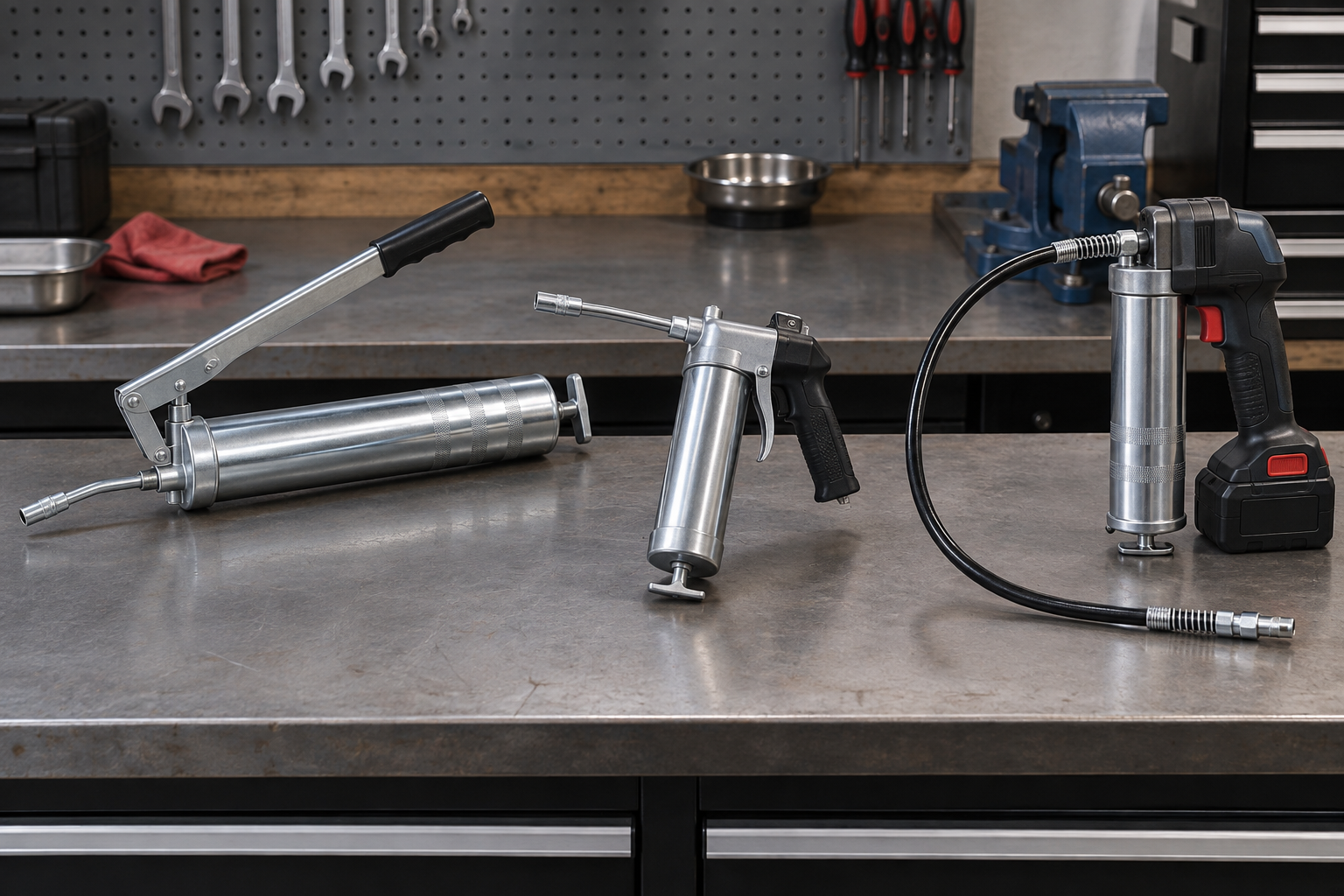
For fleet service, the choice between a cordless grease gun and a manual grease gun is mainly a question of volume, access, and downtime—not maximum pressure alone. Both tools can lubricate pins, bushings, U-joints, tie-rod ends, and other grease points. The better choice depends on how many vehicles you service, how often they need grease, and whether your technicians already use a particular cordless battery platform.
As an Amazon Associate we earn from qualifying purchases at no extra cost to you.


Where cordless grease guns save time
A manual grease gun typically delivers about 0.5 to 1.0 cubic inch of grease per 40 strokes, depending on the pump design and the grease temperature. That can mean dozens or hundreds of handle pulls on a truck, trailer, excavator, or refuse vehicle. A cordless model does the pumping for you and usually delivers roughly 5 to 10 ounces of grease per minute in low-pressure, high-volume operation.
The time savings are most noticeable on large fleets. Greasing 20 points on one vehicle may take only a few minutes with a power tool, but repeating that work across 10 or 20 vehicles adds up quickly. A cordless gun also reduces hand and wrist fatigue. That matters when technicians grease equipment at the end of a long shift, work in cold weather, or service fittings that require a stiff grease.
For a fleet shop already invested in a major battery system, a cordless grease gun can be a practical addition. Buying a bare tool is usually cheaper than starting a new battery platform, and the same batteries may already power impact wrenches, lights, drills, and inspection tools.
Manual versus cordless grease guns
| Factor | Manual grease gun | Cordless grease gun |
|---|---|---|
| Typical purchase cost | About $20–$80 | About $100–$300, often bare tool |
| Power source | Operator’s arm | Rechargeable battery |
| Grease output | Slower and stroke-dependent | Usually 5–10 ounces per minute |
| Pressure capability | Often very high by hand | Commonly 6,000–10,000 psi maximum |
| Best use | Occasional service, backup, remote work | Daily fleet and heavy-equipment service |
| Main failure risk | Fatigue, slow work, damaged hose | Dead battery, jammed fitting, motor or switch failure |
| Maintenance | Clean, refill, inspect seals | Same maintenance plus battery and charger care |
Maximum pressure figures need context. A grease gun rated at 10,000 psi does not force grease through every blocked fitting. A seized or clogged fitting may require more pressure than the tool can produce, or the fitting may be damaged before the grease passage opens. A manual gun gives the operator better feel and can sometimes build pressure gradually. A cordless gun delivers consistent force, but it can keep pushing after a fitting has failed or a hose has separated.
When a manual grease gun is the better buy
A manual gun is often the right answer for a small operation, a farm with a few machines, or a maintenance department that greases equipment only once or twice a month. The tool is inexpensive, needs no charging, and can remain in a service truck for months without losing readiness. It is also a useful backup when a cordless gun battery is flat or a charger is unavailable.
Manual operation provides useful feedback. If the handle suddenly becomes hard to move, the fitting may be blocked, the joint may already be full, or the hose may be kinked. With a power tool, technicians can miss these changes while concentrating on the battery, coupler, or grease outlet. Manual guns are also lighter than many powered models, which helps when reaching awkward fittings overhead.
For occasional work, a heavy-duty manual grease gun with a flexible hose and a locking coupler is generally enough. Spend more attention on the coupler and hose than on an extreme pressure rating. A poor coupler that leaks or will not stay attached wastes more time than a slightly slower pump.
What to check on a cordless model
Battery compatibility should be the first check. A bare grease gun may look inexpensive until the cost of a battery and charger is added. A 2.0Ah or 3.0Ah pack is lighter and may be adequate for a small service route. A 4.0Ah or larger pack usually provides more working time, especially with cold, thick grease, but adds weight when the tool is held at shoulder height.
Look for variable-speed control, a high-pressure setting, an air-bleed valve, and a bright work light. A bulk-loader option is valuable for shops that buy grease in larger containers. Some guns accept standard 14-ounce cartridges; others can be converted for bulk filling. The loading system must be kept clean. Air trapped in the barrel can make a power gun run without moving grease, leading a technician to assume the motor or pump has failed.
A cordless grease gun kit with battery and charger makes sense when the shop has no compatible platform. For an established fleet, matching the existing ecosystem is usually more important than choosing the brand with the highest advertised pressure. Shared batteries, chargers, and service parts simplify inventory.
Preventing common grease-gun failures
Most grease-gun problems begin with contamination or incorrect loading. Wipe the fitting before connecting the coupler, keep the hose end off the floor, and use a clean rag when changing cartridges. Mixing incompatible greases can cause separation or hardening. If the fleet uses different grease types, label guns clearly and do not top off one cartridge with another product.
Do not hold the trigger against a fitting indefinitely. If grease will not enter after a reasonable burst, stop and investigate. Check whether the coupler is fully seated, the hose is kinked, the fitting is damaged, or the joint is already packed. Excessive pressure can rupture a hose, blow out a seal, or force grease past a bearing seal.
Buying decision for fleet service
Choose cordless when technicians grease several vehicles each day, labor time matters, and the shop already owns compatible batteries. Choose manual when service is occasional, budgets are tight, or the tool must sit ready in a remote truck without charging support. In many fleets, the most sensible setup is one cordless gun for routine volume plus one quality manual gun as a backup and diagnostic tool.
Regardless of power source, verify the grease specification, coupler fit, hose condition, and lubrication schedule. A faster gun cannot compensate for the wrong grease or missed service points. The tool should reduce labor without encouraging technicians to rush the inspection that should happen at every fitting.
Related guides
- Longest Lasting Lawn Mower Battery: AGM vs Lithium vs Flooded Lifespan and Cost per Season
- Duralast Gold Lawn Mower Battery Review: U1 Fit, CCA and When to Pay for AGM
- Greenworks Pro 80V 21-Inch Mower Review: Runtime Math, Push vs Self-Propelled and Yard Fit
- Bosch High Pressure Washer Gun Replacement: Fittings, Adapters and What Fits Your Model