What's inside
As an Amazon Associate I earn from qualifying purchases. This post may contain affiliate links at no extra cost to you.
The best cordless work light for most woodworking shops is a 4,000–5,000-lumen area light on the battery platform you already own; choose a compact 1,000–2,000-lumen light for close-up bench work, or a tripod light when you need broad, elevated coverage. Runtime depends heavily on brightness setting, battery capacity, and heat management, so compare useful output at the setting you’ll actually use—not just the maximum-lumen figure.
As an Amazon Associate we earn from qualifying purchases at no extra cost to you.


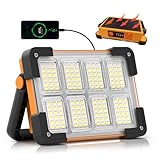
Quick picks by workspace
- Small bench or cabinet interior: A compact pivoting light, such as the Milwaukee M12 ROVER, is easy to position and less likely to crowd the work.
- General shop lighting: A mid-size area light such as the Milwaukee M18 ROVER or DeWalt 20V MAX DCL077 provides a practical balance of brightness and portability.
- Large work area or jobsite: A tripod-mounted light such as the DeWalt 20V MAX DCL079 is easier to aim over a bench or assembly area.
- Existing 18V/20V battery collection: Start with a light compatible with that platform. Buying a separate battery system just for illumination can outweigh the value of a brighter fixture.
What the numbers do—and don’t—tell you
Manufacturers commonly publish maximum lumens, but that number doesn’t reveal how evenly a light spreads across a surface, how quickly it dims as the battery empties, or how long it sustains its brightest mode. Runtime is also not directly comparable across brands unless the test uses the same battery capacity and brightness setting.
The table below uses published product specifications where available. Runtime figures are manufacturer claims, not independent measurements; actual results vary with battery age, temperature, and selected mode. For lights without a comparable published runtime, the table avoids inventing one. Check the current manual or product page before buying, since model revisions and included accessories can change.
Work-light comparison
| Light | Platform | Published output | Power and runtime context | Best fit |
|---|---|---|---|---|
| Milwaukee M12 ROVER (2367-20) | M12, 12V | Up to 1,000 lumens | Manufacturer lists up to 11 hours with an M12 4.0Ah battery; lower settings extend use. | Close-up work, cabinets, and compact benches |
| Milwaukee M18 ROVER (2366-20) | M18, 18V | Up to 4,000 lumens | Runtime varies by mode and battery; check the current specification for the battery size you plan to use. | General shop and jobsite area lighting |
| DeWalt 20V MAX DCL077 | 20V MAX | Up to 2,000 lumens | Three output settings help trade brightness for runtime; published runtime depends on battery capacity and mode. | Portable, directional task lighting |
| DeWalt 20V MAX DCL079 | 20V MAX | Up to 5,000 lumens | Three brightness settings; runtime changes substantially between them and with battery size. | Elevated, broad coverage on a tripod |
Output and runtime are manufacturer-published maximums or mode-dependent specifications, not directly comparable lab measurements. “20V MAX” is DeWalt’s nominal 18V battery platform designation.
Choose by beam coverage, not just brightness
For detailed sanding, routing, or finish inspection, a light that can be moved close and aimed from the side is often more useful than a high-output fixture across the room. Low-angle light reveals scratches and unevenness, while a broad, diffuse beam is better for general assembly. A concentrated beam can create bright hotspots and deep shadows, especially around a large machine or tall stack of lumber.
Think of coverage as a layout problem. A single light mounted behind you may cast your own shadow over the cut line. Place the source off to one side, then add a second light from another angle if the workpiece still has dark areas. For a large shop, two moderate lights positioned apart often give more even coverage than one very bright light.
Estimate runtime for your actual shift
A rough planning method is to divide battery energy in watt-hours by the light’s average power draw. For example, an 18V 5.0Ah battery stores about 90Wh (18 × 5). If a light averages 18W on the setting you use, the idealized estimate is 90 ÷ 18 = 5 hours. Real runtime will be lower or vary because battery voltage changes during discharge, electronics aren’t perfectly efficient, and the light may reduce output to manage heat.
This estimate is useful for comparing batteries, not predicting an exact shutoff time. If you need a full day of illumination, choose a lower mode, keep a spare charged battery, or use a light that can accept an AC adapter if the manufacturer offers one. Don’t assume the brightest mode is sustainable for the entire published runtime.
Match the light to your battery platform
For frequent use, platform compatibility is often the deciding factor. An existing battery collection lowers the effective cost and makes it easier to swap a depleted pack during a long job. Bare-tool prices are generally lower than kits; broad market prices vary by output and mounting hardware, with compact lights often costing less than tripod or high-output models. Compare the cost of the light, any required battery, and a spare pack rather than the fixture alone.
Some lights accept several battery sizes within a platform, but a larger pack adds weight and can make a compact light awkward to hang or carry. Check that the battery doesn’t block a hook, magnet, or mounting surface. Also verify whether the light is sold as a bare tool or includes a battery and charger.
Ownership details that matter in a woodworking shop
- Dust buildup: Fine sanding dust can coat lenses and ventilation openings. Wipe the lens with a soft, dry cloth and clear vents gently; avoid blowing dust deeper into the housing.
- Heat: High-output LEDs and their drivers warm up during extended use. Keep vents uncovered and don’t store a hot light against sawdust, finishes, or other heat-sensitive materials.
- Mounting strength: Magnets are convenient on steel machinery but won’t attach to aluminum, wood, or many painted surfaces. Use a stable hook, clamp, or tripod where appropriate.
- Impact and lens wear: A dropped light may survive while its lens becomes scratched or its mounting hardware loosens. A scuffed lens can scatter light and reduce useful contrast, so protect it in a tool bag.
- Battery care: Don’t leave packs in a hot vehicle or store them discharged for long periods. Follow the battery maker’s storage and charging guidance.
Final buying decision
Choose a compact pivoting cordless work light if you mainly illuminate a bench, drawer, or cabinet. Pick a mid-size area light for everyday shop tasks and a tripod model when the fixture needs to stand above or behind a large workpiece. Before paying for extra lumens, confirm platform compatibility, battery capacity, low-mode runtime, and whether the beam can be aimed without creating shadows. Those details determine whether the light remains useful after the first bright moment.