Our Top Picks
 POKIPO Large Power Tool Organizer Wall Mount withLarge8.5 x 33 x 15.7 inches16 PoundsCheck on Amazon
 WORKPRO Magnetic Screwdriver and Wrench Organizer Set3 Pack13.46 x 4.02 x 2.24 inches1.94 PoundsCheck on Amazon


What's inside
As an Amazon Associate I earn from qualifying purchases. This post may contain affiliate links at no extra cost to you.
The mistake most people make equipping a garage is buying machines before infrastructure. Lighting, a bench and storage make cheap tools work well; the reverse is not true. A premium table saw in a dim garage with nowhere to set the offcut down produces worse work than a jobsite saw in a bright shop with a flat surface at the right height beside it.
So the phases below matter more than the individual picks. Finish one before starting the next, because each makes the following one cheaper to live with: storage means you can find the tool, bench-height outlets mean you plug it in without running a cord across the floor, and light means you can see the line you are cutting to.
As an Amazon Associate we earn from qualifying purchases at no extra cost to you.


One constraint shapes everything: the car still has to fit. A two-car space is the sweet spot because you can hand a workshop one bay and keep the other clear, but that only holds if nothing is bolted down. If a tool cannot be rolled out of the way in a minute, it is not a workshop tool here, it is a parking problem.
Phase 1: infrastructure
None of this is exciting and all of it is load-bearing. Judge every item by whether it removes friction you meet in each session: not being able to see, not having a flat surface, not having a socket within reach.
- ✔ LED shop lighting — four fixtures minimum for a two-car garage
- ✔ A solid workbench, ideally one you build
- ✔ Wall storage, French cleats preferred
- ✔ Power: outlets at bench height, ideally two dedicated circuits
- ✔ A shop vac with a cyclone separator
Lighting: buy more than you think you need
Four linkable four-foot LED fixtures is the floor for a two-car bay, and six is better with a high ceiling or dark walls. Compare colour temperature in the 4000K to 5000K range, a stated lumen figure per fixture rather than a vague equivalence claim, and a damp rating if the garage is unheated. Cheap fixtures fail in predictable ways: no linking, so each one needs its own outlet, short pigtail cords, and sealed integrated LEDs that make the whole unit disposable. Spending more buys output and a sturdier housing, not features you need.
LED shop lights
Linkable 4-foot fixtures. The cheapest improvement to the quality of everything you make.
The bench: build it if you can
Build it because you control the height, and height is the spec that matters. Between 34 and 38 inches suits most people for assembly work; lower if you plan to hand plane, higher for repairs. Flat beats heavy, though heavy stops the bench skating when you plane or chop. Two layers of plywood with a hardboard sacrificial top is enough, and a face vise plus a row of dog holes adds more capability than a bank of drawers. Leave the underside open until you know what actually lives there.
Power and extraction
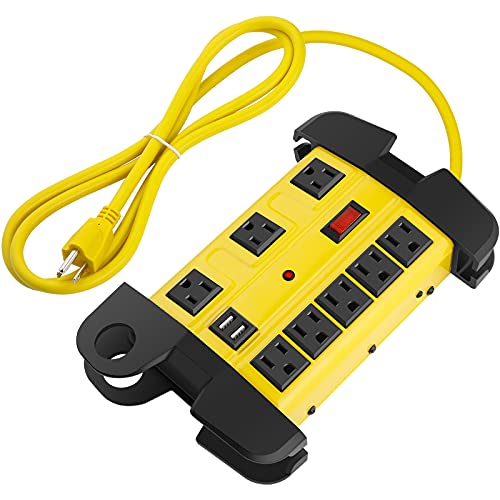
Outlets at bench height on two dedicated circuits mean a saw and a vac never share a breaker. A ceiling drop or a retractable reel over the middle of the bay beats another wall socket. For dust, put a cyclone separator ahead of the shop vac so suction stays constant instead of fading as the filter loads, match the hose to your tool ports, and add an auto-start switch. It will not replace a dust collector on a planer, but for sanders, saws and cleanup it is the right first buy.
Phase 2: core power tools
Drill and impact driver, circular saw, random orbital sander, jigsaw or oscillating tool. This set handles repairs, assembly and most sheet-goods work.
The decision that matters is the battery platform, not the tools, because every later purchase gets cheaper once you can buy bare tools. Weigh it honestly: work most weekends and a brushless mid-tier or premium platform pays back in runtime and heat tolerance; run one project a month and a budget platform with a wide catalogue is the right answer, with the difference spent on Phase 1. Buy two batteries either way, one of them high-capacity.
On the tools themselves, a 7-1/4 inch circular saw with the blade on the left gives you a sightline, and with a clamped straightedge it does most of what a track saw does. Get a five-inch random orbit sander whose dust port fits your vac hose. Choose between the jigsaw and the oscillating tool by the work: curves and cutouts point to the jigsaw, flush cuts, trim removal and drywall patching to the multi-tool.
If the tools never leave the garage and the budget is tight, corded versions of the saw and sander cost less and never go flat. The trade-off is cords, and cords in a bay you also park in become a hazard you will resent.
Cordless combo kits
A four-tool brushless kit covers this phase in one purchase and usually costs less than buying two tools separately.
Phase 3: benchtop machines
Miter saw, benchtop drill press, and either a jobsite table saw or a track saw depending on your space. All on mobile bases or a rolling stand.
Table saw or track saw
A jobsite table saw suits repeat rips, narrow stock and joinery; look for a rack-and-pinion fence that stays parallel, a usable riving knife and a stand that does not flex. A track saw suits people who mainly break down plywood and cannot spare the footprint or the outfeed room, though it needs foam or a sacrificial platform and it is slow for repeated narrow cuts. Owning both is a later problem. Cabinets and shelving from sheet goods point to the track saw first.
Miter saw, drill press and matching heights
A 10-inch miter saw handles trim, framing and most furniture stock, costs less to feed with blades and is easier to move; go to 12 inches or a slider only if wide boards and deck framing are routine. On a drill press, quill travel, a cast-iron table and low runout matter more than horsepower, and if you never drill metal or dowels you can skip it for now. Set every machine table to bench height so each one works as outfeed support for the others.
Mobile machine bases
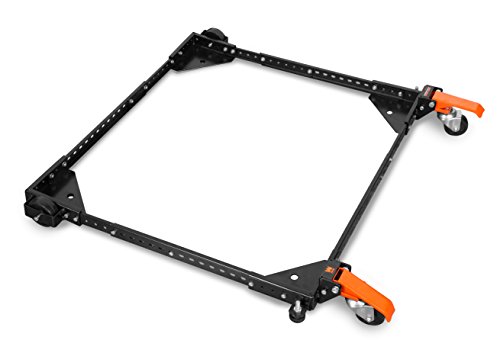
Every machine should roll. This is what lets a garage be a workshop and still hold a car.
Phase 4: air, dust and comfort
An air compressor for inflation, blowing out tools and nailers; a ceiling air filter; anti-fatigue matting; and heating or cooling depending on your climate. These are quality-of-life purchases that determine whether you actually use the shop.
On compressors, compare delivered air at 90 psi rather than tank size; the tank only buys a longer run before the motor restarts. In an attached garage a quiet oil-free unit earns its premium, because a loud one gets used less. A longer hose beats a bigger tank. Size a ceiling filter to the room volume, hang it where the air can loop back, and put matting where you stand rather than wall to wall.
Air compressors for garages
A pancake or small vertical unit covers tyres, blowing out tools and brad nailers. Larger tanks only matter for air tools.
Storage that survives
Storage fails when it assumes this year’s layout is permanent. A French cleat wall survives because it is a grid: build a holder, hang it anywhere, move it when the bench moves.
- ✔ French cleat wall for hand tools
- ✔ Rolling cabinet for consumables and fasteners
- ✔ Vertical sheet goods storage against a wall
- ✔ Lumber rack off the floor
- ✔ Labelled bins — future you will not remember
Cut cleats from three-quarter plywood at 45 degrees, screw them into studs, and keep the offcuts for future holders. Stand sheet goods on edge with a slight lean, keep lumber off the concrete so it stops wicking moisture, and label bins even when they are clear, because the label is what saves you.
What to skip in a garage
Everything below fails the same test: it claims floor or wall space you will want back.
- ✘ Full-size cabinet saws unless you have dedicated space and 220V
- ✘ Fixed benches on every wall — you lose flexibility
- ✘ Wall-mounted tool boards that block future layout changes
- ✘ Anything that cannot be moved when you need floor space
The costlier mistakes are quieter. Mixing battery platforms doubles your chargers and halves your usable spares. A dust collector bought before you own a machine that needs ducting is money parked in a corner. A flexing budget stand undoes the accuracy of a good miter saw. And a big-tank compressor bought for a brad nailer only takes longer to fill.
FAQ
How much space do I need? A single-car garage works if everything is mobile. Two-car is comfortable. What decides it is outfeed and assembly room, so measure the longest cut you plan to make rather than the floor area.
What about noise and neighbours? Miter saws and routers are the loudest offenders. Close the door and keep to reasonable hours. A quiet compressor and a vac silencer do more than anything you can change about the building.
Heating? Insulate the garage door first — it is the biggest heat loss by far. Then heat the space you occupy rather than the whole bay, and remember that glues and finishes have minimum working temperatures.
What if the budget only covers three things? Lights, a bench, then a combo kit. That order gives you a shop you will use; the reverse gives you good tools sitting on the floor of a dark garage.
See garage shop gear →