What's inside
As an Amazon Associate I earn from qualifying purchases. This post may contain affiliate links at no extra cost to you.
Thick construction adhesive is hard on a caulk gun. It takes steady force to push through a narrow nozzle, and a weak gun can stall, drip, or leave gaps when you try to keep a bead moving. A cordless model helps most on long runs, overhead work, and repeated applications—not necessarily on a one-off tube.
For this job, compare thrust, speed control, cartridge capacity, and the battery platform you already own. A high thrust rating is useful, but it is not a guarantee that every adhesive will flow easily: cold product, a small nozzle opening, and a stiff formula all increase resistance.
As an Amazon Associate we earn from qualifying purchases at no extra cost to you.


What matters with thick adhesive
Thrust: Manufacturers may state force in pounds or newtons. Higher ratings give more headroom for dense adhesive, but ratings are not always measured or presented the same way. Treat them as a comparison within a brand, not a promise that a gun will handle every product.
Speed control: A variable-speed trigger and adjustable feed speed make it easier to start slowly, maintain a consistent bead, and avoid pushing out too much material. A fast gun with coarse control can waste adhesive before you can react.
Anti-drip and pressure release: When you release the trigger, a good mechanism backs off pressure on the plunger. That reduces ooze at the nozzle. It will not stop every drip, especially with warm adhesive or a wide-open nozzle, so keep a scrap surface nearby.
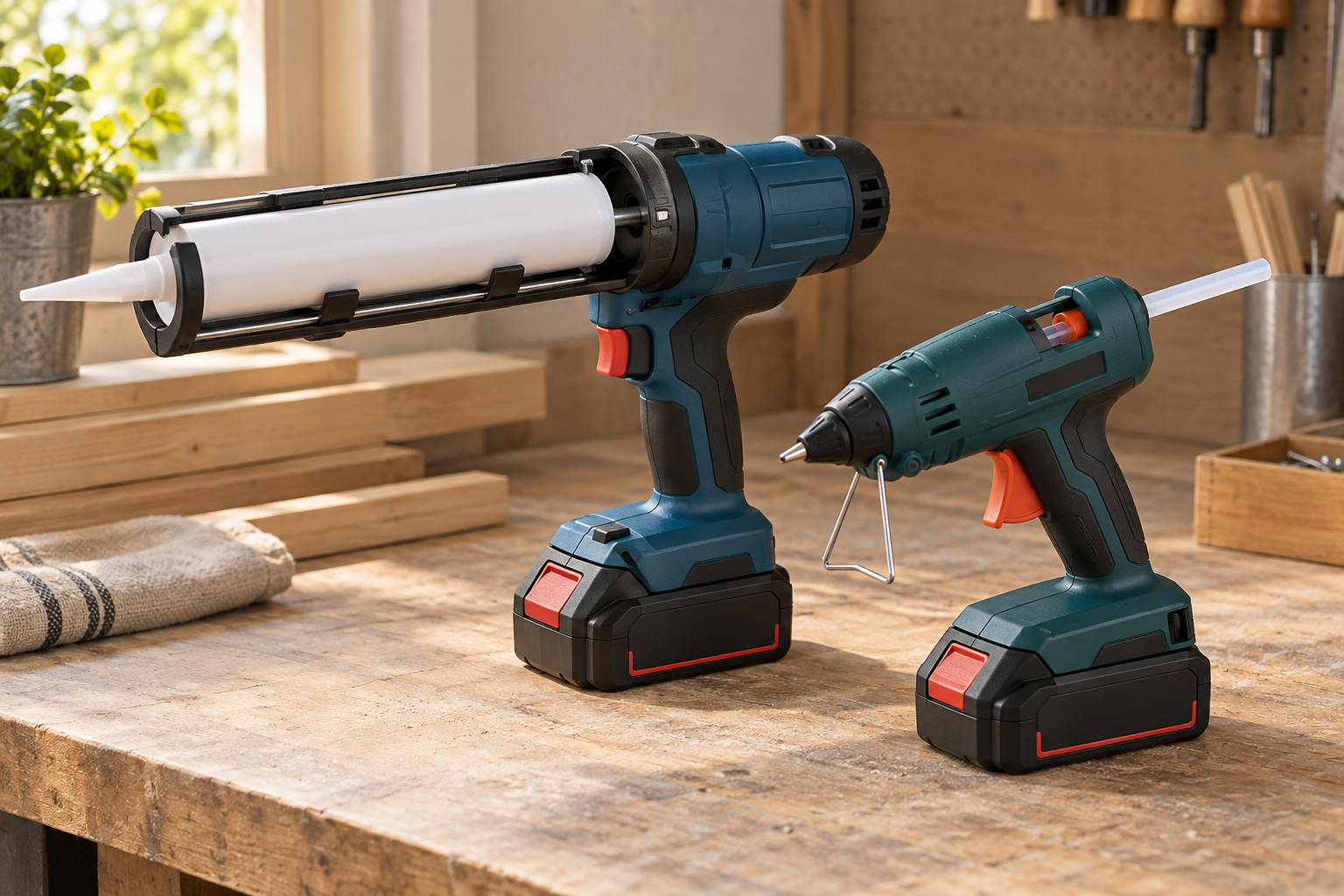
Capacity and balance: Most jobs use standard 10-ounce cartridges; larger 20-ounce sausages need a gun designed for that format. A larger gun can reduce cartridge changes, but it is heavier and less convenient in tight spaces. Check the product label and gun specifications before buying.
Cordless caulk gun types compared
| Type | Best for | Trade-off |
|---|---|---|
| Compact 10-ounce gun | Occasional repairs and standard cartridges | May lack the force or capacity for demanding, continuous work |
| Heavy-duty 10-ounce gun | Thick adhesive in standard cartridges | More weight and cost than a basic model |
| High-thrust or sausage gun | Frequent use, larger packs, long runs | Bulkier; verify cartridge compatibility and platform cost |
| Manual ratchet gun | One short bead or infrequent use | More hand effort and less consistent flow |
Choosing a gun and battery platform
If you already own cordless tools, start by checking for a caulk gun on that battery platform. Buying a bare tool can be a better value than starting another battery system. Compare the tool-only price with a kit price, and factor in whether the included charger and battery are useful for other tools you plan to buy.
For repeated work with dense adhesive in standard cartridges, look at high-thrust cordless 10-ounce caulk guns. Check the stated thrust, speed settings, anti-drip action, and whether the tool accepts the adhesive cartridge you use. A bare tool only makes sense if you already have compatible batteries and a charger.
For bigger jobs, consider a cordless sausage gun only if you actually buy adhesive in sausage packs. These guns can cut down on cartridge changes, but the pack format and loading procedure differ. Confirm capacity and compatibility rather than assuming a 10-ounce cartridge will fit.
A manual gun is still reasonable for a few short beads. A sturdy manual model costs less, needs no battery, and avoids storing another tool. The trade-off shows up when you have to hold the trigger for a long time: hand fatigue makes bead speed and pressure harder to control.
Set up the gun to prevent stalls and mess
Read the adhesive label first. Some products specify temperature limits, surfaces, or bead dimensions that matter more than the gun. If the cartridge is cold, let it reach the temperature recommended by the manufacturer. Cold adhesive can become noticeably harder to dispense; forcing the trigger may stall the tool or damage a cartridge instead of solving the problem.
Cut the nozzle conservatively. A smaller opening gives better control but raises pressure; an opening that is too small can make the gun struggle. Start with a modest cut, test on scrap, and enlarge it if the bead is too difficult to maintain. Cut at an angle if that helps you guide the nozzle into a joint.
Set feed speed low for the first test. Pull the trigger in short bursts until adhesive reaches the nozzle, then establish a steady pace. If the bead keeps surging, reduce speed or use a wider nozzle opening. If the motor slows sharply or stops, release the trigger. Do not keep forcing it: check the nozzle for a blocked opening, confirm the cartridge is seated, and inspect the adhesive instructions.
Avoid common failures
After use, release plunger pressure, retract the rod if the tool allows it, and remove the cartridge. Adhesive left to cure in the nozzle can block the next job; a cured plug may be harder to clear than the time saved by leaving the cartridge loaded. Wipe the plunger and barrel before material sets, following the tool maker’s cleaning guidance.
Keep spare batteries charged for long runs, but do not assume a larger battery will increase dispensing force. Battery capacity mainly affects runtime; the gun’s drive mechanism and the adhesive’s resistance determine whether it can push the bead. If the tool repeatedly stalls with a clean, properly cut nozzle and a warm cartridge, it may be the wrong match for that product.
Buy for the work you actually do
For occasional repairs, a manual gun or a basic cordless model on your existing platform may be enough. For frequent thick-adhesive work, prioritize controllable feed, adequate thrust, and anti-drip action over maximum speed. If the job uses large sausage packs, buy a compatible gun rather than trying to adapt a standard cartridge tool. Those checks matter more than a long list of features.
Related guides
- Longest Lasting Lawn Mower Battery: AGM vs Lithium vs Flooded Lifespan and Cost per Season
- Duralast Gold Lawn Mower Battery Review: U1 Fit, CCA and When to Pay for AGM
- Greenworks Pro 80V 21-Inch Mower Review: Runtime Math, Push vs Self-Propelled and Yard Fit
- Bosch High Pressure Washer Gun Replacement: Fittings, Adapters and What Fits Your Model