What's inside
As an Amazon Associate I earn from qualifying purchases. This post may contain affiliate links at no extra cost to you.
Repetitive drywall installation is a different job from occasional screwdriving. You may install several hundred screws in a day, often overhead, and a tool that feels fine for ten minutes can become tiring, inconsistent, or unreliable by lunch. The best cordless screw gun is not necessarily the fastest tool in the store. It is the one that controls depth repeatedly, balances well, and fits the battery platform you already use.
As an Amazon Associate we earn from qualifying purchases at no extra cost to you.


What makes a good drywall screw gun
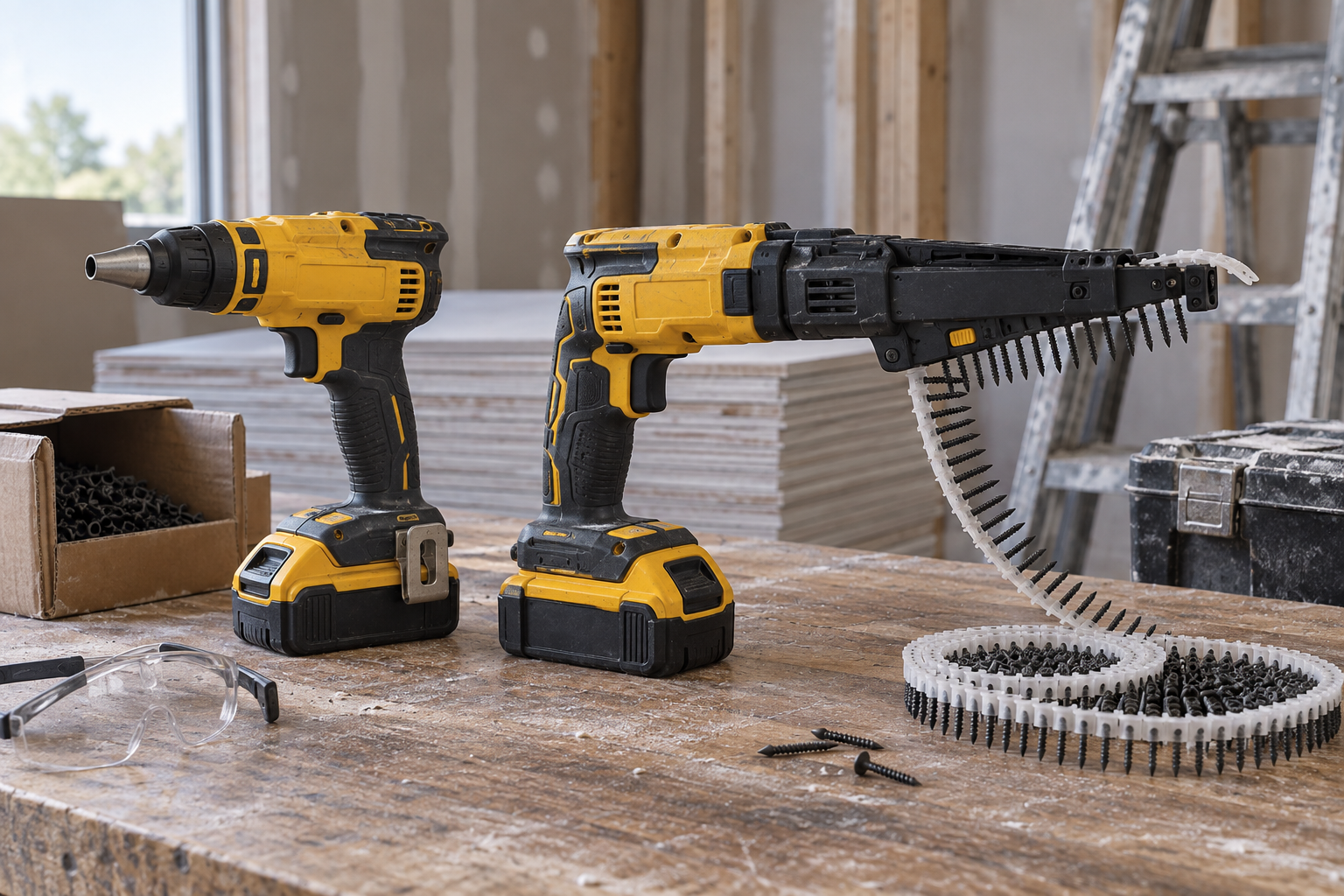
A dedicated drywall screw gun uses a high-speed motor, an adjustable nose cone, and a clutch or shutoff mechanism designed to stop driving at a set depth. That matters because drywall screws must dimple the paper face without tearing through it. A torn face reduces holding power and leaves a weak spot that can show through finishing compound.
Look for a tool with a usable depth adjustment rather than a control that moves too freely. The adjustment should hold its setting when the tool vibrates. A lock-on switch is also valuable for repetitive work, although it should be used carefully when working near wiring, outlets, or other obstructions.
Most cordless drywall screw guns run at roughly 4,000 to 6,000 rpm. That speed is useful for standard fine-thread and coarse-thread drywall screws, but it is not a substitute for correct pressure. Hold the gun square to the panel and apply enough forward force to keep the nose cone engaged. Pulling away too early can leave proud screws; pushing too hard can bury or strip them.
Dedicated screw gun versus drill or impact driver
A drill driver can install drywall screws, and it is perfectly reasonable for a small repair or one-room project. Set the clutch low, use a depth stop if available, and check the first several screws. The problem is consistency. A drill’s clutch can behave differently as the bit heats up, the battery voltage drops, or the operator changes pressure.
An impact driver is usually the wrong primary tool for drywall. Its hammering action makes depth control less predictable and can tear paper quickly. It is useful for framing, backing out damaged screws, and driving structural fasteners, but not for hundreds of finish-sensitive drywall screws.
For a whole house, basement, or production-style job, choose a cordless drywall screw gun. For occasional drywall work, a drill driver from your existing battery system is the cheaper option and may be all you need.
| Tool type | Best use | Main advantage | Main drawback |
|---|---|---|---|
| Dedicated screw gun | Large drywall jobs | Fast, repeatable depth control | Less useful for general tasks |
| Auto-feed screw gun | Very high screw counts | Feeds strips without handling each screw | Heavier, costlier, and more setup-sensitive |
| Drill driver | Repairs and occasional rooms | Already useful for many jobs | Slower and less consistent at scale |
| Impact driver | Framing and heavy fastening | Compact and powerful | Poor depth control for drywall |
When an auto-feed model is worth buying
An auto-feed drywall screw gun uses collated screw strips and advances the next fastener after each drive. This removes the repeated motion of picking up a screw, placing it on the bit, and starting the tool. On a large ceiling or commercial-style job, that can reduce hand movement and keep production moving.
The trade-off is weight and complexity. The feed attachment can make the tool nose-heavy, and poorly aligned strips may cause jams or partially driven screws. You also need the correct collated screws; loose screws generally cannot be used through the attachment. If you install only a few hundred screws per project, the extra cost may not pay back. If you routinely install thousands, compare cordless auto-feed drywall screw guns with standard models based on total labor saved, not just the tool price.
Battery platform and runtime
Battery choice affects fatigue as much as runtime. A compact battery keeps the tool lighter for ceilings, but a larger pack may be worthwhile when working away from the charger. As a practical starting point, carry two charged packs and rotate them. A screw gun uses less energy per fastener than a saw, but high-speed operation and cold conditions still reduce runtime.
For overhead work, a compact 2.0Ah to 4.0Ah pack is often more comfortable than a high-capacity pack. For wall panels or long production runs, a 5.0Ah or larger pack can reduce battery changes. The best answer is usually the battery system already shared by your drill, light, reciprocating saw, and other cordless tools.
Do not choose a platform solely because its bare tool is inexpensive. Check the cost of a replacement battery and charger, the availability of smaller packs, and whether the manufacturer offers a suitable charger at the jobsite. A fast charger is convenient, but it can be noisy and may generate more heat than a slower charger.
If you are starting from zero and want one battery system for general remodeling, compare 18V or 20V cordless tool kits that include a drill, charger, and two batteries. The screw gun should be an addition to a useful ecosystem, not the reason to buy into a poorly supported one.
Setup and depth control
Before starting a wall, test ten screws on a scrap piece of the same drywall and framing material. The screw head should sit slightly below the paper surface, creating a shallow dimple without breaking the paper. If the bit spins after the nose cone reaches the panel, reduce pressure or adjust the depth stop. If the screw remains proud, increase depth in small increments.
Use the correct screw length. For standard 1/2-inch drywall over wood framing, 1-1/4-inch screws are common; thicker layers require longer fasteners. Metal framing may require fine-thread screws, while wood framing typically uses coarse-thread screws. Confirm the specification for the board and framing rather than relying on one screw type for every job.
Common failure modes
Stripped screw heads usually indicate a worn bit, poor alignment, insufficient forward pressure, or a screw type that does not match the material. Replace the bit early; a cheap worn bit can waste more time than it costs. Screws that spin without gripping may have missed the stud or been driven into a damaged hole.
Overdriven screws are often caused by a depth setting that is too aggressive or by leaning hard into the tool. Back out badly damaged screws and replace them nearby, rather than trying to bury them deeper. Keep the nose cone clean of gypsum dust, since buildup can change the effective depth and interfere with the shutoff mechanism.
Related guides
- Longest Lasting Lawn Mower Battery: AGM vs Lithium vs Flooded Lifespan and Cost per Season
- Duralast Gold Lawn Mower Battery Review: U1 Fit, CCA and When to Pay for AGM
- Greenworks Pro 80V 21-Inch Mower Review: Runtime Math, Push vs Self-Propelled and Yard Fit
- Bosch High Pressure Washer Gun Replacement: Fittings, Adapters and What Fits Your Model