
What's inside
- What Is a 7 1/4 Miter Saw?
- What Can a 7 1/4 Miter Saw Cut?
- Understanding the Cutting Capacity of a 7 1/4 Miter Saw
- 7 1/4 vs. 10-Inch vs. 12-Inch Miter Saws
- Corded vs. Cordless 7 1/4 Miter Saws
- Important Features to Consider Before Choosing a 7 1/4 Miter Saw
- How to Use a 7 1/4 Miter Saw Safely
- Common Limitations of a 7 1/4 Miter Saw
- Is a 7 1/4 Miter Saw Worth Buying?
- Frequently Asked Questions
- Final Thoughts
As an Amazon Associate I earn from qualifying purchases. This post may contain affiliate links at no extra cost to you.
A 7 1/4 miter saw is a compact power saw designed to make accurate crosscuts, miter cuts, and bevel cuts using a 7 1/4-inch (184–185 mm) circular blade. It is particularly useful for trim installation, small woodworking projects, flooring, shelving, and general home renovation. Compared with larger 10-inch and 12-inch miter saws, it can offer easier transportation and a smaller workspace footprint, although its cutting capacity depends heavily on the saw’s design.
The important distinction is that blade diameter alone does not determine what a miter saw can cut. A sliding 7 1/4-inch model may handle considerably wider boards than a non-sliding model with the same blade size. Understanding blade dimensions, cutting capacity, sliding mechanisms, and bevel functions will help you decide whether this saw is suitable for your projects.
As an Amazon Associate we earn from qualifying purchases at no extra cost to you.


Our Top Picks
 Hoteche 7-1/4-Inch Miter Saw 7.5A Compound Single Bevel7.5in Sliding Single Bevel1 x 1 x 1 inchesCheck on Amazon

What Is a 7 1/4 Miter Saw?
A 7 1/4 miter saw is a stationary or portable cutting tool that uses a blade approximately 7.25 inches in diameter. The saw head pivots downward to cut material supported against a rear fence, while the rotating table allows the operator to select different miter angles.
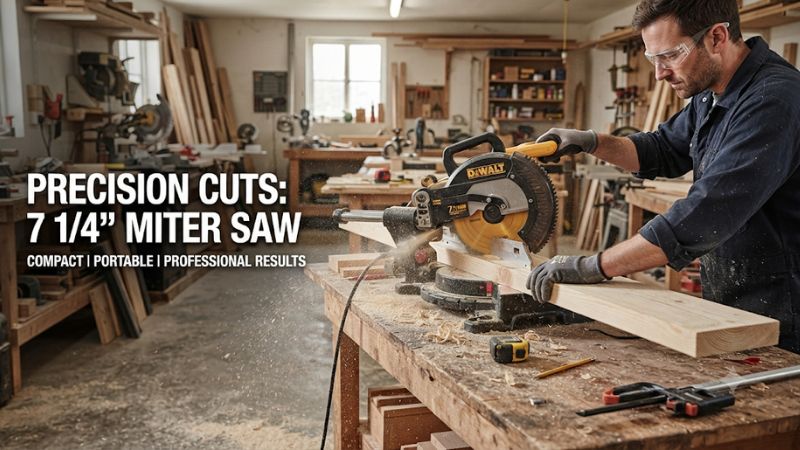
The 7 1/4-inch measurement refers to the blade diameter, not the maximum width or thickness of material the saw can cut.
These saws are available in several configurations:
- Basic miter saw: Rotates the cutting head horizontally to make angled crosscuts.
- Compound miter saw: Adds a bevel function, allowing the blade to tilt for angled cuts through the material.
- Sliding compound miter saw: Uses sliding rails to move the blade across wider workpieces.
- Dual-bevel sliding miter saw: Tilts in both directions and slides, reducing the need to reposition material for opposite bevel cuts.
Each configuration serves a different purpose. A basic model may be sufficient for small trim projects, while a sliding compound version provides more flexibility for wider boards and complicated woodworking tasks.
For example, DEWALT’s DCS361B is a cordless 7 1/4-inch sliding miter saw designed around its 20V MAX battery platform. Its manufacturer specifies an 8-inch horizontal cutting capacity at 90 degrees. This illustrates why checking the complete model specifications matters more than judging a saw by blade diameter alone.
dewalt.com+1
What Can a 7 1/4 Miter Saw Cut?
A 7 1/4 miter saw is suitable for many common woodworking and renovation materials, provided the workpiece dimensions fall within the manufacturer’s published cutting capacity.
Typical applications include:
- Wood trim, casing, and baseboards.
- Dimensional lumber used in small construction projects.
- Shelving boards and furniture components.
- Flooring materials approved for the installed blade.
- PVC trim and compatible plastic materials.
- Small framing components and woodworking stock.
The saw’s actual capabilities depend on the blade, cutting angle, sliding mechanism, and material dimensions.
Cutting dimensional lumber
Dimensional lumber is commonly used in home improvement projects. A suitable 7 1/4-inch saw can handle many smaller boards, but the maximum crosscut width varies considerably between models.
A compact non-sliding saw may have limited horizontal reach. A sliding model can move the blade across a wider board while maintaining the same blade diameter.
For example, the SKIL MS6316-00 is a 10-amp, single-bevel sliding miter saw with a published maximum 90-degree cutting capacity of 2 × 10 lumber. Its manufacturer also specifies a 2 × 6 capacity for 45-degree miter cuts. These figures are specific to that model and should not be treated as universal capacities for every 7 1/4-inch saw.
SKIL (MS6316-00)
Cutting baseboards and trim
Baseboards, door casings, and decorative trim are among the most practical applications for this saw size.
A miter saw can produce accurate angled joints, helping trim pieces meet neatly at inside and outside corners. A compound model also allows bevel adjustments when the project requires angled edges.
However, tall baseboards and wide molding should be checked against the saw’s vertical capacity. A board that fits horizontally may still be too tall to position safely against the fence.
Cutting crown molding
Some 7 1/4-inch sliding miter saws support crown molding, but their capacity is generally more limited than larger saws.
The important specifications are nested crown capacity and base molding capacity. These describe how much molding the saw can accommodate in the intended cutting position.
Do not assume that every compact saw can handle standard crown molding. Check the exact manual and use the manufacturer’s recommended cutting orientation and support arrangements.
Understanding the Cutting Capacity of a 7 1/4 Miter Saw
Cutting capacity is one of the most important specifications to examine before buying a miter saw.
It describes the maximum workpiece dimensions the manufacturer permits for a particular combination of miter and bevel angles.
| Specification | What It Means |
| 90-degree crosscut | Maximum width and height for a straight cut |
| 45-degree miter | Maximum material dimensions when the table is rotated |
| 45-degree bevel | Maximum dimensions when the blade tilts |
| Compound cut | Capacity when both miter and bevel angles are adjusted |
| Sliding capacity | Maximum supported horizontal reach with the sliding mechanism |
| Vertical capacity | Maximum material height supported against the fence |
These measurements are not interchangeable. A saw capable of cutting a wide board at 90 degrees may have a significantly smaller capacity when set to a 45-degree miter.
Does a 7 1/4 miter saw cut a 2×4?
Yes. Many 7 1/4-inch miter saws can cut a standard 2×4 in one pass, although you should confirm the exact model’s capacity.
A nominal 2×4 actually measures approximately 1.5 × 3.5 inches after standard dimensional lumber processing. Its actual dimensions, rather than the nominal name, should be used when checking clearance.
Can a 7 1/4 miter saw cut a 2×6?
Some models can cut a 2×6 in one pass, while others cannot.
A standard 2×6 measures approximately 1.5 × 5.5 inches. A sliding model generally offers more horizontal cutting reach than a compact non-sliding design.
Always compare the manufacturer’s capacity chart with the actual board dimensions and intended cutting angle.
Can a 7 1/4 miter saw cut a 4×4?
Not necessarily. A 4×4 has actual dimensions of approximately 3.5 × 3.5 inches, so the saw must provide sufficient cutting depth.
Blade diameter does not automatically establish the maximum cutting depth because the blade’s position, arbor arrangement, and saw-head geometry also matter.
If the manufacturer’s specifications do not explicitly support the required dimensions, choose a larger suitable saw rather than improvising a cutting method.
7 1/4 vs. 10-Inch vs. 12-Inch Miter Saws
The main difference between these sizes is their potential cutting capacity, portability, and suitability for different workloads.
General comparison. Actual capacity and weight depend on the individual saw design.
| Feature | 7 1/4-Inch | 10-Inch | 12-Inch |
| Blade diameter | 7.25 inches | 10 inches | 12 inches |
| Portability | Generally easier | Moderate | Generally lower |
| Workspace requirements | Often compact | Moderate | Often larger |
| Cutting depth | More limited | Greater potential | Greater potential |
| Typical applications | Trim and smaller boards | General woodworking | Wider and thicker stock |
| Blade availability | Common | Common | Common |
7 1/4-inch vs. 10-inch miter saw
A 10-inch miter saw offers a larger blade and generally greater cutting depth. It may be more suitable for users who regularly cut thicker lumber, larger molding, or construction materials.
A 7 1/4-inch saw, on the other hand, can be easier to transport and store. It is attractive for contractors who move between smaller jobsites and homeowners who do not need the additional capacity of a larger machine.
However, sliding mechanisms can narrow the difference in horizontal cutting capacity. A sliding 7 1/4-inch model may cut wider boards than a non-sliding 10-inch model.
7 1/4-inch vs. 12-inch miter saw
A 12-inch saw is designed for applications that require substantial cutting capacity. Larger blades can accommodate deeper cuts, while sliding designs provide additional horizontal reach.
This makes 12-inch models useful for demanding carpentry, larger molding, and repetitive construction work.
The trade-off is that these machines generally require more storage space and can be heavier to transport.
For occasional DIY work, the additional capacity may not justify the larger footprint. For professional users who regularly handle large materials, it can be an important advantage.
Corded vs. Cordless 7 1/4 Miter Saws
Another important buying decision is whether to choose a corded or cordless configuration.
Both types can perform accurate cutting operations, but their power requirements and ownership costs are different.
Corded 7 1/4 miter saws
Corded models connect to an electrical supply and are suitable for workshops, garages, and jobsites with reliable access to compatible power.
Their main advantages include:
- No battery charging between cutting sessions.
- Consistent access to the rated electrical supply.
- No need to purchase replacement battery packs for normal operation.
- Suitable for extended workshop use when operated within manufacturer limitations.
However, the power cord restricts movement and introduces additional setup considerations. Users must keep the cable away from the blade, moving components, and cutting area.
Always verify the required voltage and frequency before connecting a corded saw. A US-market 120V, 60Hz model should not automatically be assumed compatible with a 220–240V electrical supply.
Cordless 7 1/4 miter saws
Cordless models provide greater freedom of movement, making them useful for remodeling projects, remote jobsites, and locations without convenient electrical access.
For example, the DEWALT DCS361B operates on the 20V MAX platform. DEWALT specifies a nominal battery voltage of 18V, with 20V representing maximum initial voltage measured without a workload. The DCS361B is sold as a bare tool, so its battery and charger must be purchased separately.
dewalt.com
The Milwaukee 2733-20 is another example. It belongs to the M18 battery platform and is a 7 1/4-inch dual-bevel sliding compound miter saw. Milwaukee lists a weight of 28 pounds with battery and a horizontal 2×8 cutting capacity at 90 degrees.
Milwaukee Tool
When comparing cordless models, consider:
- Battery platform compatibility.
- Battery capacity and the number of packs included.
- Charger compatibility.
- Tool weight with the battery installed.
- Manufacturer-published runtime or cut-count conditions.
- Replacement battery costs.
A bare-tool price does not represent the complete purchase cost if you still need batteries and a charger.
Important Features to Consider Before Choosing a 7 1/4 Miter Saw
Not every saw with a 7 1/4-inch blade offers the same functionality. Several design features can influence its usefulness for your projects.
1. Sliding mechanism
A sliding mechanism allows the saw head to travel horizontally along rails.
This increases the width of material the blade can crosscut without requiring a larger blade diameter.
For users who frequently cut shelving boards, wider trim, and dimensional lumber, sliding functionality can be particularly useful.
However, sliding rails add mechanical components and may increase the saw’s overall size. Some compact models use fixed-rail arrangements to reduce the rear clearance required behind the machine.
2. Single-bevel vs. dual-bevel design
A single-bevel saw tilts in one direction, usually to the left. To create the opposite bevel orientation, the operator generally needs to reposition or turn the workpiece.
A dual-bevel saw tilts in both directions, making repeated compound cuts more convenient.
This feature can save setup time when installing crown molding, creating furniture components, or completing projects with multiple mirrored angles.
Dual-bevel functionality does not automatically mean greater cutting capacity. Check the model’s specifications for both bevel directions.
3. Miter angle range and detents
The miter range determines how far the rotating table can turn to the left or right.
Common detent positions include:
- 0 degrees for straight crosscuts.
- 15 degrees for angled joints.
- 22.5 degrees for common polygon layouts.
- 31.6 degrees for certain crown molding applications.
- 45 degrees for standard corner joints.
Some saws also offer additional detent positions and an override mechanism for selecting intermediate angles.
A positive detent helps locate frequently used angles, but it does not eliminate the need to verify accuracy and secure the table before cutting.
4. Blade quality and tooth count
The blade has a major influence on the finish of the cut.
A lower-tooth-count blade can be suitable for general crosscutting, while a higher-tooth-count blade may produce cleaner results on certain trim and woodworking materials.
However, tooth count is not the only consideration. Blade geometry, tooth design, material compatibility, and cutting speed also affect performance.
Before purchasing a replacement blade, verify:
- The required 7 1/4-inch diameter.
- Correct arbor-hole diameter.
- Maximum permitted kerf thickness.
- Rated operating speed.
- Compatibility with the material.
- Manufacturer approval for the particular saw.
For example, the DEWALT DCS361 manual specifies a 7 1/4-inch blade with a 5/8-inch round arbor hole, maximum kerf of 2.1 mm, and minimum speed rating of 4,500 RPM. These requirements are model-specific, not universal specifications for all 7 1/4-inch saws.
dewalt.com
5. Dust collection and cut-line visibility
Dust collection is particularly important when using a miter saw indoors or in a workshop.
Some models include dust bags, while others provide ports for connection to compatible extraction equipment.
Cut-line visibility is another useful feature. Depending on the design, a saw may use a laser or LED shadow-line system to help position the blade relative to the workpiece.
These features can improve setup convenience, but they do not replace accurate measurements, appropriate dust controls, or proper cutting technique.
How to Use a 7 1/4 Miter Saw Safely
A smaller blade does not make a miter saw harmless. The rotating blade can cause severe injuries, and incorrect workpiece positioning can lead to unexpected movement during cutting.
Follow the exact manufacturer’s operating instructions.
- Prepare the work area. Place the saw on a stable, level surface or a properly secured miter saw stand. Ensure adequate lighting and space for supporting long materials.
- Inspect the equipment. Check the blade, power cord or battery, fence, table, clamp, and blade guard. Do not operate a saw with damaged components or a malfunctioning guard.
- Wear appropriate PPE. Use safety glasses or suitable eye and face protection, hearing protection, and appropriate respiratory protection based on the material and dust exposure.
- Secure the workpiece. Position the material firmly against the fence and use the supplied clamp when appropriate. Never hold a small workpiece close to the blade by hand.
- Set the cutting angle. Adjust the miter and bevel settings according to the project requirements. Tighten the adjustment locks before operating the saw.
- Check blade clearance. With the saw disconnected from its power source, verify that the blade and guard can move through the intended cutting path without contacting the fence, clamp, or other components.
- Make the cut. Follow the operating sequence in the manual. On sliding models, use the prescribed head movement and never pull the rotating blade toward yourself through the workpiece.
- Wait for the blade to stop. Keep your hands away from the cutting area until the blade has completely stopped. Only then should you remove the material or make adjustments.
OSHA identifies miter saw blade contact as a serious point-of-operation hazard and emphasizes effective guarding and keeping hands away from the blade.
Occupational Safety and Health Administration+1
Important: Never disable the blade guard, cut freehand, or reach behind the blade. Disconnect the power source before changing blades, servicing the machine, or performing adjustments that require access to moving components.
Common Limitations of a 7 1/4 Miter Saw
Although compact miter saws are versatile, they are not suitable for every cutting application.
Limited cutting depth: The smaller blade diameter restricts the maximum depth available compared with many 10-inch and 12-inch models.
Reduced capacity on thicker materials: Some workpieces require a larger saw to complete a cut in one pass. Never assume that flipping a workpiece or making multiple cuts is safe or accurate unless the manufacturer explicitly permits the procedure.
Limited crown molding capacity: Smaller models may not accommodate taller or wider molding profiles in a nested position.
Blade compatibility restrictions: A 7 1/4-inch blade must also have the correct arbor, kerf, speed rating, and material suitability. Matching diameter alone is insufficient.
Different capacities between models: Two saws with identical blade diameters can have substantially different cutting capacities because of their sliding mechanisms and head designs.
For these reasons, the manufacturer’s capacity chart should be one of the first documents you review before purchasing.
Is a 7 1/4 Miter Saw Worth Buying?
A 7 1/4 miter saw can be a practical investment when its cutting capacity matches your regular workload.
It is particularly appropriate for homeowners, DIY enthusiasts, finish carpenters, and contractors who prioritize portability and work with smaller materials.
Consider the following scenarios:
| User or Project | Suitability | Reason |
| DIY furniture projects | Good | Handles many small woodworking components |
| Baseboard installation | Good | Supports common trim-cutting applications |
| Door casing | Good | Useful for accurate angled joints |
| Small shelving projects | Good | Compact design suits smaller boards |
| Frequent large framing cuts | Depends on model | Requires sufficient cutting capacity |
| Large crown molding | Limited | Vertical and nested capacity may be insufficient |
| Heavy-duty construction | Depends on workload | Larger saws may offer more suitable capacity |
If you already own compatible cordless batteries, a cordless model may also reduce your overall equipment costs. However, purchasing an entirely new battery platform just for a miter saw can make the initial investment less attractive.
For regular workshop use, compare corded models as well. The absence of battery charging requirements can be beneficial when performing repeated cuts throughout the day.
Frequently Asked Questions
Is a 7 1/4 miter saw big enough for home projects?
Yes, a 7 1/4 miter saw is suitable for many home improvement projects, including trim installation, shelving, furniture components, and smaller woodworking tasks. Its suitability depends on the dimensions of the materials you intend to cut.
What size wood can a 7 1/4 miter saw cut?
The answer depends on the specific model and its sliding mechanism. Some models handle nominal 2×4 lumber, while certain sliding versions support 2×8 or even 2×10 crosscuts. Always check the manufacturer’s cutting capacity chart for the intended angle.
Is a sliding 7 1/4 miter saw better than a non-sliding model?
A sliding model generally offers greater horizontal cutting capacity because its blade can travel across wider materials. A non-sliding model can be simpler and more compact, making it suitable for projects that do not require additional cutting reach.
Can I use a circular saw blade on a 7 1/4 miter saw?
Not automatically. A circular saw blade must meet the miter saw manufacturer’s requirements for diameter, arbor size, kerf thickness, operating speed, tooth configuration, and intended material. Only use blades approved for the particular saw and cutting application.
Final Thoughts
A 7 1/4 miter saw is a useful compact cutting solution for woodworking, trim installation, furniture projects, and everyday home renovation. Its smaller blade can provide sufficient capacity for many common tasks while making transportation and storage easier than with some larger saws.
The most important buying consideration is not simply the blade diameter. Sliding capability, crosscut capacity, bevel functionality, blade compatibility, and the dimensions of your typical workpieces should determine whether a particular model is suitable.
If your projects mainly involve smaller boards, baseboards, and casing, a 7 1/4-inch model may provide all the capacity you need. If you regularly work with thicker lumber, wide molding, or larger construction materials, compare its specifications against a 10-inch or 12-inch alternative before making a purchase.
Choose a saw that comfortably supports your actual workload, follow its operating manual, and prioritize safe workpiece support and blade guarding.
Related guides
More from Amazon
Programs that pair well with the guide above. Offers and eligibility are set by Amazon and may change.
A free business account with business pricing and bulk-buying tools for work, shop or home office.
Create a business accountFree shipping on eligible items, Prime Video and more. Eligible new members can start with a free trial.
Start a Prime free trialAudiobooks and podcasts to listen to on the go. Eligible new members can start with a free trial.
Try Audible freeAd-free music streaming. Eligible new subscribers can start with a free trial.
Try Music Unlimited freeAs an Amazon Associate we earn from qualifying purchases.
Write Your Review
No reviews yet. Be the first to share your experience!