What's inside
As an Amazon Associate I earn from qualifying purchases. This post may contain affiliate links at no extra cost to you.
On a jobsite, a soft tire on a wheelbarrow, skid-steer, mini excavator, or dump cart doesn’t just slow you down – it chews up sidewalls and rips beads when you run loaded over rebar and gravel. A cordless inflator that lives in the gang box or service truck saves a trip to the compressor and lets you air up before the tire is damaged. The right choice depends on what you are actually inflating and which battery platform you already own.
As an Amazon Associate we earn from qualifying purchases at no extra cost to you.


Pressure vs. Volume: What Equipment Tires Actually Need
Most site equipment tires fall into two very different air needs. Small high-pressure tires like wheelbarrows, hand trucks, plate compactors, and small trailer tires often want 50-90 PSI but hold very little air volume. Larger low-pressure tires like skid-steer, zero-turn mower, tractor, and UTV tires might only need 30-45 PSI, but they hold 10 to 30 times more air.
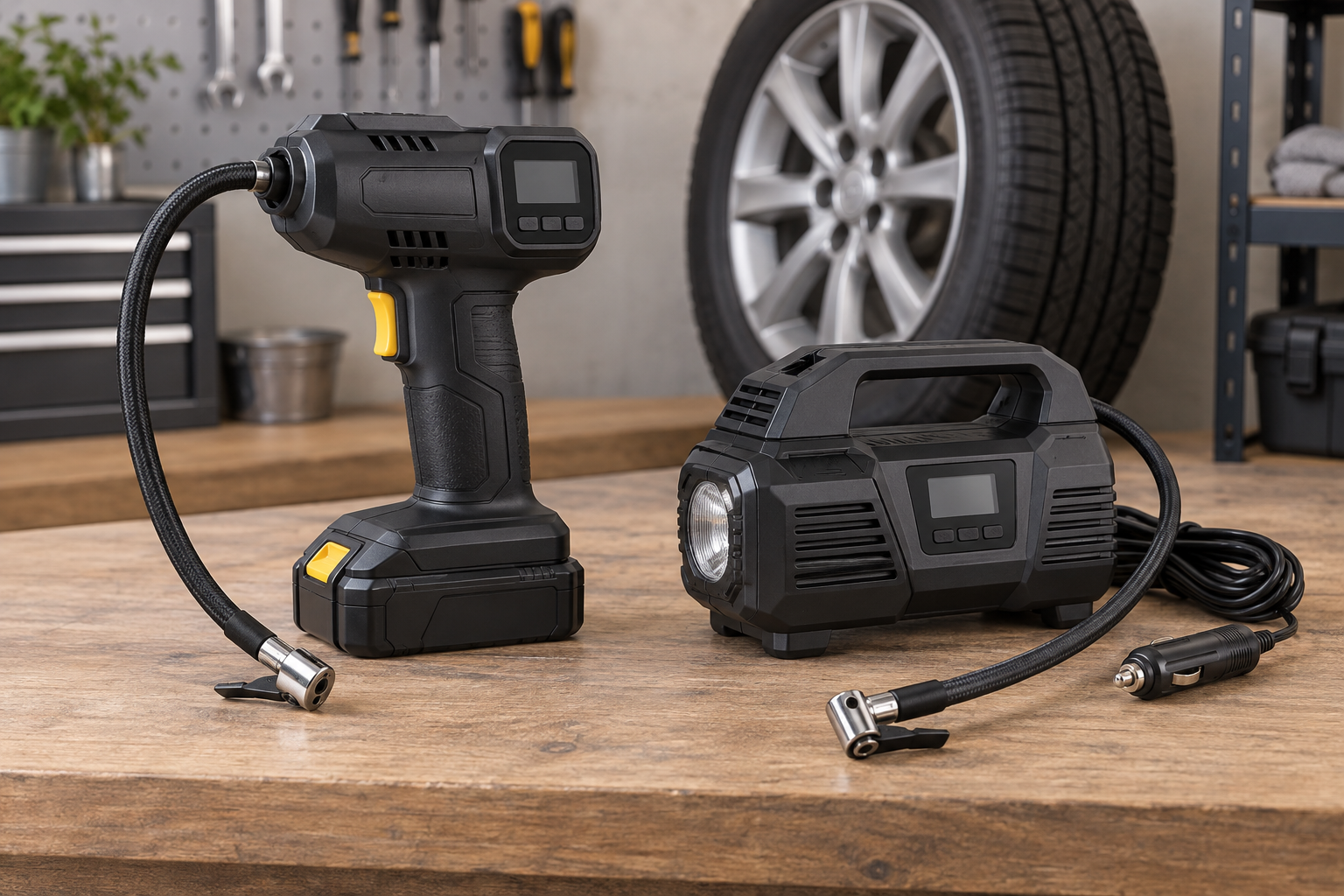
That distinction matters because cordless inflators are built for one job or the other. A compact high-pressure inflator (the brick-shaped units with a digital gauge and short hose) can hit 120-160 PSI, but its airflow is tiny – typically 15-25 liters per minute. It will take a completely flat compact tractor rear tire from 0 to 32 PSI in 15 to 20 minutes if it doesn’t overheat first, and most have a 10-15 minute duty cycle before they need to cool down.
A cordless high-volume inflator/blower (the kind that also does rafts and air mattresses) moves a lot of air at under 10 PSI. It will not seat a bead or inflate any equipment tire. For site work you want pressure. If you also need to handle large tubeless tires quickly, a cordless tire inflator on your existing 18V platform paired with a small 2-3 gallon cordless compressor is often faster than waiting on a slow inflator.
What to Look For in a Site Inflator
Forget marketing max PSI numbers. Every decent unit claims 120 PSI or more. What matters on site is accuracy, duty cycle, hose and chuck design, and power source.
Gauge accuracy: Built-in gauges are often off by 3-6 PSI, which is enough to leave a skid-steer tire 15% under-inflated. Look for units with a claimed +/- 1 to 2 PSI accuracy and then verify once with a separate dial gauge you trust. Auto-shutoff at a set pressure is useful, but don’t trust it blindly until you’ve checked it. The better inflators hold the set pressure within 1 PSI on repeat tests.
Duty cycle and heat: This is the number one failure mode. Inexpensive inflators use a small piston compressor that gets extremely hot. After 8-10 minutes of continuous running, the thermal cutoff trips or the plastic cylinder softens and efficiency drops. Check the manual for duty cycle – a common spec is 10 minutes on / 10 minutes off. If you plan to air up four equipment tires in a row, you need a unit with a larger metal cylinder and cooling fins, or you will be waiting around.
Hose and chuck: A 20-24 inch rubber hose with a threaded brass chuck beats a 12 inch plastic hose with a lever lock. On site, you are reaching past fenders, counterweights, and mud. The short hose forces you to hold the inflator at an awkward angle and it vibrates off the valve. A threaded Schrader chuck seals better when the valve stem is dirty. Bring a spare valve core tool – a leaking or slow core will make any inflator look weak.
Power source: The most versatile site units run off both your tool battery and 12V vehicle power. Battery-only is fine if you already carry spare packs, but a dead 2.0Ah battery at 25 PSI leaves you stranded. Units that can also plug into a truck’s 12V socket let you finish the job. Avoid inflators with internal non-removable lithium packs if you work away from outlets – you cannot swap in a fresh pack when it dies.
Dust and vibration: Jobsite dust kills inflators with exposed intakes and no filter. Keep the intake clear and blow it out with compressed air at the end of the week. Also secure the inflator during transport. They bounce around in toolboxes and crack hose fittings at the base, which then leak at 40 PSI and never build pressure correctly.
Comparison: Types of Cordless Inflation Options
| Type | Typical Max PSI | Time to Fill Standard Wheelbarrow Tire (4.80×8) 0-60 PSI | Best Use Case | Weakness on Site |
|---|---|---|---|---|
| Compact 12V/18V Inflator (tool battery platform) | 120-160 | 3-5 minutes | Top-offs, wheelbarrows, hand trucks, small trailers | Slow on large volume tires, duty cycle limited |
| Multi-Power Inflator (battery + 12V + 120V) | 120-150 | 3-5 minutes | Service truck, shared crew use | Bulkier, more expensive, more hose connections to leak |
| Cordless 2-Gallon Compressor (18V/40V) | 120-135 | 1-2 minutes | Seating beads, multiple large tires, blowing out filters | Heavy (15-25 lbs), uses batteries fast, overkill for top-offs |
| 12V Direct-Drive (cigarette lighter plug only) | 100-120 | 6-10 minutes | Emergency backup in personal vehicle | Very slow, melts cheap plugs, not for repeated site use |
Staying in Your Battery Ecosystem
For most crews the smartest inflator is the one that uses batteries you already own. Buying into a new battery for a $60 inflator makes no sense when you have five 5.0Ah packs on the same platform.
All major 18V/20V platforms now have at least one inflator option, and 12V sub-compact versions exist for lighter use. Performance between brands is surprisingly similar at the same price point – the airflow and duty cycle are limited by the physics of a small piston, not the logo. The difference is warranty support and whether the inflator is actually stocked at your local supply house when the hose rips.
Expect to pay $70-$110 for a bare tool inflator from your platform if you already own batteries. Kits with a 2.0Ah battery and charger often run $120-$160. If you don’t have a cordless platform yet and just need one inflator for a maintenance shed, a standalone battery powered tire inflator with gauge with its own charger and 12V adapter is cheaper than buying into a full tool line.
Battery size matters. A small 2.0Ah pack will top off four wheelbarrow tires from 35 to 60 PSI easily, but may not finish one large zero-turn rear tire from flat. Carry a 4.0Ah or 5.0Ah pack for equipment duty. In cold weather, keep batteries inside the cab – a cold lithium pack at 30F can show half its normal runtime on a high-draw inflator.
When the Cheaper Option Is Fine And When It Isn’t
If your site work is limited to wheelbarrows, dollies, and single-axle utility trailers that just need a quick 10-15 PSI top-off once a week, a basic $45-$65 compact inflator is perfectly adequate. You don’t need auto-shutoff or high airflow. You do need a readable gauge and a chuck that doesn’t leak. The cheap units fail when you ask them to run for 15 minutes straight – don’t.
Step up when you are responsible for tubeless skid-steer or tractor tires that lose air regularly, or when you have to seat a bead after a tire came off the rim. No compact inflator will reliably seat a bead, even with a ratchet strap. For that you need tank pressure and burst volume. In that case a small cordless compressor or even a 12V portable air compressor for tractor tires with a 1-2 gallon tank is the right tool, even though it costs $200-$350 and weighs 10 times more.
Also consider how you check pressure. If you rely on the inflator’s gauge alone, you will run tires soft or over-hard. A $12 pencil gauge left in the dust is just as bad. Spend $20-$30 on a decent dial gauge with a pressure relief valve and check cold. That one tool extends tire life more than any inflator upgrade.
A Simple Site Routine That Prevents Flats
Don’t wait for a tire to look low. Visually, a tire at 25 PSI and a tire at 35 PSI look almost identical under load. Check pressures Monday morning cold, before the sun heats the tires and before you load the machine.
Set the inflator to 2 PSI above your target – the hose and chuck lose a little when you disconnect. Fill in short bursts if the unit is hot, and feel the cylinder head. If you can’t hold your hand on it, let it cool. After inflating, put a cap back on the valve stem. Missing caps let grit into the core and cause the slow leak you are constantly chasing.
Keep a small kit with the inflator: spare valve cores, a four-way valve tool, a brass chuck, and a plug kit for nail punctures. Most slow leaks on site are not punctures but leaking valve stems and loose cores. Tightening or replacing a core takes 30 seconds and solves the problem without any air at all.
Related guides
- Longest Lasting Lawn Mower Battery: AGM vs Lithium vs Flooded Lifespan and Cost per Season
- Duralast Gold Lawn Mower Battery Review: U1 Fit, CCA and When to Pay for AGM
- Greenworks Pro 80V 21-Inch Mower Review: Runtime Math, Push vs Self-Propelled and Yard Fit
- Bosch High Pressure Washer Gun Replacement: Fittings, Adapters and What Fits Your Model