Our Top Picks
 DEWALT Reciprocating Saw Blade Set for Metal andOne Size6.5 x 6.5 x 0.09 Inches0.28 poundsCheck on Amazon

What's inside
As an Amazon Associate I earn from qualifying purchases. This post may contain affiliate links at no extra cost to you.
Most first-time flippers buy tools in the wrong order. They start with a nail gun because framing looks like the fun part, then spend the first three weeks of the project doing demo with a pry bar and a Sawzall they borrowed. The best power tools for house flipping are not the most impressive ones. They are the ones that unlock the next phase of work on a house you are paying carrying costs on every single day.
So this list is ordered by purchase priority, not by price and not by how satisfying the tool is to use. Each entry says which job it unlocks, because on a flip that is the only metric that matters. If a tool does not remove a bottleneck between you and a certificate of occupancy or a listing photo, it can wait until the second flip.
| Priority | Tool | Job It Unlocks | Buy New Or Used |
|---|---|---|---|
| 1 | 18V/20V brushless drill and impact driver kit | Everything with a fastener in it | New, kitted |
| 2 | Cordless reciprocating saw | Demo, plumbing removal, nail-embedded wood | New |
| 3 | Cordless circular saw or track saw | Subfloor, sheathing, plywood ripping | New |
| 4 | Cordless oscillating multi-tool | Flush cuts, door jambs, drywall patches | New |
| 5 | Compact router or trim router | Countertop cutouts, hinge mortises, edge work | New |
| 6 | Miter saw (10 or 12 inch) | Trim, baseboard, casing, deck framing | Either |
| 7 | Pneumatic nailer set plus compressor | Trim, framing, roofing | Either |
| 8 | Rotary hammer | Concrete anchors, block, tile removal | Rent or used |
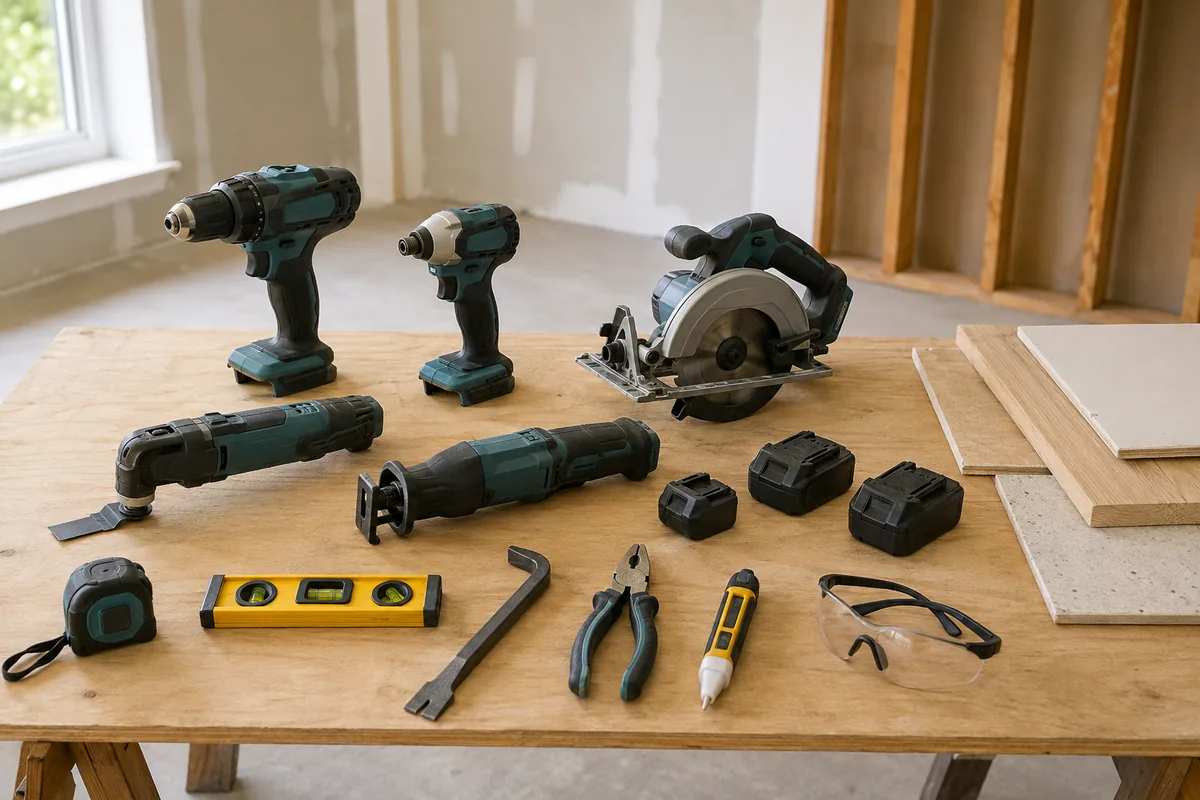
Ranked: The Best Power Tools For House Flipping, In Buying Order
1. Brushless drill and impact driver combo kit
This is not a controversial pick, but the reasoning usually is. Buy the two-tool kit specifically because it sets your battery platform for the next five years, and the platform decision is worth more than the tools in the box. Once you commit to DeWalt 20V MAX XR, Milwaukee M18 FUEL, or Makita 18V LXT, every subsequent purchase gets cheaper because you buy bare tools instead of kits.
The job it unlocks is everything: cabinet install, deck screws, drywall, hinges, closet systems, subfloor screws, blinds, door hardware. Buy the kit with two batteries at minimum, and get one high-capacity pack for sustained work. Brushless matters here not for the marketing but because a flip involves hundreds of driving cycles a day and brushed motors run hot and die mid-project.
Brushless drill and impact driver combo kit
Skip the seven-piece “contractor kit” bundles that include a flashlight and a brushed circular saw you will replace within a month. Buy the two-tool brushless kit with two batteries and a charger, then add bare tools as jobs come up. You will spend less and end up with better tools.
2. Cordless reciprocating saw
Second, because demo comes before everything and demo with hand tools is where flip schedules go to die. A recip saw cuts out old cast iron and ABS drain lines, takes down non-load-bearing framing, removes rotted deck boards, cuts nails behind trim, and handles rough openings for new windows.
Go cordless even though corded is cheaper. On a flip the power is often off, half-off, or on a single extension cord shared with a work light, and demo means moving constantly. Buy a wide blade assortment before you need it: a demolition blade set with nail-embedded wood blades, plus metal-cutting blades for pipe and conduit. Blades are the actual consumable cost of demo and the cheap ones burn out fast enough to erase their savings.
3. Cordless circular saw or track saw
Third, because once demo is done you are cutting sheet goods for subfloor, sheathing, and underlayment. A circular saw with a good blade is the general answer. A track saw is the better answer if your flips lean toward finish-heavy work, since it gives you glue-line rips on plywood without a table saw, which matters when you are building cabinet panels, closet shelving, or oversized shelves on site.
For most flippers the circular saw wins on priority. It is more versatile in rough conditions, it does not care about dirt, and it can be dropped off a scaffold plank without ending the workday. Add the track saw on flip number two or three when you notice you are paying someone else to make clean cuts.
4. Cordless oscillating multi-tool
The most underrated tool on the list and the one experienced flippers reach for constantly. It undercuts door jambs for new flooring, cuts drywall for outlet boxes without hitting wires, trims shims flush, removes old caulk and grout, and makes plunge cuts in the middle of a panel where nothing else fits.
It is fourth rather than first because nothing on a flip is impossible without it. But once you own one, you stop doing five awkward workarounds a day. Buy quality blades. The tool-free blade change systems on current models are worth the small premium because you will change blades constantly.
5. Compact router
Fifth on the list, and the point at which a flip starts to look professional instead of merely finished. A trim router handles hinge mortises for new doors, sink and cooktop cutouts in butcher block, roundovers on stair treads and shelf edges, and flush trimming laminate. These are the details that show up in listing photos and buyer walkthroughs.
Compact is the operative word. A full-size plunge router is a shop tool. A one-handed compact router with an edge guide and a template bit set does nearly everything a flip requires and fits in the same bag as your drill.
Compact cordless router with template and roundover bits
This is the buy that separates a rehab that looks flipped from one that looks renovated. Get a compact router, a flush-trim bit, a quarter-inch roundover, and a straight bit for mortises. That covers doors, countertops, and every edge a buyer will run a hand along.
6. Miter saw
Sixth because trim comes late, and because until trim comes you can make every cut with a circular saw and a speed square. When you do get here, a 10 inch sliding compound miter saw covers baseboard, casing, shoe molding, and crown on most residential trim packages. A 12 inch saw buys crosscut capacity for deck framing and stair stringers.
This is the first tool on the list where used is genuinely fine. Miter saws are simple, the fences are adjustable, and a well-kept older saw with a fresh 60 to 80 tooth finish blade cuts as clean as a new one. Blade quality matters more than the saw here, and it is not close.
7. Pneumatic nailer set and compressor
Seventh, not first, and this is where the list annoys people. Cordless nailers exist and are excellent, but on a flip you are shooting thousands of nails through a trim package, and pneumatic guns are lighter, cheaper, and effectively immortal. A pancake compressor with a 16 gauge finish nailer, an 18 gauge brad nailer, and a framing gun covers the entire scope of most residential flips.
Buy the compressor sized for the guns, not for future dreams of spraying finish. A small pancake unit keeps up with two trim guns running simultaneously, which is all you need unless you are running a crew.
- ✔ Pneumatic trim guns cost a fraction of cordless equivalents
- ✔ Lighter in the hand over a full day of baseboard
- ✔ Hoses and fittings are cheap and universally available
- ✔ One compressor runs multiple guns at once
- ✘ You are dragging a hose and managing a cord
- ✘ Compressor noise is genuinely unpleasant in a closed house
- ✘ Not practical for a quick five-nail fix on a punch list
- ✘ Cold-weather moisture in lines needs draining
8. Rotary hammer
Last, and mostly a rental. You need it for anchoring ledgers to foundation walls, drilling block for plumbing penetrations, and chipping tile off a concrete slab. That is a handful of hours across an entire flip. Rent the big SDS-Max unit for a demo day and buy a small SDS-Plus rotary hammer only if you are doing basement work regularly.
What To Skip
Money you do not spend on the wrong tools is money in the rehab budget. These are the purchases flippers regret most often.
Skip the giant multi-tool combo kits. The eight-piece bundles look like value and are usually built from brushed motors and low-amp-hour batteries. You will replace the saw and the recip saw within one project, which means you paid for them twice.
Skip the table saw, at first. Job site table saws are heavy, take up a room, and get used for maybe two hours per flip. A circular saw with a straightedge or a track saw covers almost all of it. Buy a table saw when you are building things, not when you are installing them.
Skip the paint sprayer until flip three. Airless sprayers are fast, but masking a house properly takes longer than most people estimate, and the cleanup discipline required is real. On a first flip, subcontract paint or roll it. Learning to spray on a house you own is expensive tuition.
Skip second battery platforms. The moment you own chargers and batteries for two brands, you have doubled the cost of ownership and halved the chance the right pack is charged. Pick one platform and stay in it even when a competing tool is slightly better.
Skip the drywall-specific tools on small flips. Automatic taping tools and drywall screw guns pay off on volume. On a single house with patch work and one or two rooms of new board, a drill with a depth-sensing bit and a good knife set is enough.
Cordless reciprocating saw with demolition blade assortment
Buy this as a bare tool on the platform you already chose and put the savings into blades. Nail-embedded wood blades and bi-metal metal blades cover demo, plumbing removal, and rough openings. Blade quality changes cut speed more than the saw does.
How To Budget Tools Against A Flip Spread
Treat tools as a fixed cost amortized across multiple projects, not as a line item on one house. A reasonable starter kit built from the first four entries on this list generally lands in the low four figures at typical Home Depot, Lowe’s, and Amazon pricing, and it should last several flips with battery replacements along the way. Compare that against rental costs, which run per day and add up faster than most people expect once a project slips two weeks.
The math that matters is holding cost. If your carrying cost is a few thousand dollars a month between financing, taxes, insurance, and utilities, then a tool that removes a week from your schedule pays for itself immediately even if you never touch it again. That is the entire argument for buying cordless demo tools early and buying finish tools later.
One more budgeting note: batteries are consumables. Plan on replacing packs every couple of years under heavy use, and buy first-party batteries. Third-party packs are cheaper up front and the failure modes range from disappointing to genuinely hazardous.
Frequently Asked Questions
Should I buy corded or cordless tools for flipping? Cordless for anything you carry, corded or pneumatic for anything that lives in one spot. Power on a flip is unreliable during demo and rough-in, and running extension cords through a gutted house wastes more time than the batteries cost. The exceptions are stationary tools like the miter saw and the compressor, where corded is cheaper and there is no benefit to a battery.
Which battery platform should a flipper choose? Any of the major professional lines will serve you well, and the differences between DeWalt XR, Milwaukee FUEL, and Makita LXT matter less than committing to one. Choose based on which brand’s specialty tools you expect to add later, and on which one your local supplier actually stocks so you can get a replacement pack the same day. Availability beats spec sheets on a job site.
Is it worth buying used tools for a flip? Yes for stationary and mechanically simple tools like miter saws, compressors, and pneumatic nailers, where wear is visible and parts are cheap. No for cordless tools, because you cannot assess battery health from a photo and a tired pack turns a bargain into a paperweight. Buy used bodies only if you already own healthy batteries for that platform.
Buy in this order, resist the bundle upsells, and let the schedule tell you when to add the next tool. The flippers who lose money on tools are almost always the ones who bought a full shop before they knew which jobs they would actually be doing themselves.
Check prices on Amazon →