What's inside
As an Amazon Associate I earn from qualifying purchases. This post may contain affiliate links at no extra cost to you.
The DeWalt DCE530 is the best DeWalt heat gun for cordless repair and installation work, while the D26414 is the better choice when you need precise temperature control and unlimited runtime from a power outlet. DeWalt’s corded models deliver more consistent airflow for long jobs, but the 20V MAX DCE530 is easier to carry, starts quickly, and avoids a cord around trim, vehicles, and job sites.
As an Amazon Associate we earn from qualifying purchases at no extra cost to you.

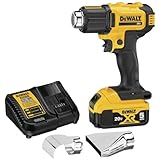


DeWalt heat gun comparison
The most useful distinction is not simply cordless versus corded. It is control. The DCE530 has two practical temperature settings and short-term portability; the D26414 provides a much wider adjustable range and an LCD readout; older or region-specific DeWalt corded models may offer variable temperature without the same display. Check the voltage and included accessories for your market before ordering.
| Model | Power source | Temperature range | Airflow | Warm-up | Best use |
|---|---|---|---|---|---|
| DCE530B | 20V MAX battery | 550°F / 290°C and 990°F / 532°C | 6.5 or 11 CFM | About 7 seconds | Portable stripping, tubing, adhesive and shrink-wrap work |
| D26414 | 120V corded, 1,550W | 150°F–1,100°F / 65°C–593°C | 8.5 or 17 CFM | Typically under 30 seconds, depending on setting | Controlled heating, forming plastic and repeated workshop use |
| Older variable-temperature corded models | 120V corded, approximately 1,500W–1,550W | Often about 120°F–1,100°F | Usually two airflow levels | Varies by model | Budget workshop use when precise display control is not needed |
Specifications can vary slightly by country, revision, and kit. The DCE530B is commonly sold as a bare tool, so the battery and charger may be an additional expense. The D26414 is a corded tool and normally avoids that battery investment.
Head-to-head: DCE530 versus D26414
Temperature settings and control
The DCE530’s two settings are convenient rather than finely adjustable. Its lower setting is suitable for heat-shrink tubing, loosening labels, softening adhesive, and warming plastic cautiously. Its higher setting is useful for paint removal and tougher adhesive, but it gives you less control near delicate materials.
The D26414 is the better DeWalt heat gun for jobs where temperature matters. Its adjustable range starts low enough for temperature-sensitive plastic and rises to roughly 1,100°F. The LCD display lets you set and monitor the target temperature rather than guessing from the trigger position. That matters when bending acrylic, forming PVC, softening vinyl, or working close to finished surfaces.
Airflow and heating performance
The DCE530 offers approximately 6.5 CFM on low and 11 CFM on high. That is enough for localized work, but the small nozzle and battery-powered heating system are not intended to replace a high-output industrial heat gun for large surfaces.
The D26414’s approximately 8.5 and 17 CFM settings move more air and maintain stronger performance during extended operation. The higher airflow can cover a wider area, although it also increases the risk of overheating nearby paint, laminate, wiring, or plastic. More airflow is not automatically better; use the lowest setting that transfers heat effectively.
Warm-up time
The cordless DCE530 reaches working heat in about seven seconds, which is valuable when you need to make several short adjustments. There is no cord to route and no need to locate an outlet before each small task.
The corded D26414 takes longer to reach a selected temperature, particularly at the upper end of its range, but it can continue heating for as long as the tool remains plugged in. For a ten-minute stripping session or a production-style workshop task, unlimited electrical supply outweighs the DCE530’s faster start.
Battery runtime
DeWalt lists up to approximately 42 minutes of runtime for the DCE530 with a 20V MAX 5Ah battery under stated conditions. Treat that as a best-case operating figure, not 42 minutes of continuous high-temperature use on every material. High heat, high airflow, cold batteries, and repeated starts can reduce practical runtime.
A useful planning calculation is:
42 minutes × 60 ÷ 15 seconds per short heating operation = about 168 theoretical cycles.
Real work will produce fewer cycles because the gun may remain hot while you reposition material, and the battery will not necessarily deliver its full rated capacity in this application. If each operation lasts 30 seconds, a 5Ah battery provides roughly 84 theoretical operations before allowing for real-world losses. For occasional jobs, one existing battery may be sufficient. For continuous renovation work, budget for a second battery or choose the corded tool.
Which DeWalt heat gun should you choose?
| Your situation | Recommended choice | Reason |
|---|---|---|
| Already own several 20V MAX batteries | DCE530B | Lower entry cost as a bare tool and no separate battery platform to maintain |
| Need occasional adhesive, tubing, or label work | DCE530B | Fast startup and convenient short-duration use |
| Strip paint from broad panels | D26414 | Higher airflow and continuous corded operation |
| Work with several plastics or delicate finishes | D26414 | Wide variable temperature range and display feedback |
| Limited bench space or frequent ladder work | DCE530B | No power cord to snag or drag |
| Daily workshop use | D26414 | Unlimited runtime and less dependence on battery charging |
Performance by common task
Heat-shrink tubing and electrical work
The DCE530 is especially convenient for small batches of heat-shrink tubing. Use the lower setting first, keep the nozzle moving, and rotate the wire or connector rather than concentrating heat on one side. A reflector nozzle, if included with the kit or purchased separately, distributes heat around tubing more evenly.
Removing paint and adhesive
For paint removal, the D26414’s higher airflow and continuous runtime make it the stronger choice. Keep the nozzle moving and work in a small area until the coating softens. A scraper should lift the softened coating; the heat gun should not be used as a substitute for mechanical removal.
Both tools can soften stickers, construction adhesive, and carpet adhesive, but test an inconspicuous area first. Heat can discolor varnish, loosen veneer, damage laminate, or soften the substrate beneath a floor covering.
Forming plastic
Choose the D26414 when forming plastic is a recurring task. Start near the lower end of its range and increase temperature gradually. Heat the bend zone evenly, use a simple former or jig, and allow the part to cool while supported. The DCE530 can handle occasional plastic shaping, but its two settings make it easier to overshoot the softening point.
Handling, safety, and ownership realities
The DCE530’s cordless design improves balance around a vehicle, cabinet, or ladder, but a large battery adds weight behind the handle. The D26414 is generally better suited to a fixed bench because its cord and larger airflow make it less convenient in confined spaces. Whichever model you choose, use the built-in stand when the tool is designed to rest upright, and never leave a hot nozzle unattended.
- Keep the air intake clear of dust, shavings, and insulation fibers.
- Do not cover the intake while gripping the handle.
- Allow the nozzle and housing to cool before storing the tool.
- Use ventilation when heating old coatings, plastics, adhesives, or unknown materials.
- Assume old paint may contain hazardous substances; identify the coating and follow applicable local safety guidance.
- Keep a clear, nonflammable work area and have suitable fire-control equipment nearby.
The parts most likely to suffer from misuse are the nozzle, power cord on corded models, battery contacts, and the air intake. Dropping a hot tool can distort the nozzle or damage its internal heater. On the DCE530, storing batteries fully charged for long periods in extreme heat can shorten battery life; follow DeWalt’s battery-storage guidance. On corded models, inspect the cable for cuts and avoid tight bends at the strain relief.
Bottom line
Buy the DCE530B if portability, rapid warm-up, and short jobs are your priorities, especially if you already use DeWalt 20V MAX batteries. Buy the D26414 if you need adjustable temperature, stronger airflow, repeatable plastic-forming work, or uninterrupted operation. For a workshop that handles both quick repairs and long stripping sessions, the two tools complement rather than duplicate each other: cordless convenience for targeted work, corded control for demanding heat applications.