What's inside
- What Separates a Good Half Moon Edger From a Bad One
- Half Moon Edger Specs Compared by Type
- Which Half Moon Edger Fits Your Yard
- About the Wolf-Garten Lawn Edger
- How to Cut a Clean Edge With a Half Moon Edger
- Time and Effort: A Quick Calculation
- Durability and Ownership Realities
- Half Moon Edger vs Other Edging Tools
- FAQ
- What Separates a Good Half Moon Edger From a Bad One
- Half Moon Edger Specs Compared by Type
- Which Half Moon Edger Fits Your Yard
- About the Wolf-Garten Lawn Edger
- How to Cut a Clean Edge With a Half Moon Edger
- Time and Effort: A Quick Calculation
- Durability and Ownership Realities
- Half Moon Edger vs Other Edging Tools
- FAQ
As an Amazon Associate I earn from qualifying purchases. This post may contain affiliate links at no extra cost to you.
The best half moon lawn edger for most yards is a forged or heat-treated steel model with a blade at least 8 inches wide, a sharpened curved edge, a wide footplate on both shoulders, and a 34 to 40 inch shaft with a D-grip or T-grip that matches your height. Everything else, including brand, matters less than those four details, because they decide whether the tool slices sod cleanly or bounces off it.
A half moon edger (also called a half-moon or crescent edger) is the simplest edging tool there is: a semicircular blade on a handle that you push straight down with your foot to cut a vertical line between turf and a bed, path or driveway. It has no motor, no fuel and no battery, which is exactly why it still earns a place next to string trimmers and powered edgers.
As an Amazon Associate we earn from qualifying purchases at no extra cost to you.

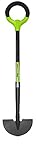
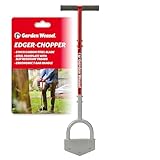

What Separates a Good Half Moon Edger From a Bad One
Blade material and thickness
Cheap edgers use thin pressed steel around 1.5 mm thick. They work in loose, damp loam but bend at the corners the first time they meet a root or compacted clay. Better models use carbon or boron steel in the 2 to 3 mm range, often hardened, and some premium options are stainless. Stainless resists rust and sheds wet soil, but it is usually a little softer than hardened carbon steel, so it loses its edge sooner in stony ground.
Blade width and curve
Blades typically run from about 7 to 10 inches across. A wider blade cuts more edge per push, which matters on long borders. A narrower, deeper-curved blade is easier to steer around tight curves and island beds. If most of your edging is straight lines along a driveway, go wide. If your beds are full of curves, a slightly narrower blade is more forgiving.
Footplate (tread)
The top edge of the blade should be rolled or fitted with a tread on both sides so your boot has a flat surface to push on. A bare blade edge is uncomfortable within minutes and can slip under a wet sole. Dual treads also let you switch feet, which spreads the work on long jobs.
Handle and joint
The weak point on most failures is where the shaft meets the blade socket. Look for a long welded or riveted socket rather than a short crimped collar. Shafts come in wood (ash or hardwood), fiberglass and steel tube. Fiberglass is light and does not rot; wood feels good but needs to be kept dry; steel is strong but heavier and can get cold or hot in the hand.
Half Moon Edger Specs Compared by Type
| Edger type | Blade width | Blade steel | Typical weight | Shaft length | Rough price range |
|---|---|---|---|---|---|
| Budget pressed steel | 7-8 in | ~1.5 mm mild steel | 2-3 lb | 32-36 in | $15-$25 |
| Mid-range carbon steel, fiberglass handle | 8-9 in | 2-2.5 mm hardened carbon | 3-4 lb | 36-40 in | $25-$45 |
| Stainless head, wood or fiberglass handle | 8-9 in | 2-2.5 mm stainless | 3-4 lb | 35-40 in | $35-$70 |
| Heavy-duty all-steel / serrated | 9-10 in | 3 mm+ boron or carbon | 4-6 lb | 38-42 in | $40-$80 |
| Interchangeable-handle head (system tools) | about 8-9 in | hardened steel | head under 2 lb | depends on handle | $20-$40 head only |
Which Half Moon Edger Fits Your Yard
| Your situation | Best choice | Why |
|---|---|---|
| Re-cutting existing edges a few times a year, soft soil | Mid-range carbon steel, 8 in | Light enough to work fast; edge stays sharp for a season |
| Cutting new beds in compacted clay or root-filled turf | Heavy-duty steel with serrated edge | Serrations start the cut in roots; thicker blade will not fold |
| Wet climate, tool stored in an open shed | Stainless head, fiberglass handle | No rust, no rot, soil releases cleanly |
| Long straight driveway or sidewalk borders | 9-10 in blade, 40 in shaft | More length per cut; long shaft keeps your back straighter |
| Small garden, little storage | Interchangeable-head system | One handle serves a rake, hoe and edger |
| Over 6 ft tall | Model with 40 in+ shaft or long T-grip | Short shafts force you to stoop on every push |
About the Wolf-Garten Lawn Edger
Wolf-Garten is a long-established German garden tool brand known for its multi-star system, where one handle accepts many clip-on heads. Its lawn edger head is a classic half-moon blade that mounts on a separate handle, so you buy the head and the handle length you want. The strengths of that approach are compact storage and the ability to pick a handle that suits your height. The trade-off is that the joint between head and handle is a mechanical connection rather than a one-piece weld, so it is worth checking that it is fully seated and tight before putting your full weight on the tread. Availability in the US is limited compared with Europe, so many American buyers end up choosing a one-piece edger from domestic garden brands instead.
Other real names worth knowing include Radius Garden, whose Root Slayer edger uses a serrated, heavy-gauge blade aimed at root-filled ground, and Fiskars, which makes long-handled steel edging tools. Whatever the label, compare the blade thickness, tread and socket design rather than the brand name.
How to Cut a Clean Edge With a Half Moon Edger
- Mark the line. Use a garden hose for curves or a string line between two stakes for straight runs. Eyeballing a line almost always wanders.
- Water the day before. Moist (not muddy) soil cuts with half the effort. Bone-dry clay is where blades bend.
- Cut straight down first. Place the blade on the line, keep the shaft vertical and step down with your full weight. Go 3 to 4 inches deep for a lasting edge.
- Overlap each cut. Move the blade along by about two-thirds of its width so the cuts join without leaving ridges.
- Remove the wedge. Make a second angled cut from the bed side, or use a spade, to lift out a V-shaped strip. The trench stops grass runners from creeping back.
- Do not lever. Rocking the handle back like a spade to lift sod is the number one way to snap the shaft or bend the socket. Half moon edgers are made for cutting, not prying.
Time and Effort: A Quick Calculation
An 8 inch blade overlapping by a third advances roughly 5 inches per push. A 60 foot border (720 inches) therefore takes about 145 pushes. At a steady pace of 15 to 20 pushes per minute, that is roughly 7 to 10 minutes of cutting before you remove the wedge, which is competitive with setting up and using a powered edger on small and medium yards. A 10 inch blade drops the same job to around 115 pushes.
Durability and Ownership Realities
- The edge dulls first. Run a mill file along the bevel two or three times a season, keeping the original angle. A sharp edge cuts sod; a dull one tears it.
- Corners bend before the center. If one corner curls, it is usually from hitting stone or prying. A thicker blade or a serrated heavy-duty model is the fix if your soil is rocky.
- Clean after use. Scrape off soil and wipe carbon steel with an oily rag to stop rust pitting, which roughens the face and makes soil stick.
- Wood handles need care. Store indoors and rub with linseed oil once a year to stop cracking near the socket.
- Check the socket bolt or rivet. A loose head wobbles, wastes effort and eventually shears.
Half Moon Edger vs Other Edging Tools
A half moon edger is best for cutting a defined, deep edge once or twice a season. A string trimmer turned on its side is faster for weekly tidying but cannot create a crisp trench. A rotary hand edger with a star wheel is good for trimming along a hard path but does not cut new beds. A powered stick or walk-behind edger is worth it if you have hundreds of feet of concrete border to maintain every week. For most home lawns with planting beds, a quality half moon edger plus a trimmer covers everything.
FAQ
How deep should a half moon edger cut?
About 3 to 4 inches for a bed edge. Shallower cuts let grass rhizomes slip under and re-invade within a few weeks.
Can a half moon edger cut through tree roots?
Small roots under about half an inch, yes, especially with a serrated blade. Thicker roots need loppers or a pruning saw; forcing the edger will bend the blade.
Is a stainless steel edger worth the extra cost?
If the tool lives outdoors or you edge in wet soil, yes. If you store it dry and sharpen it regularly, hardened carbon steel cuts just as well for less money.