What's inside
As an Amazon Associate I earn from qualifying purchases. This post may contain affiliate links at no extra cost to you.
The best hydroponic reservoir pumps for steady flow are submersible mag-drive pumps in the 250-550 GPH range for most home systems, with the Active Aqua AAPW250 and AAPW550, EcoPlus Eco 396 and 633, Danner Mag-Drive Supreme 500, and Sicce Syncra Silent 1.0 covering the majority of reservoir sizes from 10 to 55 gallons when matched correctly to lift height and system type.
As an Amazon Associate we earn from qualifying purchases at no extra cost to you.


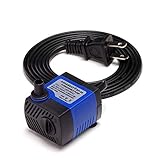
How to Match Pump Size to Your Reservoir and System
Steady flow fails when a pump is sized by reservoir volume alone. You need to account for vertical lift, tubing length, and how your system uses water. A pump rated at 400 GPH at 0 feet of head may only deliver 180 GPH at 4 feet.
Use this simple turnover calculation to size correctly:
Step 1: Calculate required flow. For recirculating systems like NFT, drip, and ebb and flow, aim to turn over the entire reservoir volume 1 to 2 times per hour. For a 25-gallon reservoir, that is 25 to 50 GPH delivered at the grow tray, not at the pump outlet.
Step 2: Account for head height. Measure vertical distance from the pump to the highest point water must reach. Add 1 foot of head for every 10 feet of horizontal tubing and for each 90-degree elbow. This is your total dynamic head.
Step 3: Check the flow curve. Find the pump’s flow chart and read the GPH at your total dynamic head. Choose a pump where your required GPH falls at 50-70% of its max head capability, which leaves margin and keeps noise and heat down.
Worked Example – 25-Gallon Ebb and Flow with 3.5 Feet of Lift:
- Reservoir: 25 gallons. Desired turnover: 1.5x per hour = 37.5 GPH at the tray.
- Lift: 3 feet vertical + 8 feet of tubing (0.8 feet) + 2 elbows (2 feet) = 5.8 feet total head, round to 6 feet.
- An EcoPlus Eco 396 rated at 396 GPH at 0 feet delivers about 150 GPH at 6 feet, which easily covers 37.5 GPH and allows for a ball valve to throttle down. An Active Aqua AAPW250 rated at 250 GPH at 0 feet delivers about 65 GPH at 6 feet, which is adequate but has no margin if you add a chiller or filter. For this setup, the 396-class pump is the better fit.
- Energy cost: A 25-watt pump running 24/7 uses 0.6 kWh per day. At $0.15 per kWh, that is about $2.70 per month to run. A 70-watt pump in the same duty would cost about $7.50 per month, so oversizing by 2-3x adds real heat and cost to the reservoir.
Flow Rate, Lift Height and Noise: What Actually Matters
Flow Rate (GPH)
Manufacturers list maximum flow at zero head. Ignore that number for sizing. Look for the GPH at 3, 4, and 6 feet on the spec sheet. For steady flow, an adjustable flow pump or an inline ball valve is essential to dial in drip emitters and prevent NFT channels from flooding.
Lift Height (Max Head)
Max head is the height where flow stops. You should never operate near it. If your system needs 4 feet of lift, choose a pump with at least 7-8 feet of max head. Inline pumps handle higher head better than small submersibles, but for reservoirs under 40 gallons, a submersible mag-drive is simpler and quieter.
Noise Levels
Noise comes from vibration against the reservoir bottom and from restricted impellers. Mag-drive pumps with epoxy-sealed motors like the Danner Mag-Drive and Sicce Syncra Silent lines are consistently the quietest because the impeller is the only moving part. Placing the pump on a small silicone mat or filter sponge drops transmitted vibration significantly. If you can hear buzzing outside the grow tent, the pump is either cavitating, clogged, or undersized and running at full restriction.
Best Hydroponic Reservoir Pumps Compared
These are established submersible models that fit standard reservoirs and use 1/2-inch to 3/4-inch fittings common in hydroponics. All are mag-drive, oil-free, and safe for nutrient solution.
| Pump Model | Max Flow (GPH) | Max Head (ft) | Power (Watts) | Fitting Size | Weight (lbs) | Best For |
|---|---|---|---|---|---|---|
| Active Aqua AAPW250 | 250 | 7.2 | 18 | 1/2″ & 3/4″ | 1.4 | 10-20 gal reservoirs, low lift (under 4 ft) |
| EcoPlus Eco 396 | 396 | 7.9 | 25 | 1/2″ & 3/4″ | 1.8 | 20-35 gal, ebb and flow / drip |
| Danner Mag-Drive Supreme 500 | 500 | 9.5 | 45 | 3/4″ | 3.9 | 30-55 gal, high lift or chiller loops |
| Active Aqua AAPW550 | 550 | 8.8 | 45 | 1/2″ & 3/4″ | 2.3 | 40-55 gal, multi-table drip |
| EcoPlus Eco 633 | 633 | 10.5 | 60 | 3/4″ & 1″ | 2.9 | Large reservoirs, 6+ ft head, inline option |
| Sicce Syncra Silent 1.0 | 251 | 5.1 | 16 | 1/2″ & 3/4″ | 1.6 | Tent grows where noise is priority |
For most home growers, general market ranges are $25 to $45 for 250-400 GPH class pumps and $55 to $95 for 500-650 GPH class pumps with higher head. Sicce and Danner models typically sit at the higher end due to quieter motors and longer duty cycles.
Decision Matrix: Pick by Your Situation
| Your Situation | Recommended Pump Class | Why |
|---|---|---|
| Small reservoir (10-20 gal), NFT or DWC top-off, lift under 3 ft | 160-250 GPH (Active Aqua AAPW160/250, Sicce 1.0) | Lower heat transfer, gentle flow prevents root disturbance, lowest power draw |
| Medium reservoir (20-35 gal), ebb and flow or 6-12 drip emitters | 350-400 GPH (EcoPlus Eco 396) | Handles 4-6 ft head with margin, adjustable flow to balance emitters |
| Large or remote reservoir (40-55 gal), lift over 6 ft or through chiller/filter | 500-633 GPH (Danner Mag-Drive 500, EcoPlus 633, Active Aqua 550) | High head needed to maintain steady flow through extra resistance |
| Grow tent in living space, noise sensitive | Sicce Syncra Silent 1.0 or Danner Mag-Drive | Low-vibration mag-drive design, best noise-to-flow ratio when decoupled from reservoir floor |
| Beginner on tight budget, single system | EcoPlus Eco 396 or Active Aqua AAPW250 | Widely available fittings, includes adapters, easy to replace impeller |
Durability and Ownership Realities
Mag-drive reservoir pumps are reliable but not maintenance-free in nutrient solution. What wears first is almost always the impeller and shaft, not the motor.
- Impeller and ceramic shaft: Calcium and nutrient salts deposit on the impeller magnet and shaft. Every 2-4 weeks, remove the front cover, pull the impeller, and soak it in a 1:10 white vinegar and water solution for 15 minutes, then scrub with a soft brush. A scored or cracked shaft causes rattling and reduced flow. Replacement impeller kits are available for Active Aqua, EcoPlus, and Danner and cost a fraction of a new pump.
- Pre-filter clog: Most pumps include a foam pre-filter. It traps root debris but clogs quickly and starves the pump. Clean it weekly or remove it and use an inline mesh filter or filter bag on the pump inlet instead. Running a pump dry or restricted for even a few minutes overheats the impeller housing.
- Heat: Submersible pumps add heat to the reservoir, about 1-2°F per 25 watts of continuous operation in a 25-gallon volume. If reservoir temperature exceeds 72°F, switch to a slightly larger pump throttled with a valve rather than a small pump at 100%, or move to an inline external pump like the Danner Mag-Drive used externally.
- Common mistakes: Using tubing that is too small (3/8-inch on a 500+ GPH pump) creates back-pressure and noise. Match tubing ID to the pump outlet. Do not use thread tape on barbed fittings, use hose clamps. Keep the pump off the bottom with a brick or riser to avoid sucking settled salts.
With regular cleaning, expect 2 to 4 years of service in continuous recirculating use. Keep a spare impeller on hand; it is the most common failure point and takes 5 minutes to swap.
Setup for Steady, Even Flow
- Place the pump low and centered, with at least 3 inches of water above the inlet at all times to prevent vortexing and air intake.
- Run a short, straight section of tubing from the pump before any elbows to reduce turbulence.
- Install a ball valve or gate valve on the outlet side, never the inlet side. Throttle by closing the outlet valve gradually until flow at the emitters is even.
- For drip systems, add a pressure-compensating manifold or adjustable emitters. For NFT, aim for a thin film (1/8 to 1/4 inch) rather than a flood; if channels flood, reduce flow at the valve.
- Use a timer appropriate to the system: continuous for NFT/DWC, 15 minutes on / 30-45 minutes off for ebb and flow, with pump-off periods still maintaining reservoir circulation via a small air stone to prevent stagnation.
Frequently Asked Questions
Do I need a different pump for DWC vs. NFT vs. ebb and flow?
Yes. DWC needs only a small pump for circulation or top-off, 150-250 GPH is often enough. NFT needs low, continuous flow, 250-400 GPH throttled down. Ebb and flow needs higher flow to flood a tray quickly, so choose one size up (400-550 GPH) to reduce fill time and pump runtime.
Can one pump run a chiller and the system?
Only if the pump has enough head. Chillers add 2-4 feet of equivalent head. If you add a chiller to a 400 GPH pump already near its limit, flow to the plants will drop. Move to a 500-633 GPH class pump or use a dedicated pump for the chiller loop.
Why does my pump get louder over time?
Scale buildup on the impeller, a worn ceramic shaft, or a clogged inlet is the usual cause. Clean the impeller and filter, check the shaft for grooves, and ensure the pump is not vibrating against the reservoir wall. Replacing the impeller often restores quiet operation.