What's inside
As an Amazon Associate I earn from qualifying purchases. This post may contain affiliate links at no extra cost to you.
The best foam cannon for most pressure washers is the MTM Hydro PF22.2, with the MJJC Foam Cannon S V3.0 close behind, but the factor that decides whether any cannon produces thick foam is matching its orifice to your machine: a 1.1 mm orifice for electric washers under about 2.0 GPM, and the standard 1.25 mm orifice for gas units at 2.0 GPM and above.
Foam cannons look similar, and most share the same basic design: a brass body, an adjustable soap-draw knob, an adjustable fan nozzle and a mesh “foam tablet” that whips air into the solution. The differences show up in build quality, how well they work on low-flow electric washers, and how easy they are to clean and rebuild.
As an Amazon Associate we earn from qualifying purchases at no extra cost to you.


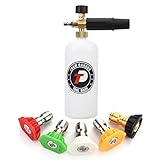

Foam Cannons Worth Buying
| Model | Body | Bottle | Inlet | Best paired with | Typical price range |
|---|---|---|---|---|---|
| MTM Hydro PF22.2 | Brass, stainless fittings | About 1 L, wide mouth | 1/4 in quick connect (others available) | Gas and higher-flow electric washers | $70-$110 |
| MJJC Foam Cannon S V3.0 | Brass | About 1 L, wide mouth | 1/4 in quick connect | Most electric and gas washers | $60-$100 |
| Chemical Guys TORQ Foam Cannon Max Foam 8 | Brass | About 1 L | 1/4 in quick connect | General home use | $50-$90 |
| Adam’s Polishes Foam Cannon | Brass | About 1 L | 1/4 in quick connect | Car care users already on Adam’s soaps | $60-$100 |
| Chemical Guys TORQ Foam Blaster 6 (hose foam gun) | Plastic body | About 0.5 L | Garden hose thread | No pressure washer | $25-$50 |
Why These Stand Out
MTM Hydro PF22.2
Made in Italy, the PF22.2 is the reference design many detailers measure others against. It has a solid brass body, a smooth and precise soap-metering knob, and readily available rebuild parts including orifices, mesh filters and seals. It produces dense, clinging foam on gas washers and on stronger electric machines.
MJJC Foam Cannon S V3.0
MJJC’s latest S-series cannon is the most popular alternative, with a wide-mouth bottle that is easy to fill, a robust brass head and a well-documented upgrade path for 1.1 mm orifices. It is a common recommendation for owners of electric washers who want thick foam without stepping up to a gas machine.
Chemical Guys TORQ Foam Cannon Max Foam 8
A good mainstream option that is widely available, works with most quick-connect washers and pairs naturally with Chemical Guys’ own snow-foam soaps. Build quality is good for homeowner use, though rebuild parts are less widely sold than for MTM or MJJC.
Adam’s Polishes Foam Cannon
Adam’s cannon is a premium brass unit sold as part of a wider car-care system. It is a sensible buy if you already use Adam’s soaps and want one-brand support.
Chemical Guys TORQ Foam Blaster 6
If you do not own a pressure washer, a hose-end foam gun lays down a wetter, thinner foam than a cannon but still helps pre-soak and lubricate the paint. It is not a substitute for a true cannon’s cling time.
Orifice Sizing: The Most Important Spec
The orifice is a small brass jet inside the cannon that creates the pressure drop to draw soap. If it is too large for your washer’s flow, pressure collapses and the foam turns watery.
| Washer flow rate | Typical machine | Recommended orifice | What happens if you use the other size |
|---|---|---|---|
| Under 1.5 GPM | Small electric (1,600-1,900 PSI) | 1.1 mm | 1.25 mm gives runny foam |
| 1.5-2.0 GPM | Mid electric (1,900-2,300 PSI) | 1.1 mm | 1.25 mm works but thinner |
| 2.0-2.5 GPM | Small gas (2,500-3,100 PSI) | 1.25 mm | 1.1 mm restricts flow and may trip unloader |
| Over 2.5 GPM | Large gas (3,100 PSI+) | 1.25 mm | 1.1 mm too restrictive |
Most cannons ship with a 1.25 mm orifice. A replacement 1.1 mm orifice costs only a few dollars and is the single biggest improvement for electric washer owners.
Soap Dilution Math
Foam cannons dilute twice: once in the bottle, then again as the cannon mixes soap with the water stream. A common starting point is 2 to 3 ounces of snow-foam soap in the bottle, topped up to about 32 ounces with warm water. Warm water dissolves thick soap faster and helps foam density.
- With the soap knob fully open, a 1 L bottle typically lasts 1 to 2 minutes of spraying, enough to coat a sedan or small SUV.
- For a full-size truck or van, plan on refilling once or using a slightly richer mix of 3 to 4 ounces.
- Thick foam is not the same as effective cleaning. Choose a pH-neutral soap for routine washes and a stronger pre-wash only when the vehicle is very dirty.
Setup and Use, Step by Step
- Confirm the quick-connect size on your washer wand, usually 1/4 inch. Some electric washers use proprietary fittings that need an adapter.
- Fit the correct orifice for your washer’s GPM.
- Fill the bottle with soap first, then warm water, to limit foaming in the bottle.
- Open the soap knob fully and set the fan nozzle to a wide spray.
- Work from the bottom up, then let the foam dwell for 3 to 5 minutes without letting it dry, especially in sun.
- Rinse from the top down, then do a contact wash with mitts if needed.
Maintenance and Common Problems
- Clogged mesh filter: Run clean water through the cannon after each use. Hard water and thick soap leave deposits that reduce foam over time.
- Leaking at the knob: Replace the O-rings; rebuild kits are inexpensive for the major brands.
- Bottle cracks: Usually from over-tightening or freezing. Store the cannon indoors in winter, emptied and dry.
- Watery foam: Check orifice size first, then soap concentration, then the mesh filter.