What's inside
As an Amazon Associate I earn from qualifying purchases. This post may contain affiliate links at no extra cost to you.
Best Milwaukee Power Tool Sets for Every Kind of Builder
The best Milwaukee power tool set depends on which tools you’ll use regularly: choose an M18 combo kit for a broad range of construction work, an M12 kit for lighter installation and repair jobs, or a smaller drill-and-driver set if you mainly need to make holes and drive fasteners. Compare the kit’s actual tool list, battery capacity and typical market price—not just the number printed on the box.
Milwaukee sells kits with different tool combinations, battery configurations and regional package numbers, and bundles change over time. The ranges below are broad U.S. market estimates, not fixed prices or quotes for a particular retailer. Check the included-tool list and battery amp-hours on the specific package before buying.
As an Amazon Associate we earn from qualifying purchases at no extra cost to you.
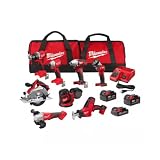

Quick comparison: which kit size fits the job?
These categories reflect common Milwaukee M12 and M18 kit configurations. Tool counts and batteries vary by bundle; the table gives representative configurations to help compare value, rather than implying that every package includes exactly the same items.
| Kit type | Representative tools | Typical battery package | Approx. U.S. price range | Approx. cost per tool | Best fit |
|---|---|---|---|---|---|
| M12 compact starter | 2 tools: drill/driver and impact driver | Two batteries, commonly 2.0 Ah each | $150–$250 | $75–$125 | Cabinet work, hardware, service calls and light assembly |
| M18 drill-and-impact set | 2 tools: drill/driver and impact driver | Often two batteries in the 2.0–5.0 Ah range | $200–$350 | $100–$175 | General carpentry and frequent fastening |
| M18 four-tool combo | 4 tools: commonly drill/driver, impact driver, circular saw and work light or reciprocating saw | Often two batteries; capacity varies, commonly 2.0–5.0 Ah | $350–$600 | $88–$150 | Remodeling and a first broad cordless setup |
| M18 six-tool combo | 6 tools: commonly drill/driver, impact driver, circular saw, reciprocating saw, work light and multi-tool | Usually two batteries; capacity and included charger vary | $500–$800 | $83–$133 | Builders who will put several tool types to work |
Cost per tool is the kit’s approximate price divided by the number of tools, rounded to the nearest dollar. It is a rough comparison, not the individual value of each tool: a saw generally costs more on its own than a work light, and an extra battery can matter more than one additional tool.
Choose by the work you actually do
For cabinetmakers, finish carpenters and punch-list work: M12
An M12 kit is the better starting point when tools spend a lot of time overhead, in cabinets or in tight spaces. The smaller platform can reduce fatigue during repeated drilling and fastening, and a compact drill-and-impact pair covers much everyday installation work. It is also easier to store in a small vehicle or shop.
The trade-off is runtime and capacity. Small batteries are convenient, but repeated heavy fastening or long cuts can mean more charging and battery changes. If your regular work includes framing, large-diameter holes or sustained saw use, compare the M12 kit’s actual tools and intended workload with an M18 option before choosing.
For general remodeling: an M18 four-tool kit
A four-tool kit often strikes the best balance for someone moving beyond basic drilling. A circular saw adds useful cutting capability for sheet goods and dimensional lumber, while a reciprocating saw or work light can help with demolition and site work. The right choice depends on which of those tools is actually included: “four-tool” does not identify a standard lineup.
Check whether the saw is a circular saw or reciprocating saw, whether the light is replacing a more useful tool for your work, and whether the package includes blades. If you already own a suitable saw, a drill-and-impact set with better batteries may be a smarter purchase than paying for another one.
For framing, rough carpentry and frequent site work: M18 six-tool
A six-tool set can make sense when you need drilling, fastening, cutting and demolition capability from one battery platform. Its lower apparent cost per tool can be appealing, but only if you will use most of the tools. A rarely used tool is not a bargain simply because it came in a bundle.
For sustained work, prioritize battery capacity as well as tool count. A 5.0 Ah battery holds more charge than a 2.0 Ah battery, though actual runtime depends on the tool, material and workload. A kit with two small batteries may have less useful working time than a similarly priced bundle with fewer tools and larger batteries.
How to judge kit value beyond the tool count
- Read the battery labels: Note both the number of batteries and their amp-hour ratings. Do not add the amp-hours together as though they were one battery; two 2.0 Ah packs provide two separate packs, each with 2.0 Ah capacity.
- Look at the high-draw tools: Saws and other demanding tools can drain a compact pack quickly. If those tools will be used often, larger-capacity batteries can reduce interruptions, although they add size and weight.
- Account for tools you already own: Milwaukee M12 and M18 are separate battery platforms. An M12 battery does not power an M18 tool. Staying on a platform you already own can make a less crowded kit a better value.
- Check the charger and case: Confirm whether a charger is included and whether the storage solution suits your vehicle or shop. A bare-tool promotion may look cheaper but leave you needing batteries and a charger.
- Compare the exact package: Bundle names and included accessories can differ. Verify tool model numbers, battery capacity and charger contents before comparing prices.
A practical value calculation
Suppose a four-tool kit costs $440 and includes two 2.0 Ah batteries. Dividing $440 by four gives $110 per tool. A six-tool kit at $600 works out to $100 per tool—but that $10 difference does not establish which is the better buy. If two of the extra tools would sit unused, the four-tool package may deliver more value for your work. If the larger kit includes a saw and multi-tool you would otherwise buy, it may save money overall.
For a useful comparison, make a short list of tools you expect to use at least monthly. Then compare the cost of the kit against buying those tools and the batteries you need separately. Treat included batteries as part of the value, but avoid assigning them a precise dollar amount unless you have a current standalone price to compare.
Ownership details that affect long-term value
Bundles are only a starting point. Saw blades, drill bits, driver bits and sanding sheets wear out and are not always included in meaningful quantities. Budget for the consumables that match your material: a dull or unsuitable blade can slow a cut and put extra strain on the tool. Keep cutting edges clean, use the correct accessory for the task and avoid forcing a saw through material when its speed drops.
Dust and debris can also accumulate around tool vents and battery contacts. Follow Milwaukee’s care instructions, keep vents clear and store batteries in a dry place away from excessive heat. Avoid leaving a battery attached to a tool in a damp or dirty work area. If a battery or tool is damaged, stop using it and consult the manufacturer’s guidance rather than attempting an improvised repair.
For many buyers, the best Milwaukee power tool set is the smallest kit that covers the jobs they do repeatedly, with enough battery capacity for the tools that draw the most power. Choose M12 for compact, lighter-duty work; an M18 four-tool bundle for a practical remodeling base; and a six-tool M18 kit when its additional tools will earn their place on the job.