What's inside
- Quick buying decision
- Bi-metal blades: the best all-round choice
- Carbide blades: the upgrade for hard or frequent cutting
- Diamond-grit blades: slow cutting, exceptional abrasion resistance
- Decision matrix: which blade suits your job?
- Compatibility matters more than the label
- How to get more life from a metal cutting blade
- Final recommendation
- Quick buying decision
- Bi-metal blades: the best all-round choice
- Carbide blades: the upgrade for hard or frequent cutting
- Diamond-grit blades: slow cutting, exceptional abrasion resistance
- Decision matrix: which blade suits your job?
- Compatibility matters more than the label
- How to get more life from a metal cutting blade
- Final recommendation
As an Amazon Associate I earn from qualifying purchases. This post may contain affiliate links at no extra cost to you.
The best metal cutting blade for an oscillating tool is usually a bi-metal blade for occasional nails, screws, thin sheet metal, and threaded rod; choose carbide for repeated cutting or hardened fasteners, and diamond grit for maximum wear life on abrasive materials rather than maximum speed.
As an Amazon Associate we earn from qualifying purchases at no extra cost to you.


Quick buying decision
| Blade type | Best metal thickness | Typical cutting speed | Tooth or abrasive durability | Best use |
|---|---|---|---|---|
| Bi-metal, fine or medium tooth | About 0.5–3 mm sheet; nails and screws up to roughly 10 mm | Fastest on ordinary mild steel | Good; teeth eventually dull or break | General repairs, demolition, plumbing, electrical work |
| Carbide-tooth | About 1–6 mm steel, depending on blade width and tooth design | Medium to fast, especially on hard fasteners | Very good; individual teeth can chip if twisted | Stainless steel, hardened screws, repeated cutting |
| Diamond-grit | Thin to medium metal sections; commonly used where abrasion resistance matters | Slowest on ordinary steel | Excellent on abrasive materials; no conventional teeth | Cast iron, cement-board fasteners, grout-adjacent work, difficult abrasive jobs |
These thicknesses are practical ranges, not guarantees. The tool’s oscillation angle, battery voltage, blade width, material hardness, and whether the workpiece is supported can change performance substantially.
Bi-metal blades: the best all-round choice
A bi-metal blade combines a flexible alloy-steel body with high-speed-steel teeth. That combination allows the blade to flex during demolition without snapping as readily as a fully hardened blade. For most homeowners and tradespeople, this is the best starting point among multi tool metal cutting blades.
Use a fine-tooth bi-metal blade for thin sheet metal, conduit, brackets, and small screws. A medium-tooth or variable-tooth blade is more suitable for nails, threaded rod, and mixed demolition. Blades around 32 mm to 44 mm wide are easier to control in confined spaces, while a 63 mm blade can make a longer cut but places more load on the tool.
Bi-metal is usually the fastest option on mild steel when the blade is sharp and the material is firmly supported. Its weakness is wear: abrasive rust, stainless steel, hardened screws, and sideways pressure can quickly round the teeth. It is also possible to burn the tooth edge by pressing too hard or running the blade against a solid section without allowing chips to clear.
Carbide blades: the upgrade for hard or frequent cutting
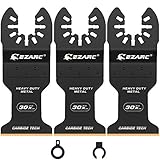
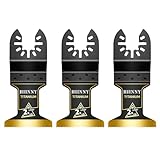
Carbide-tooth oscillating tool blades use individually brazed carbide teeth or a carbide-tipped cutting edge. Carbide retains its hardness better than high-speed steel, making it a strong choice for stainless fasteners, hardened construction screws, cast iron, and repeated metal work.
The trade-off is brittleness. A carbide blade can last far longer than bi-metal when used in a straight cut, but a sideways twist can chip or break the teeth. Carbide blades also tend to cost more, commonly about $15–$40 each or roughly $30–$80 for a multi-pack, depending on size and construction. Bi-metal blades commonly fall around $7–$20 each.
Choose carbide when replacing several bi-metal blades would cost more than buying one durable blade. For example, if a $12 bi-metal blade lasts through 30 cuts, its consumable cost is $0.40 per cut. A $28 carbide blade lasting 100 similar cuts costs $0.28 per cut, even though its purchase price is higher. Actual life depends heavily on technique and the metal being cut.
Diamond-grit blades: slow cutting, exceptional abrasion resistance
Diamond-grit blades have a continuous edge coated with diamond particles rather than teeth. They are not normally the fastest metal cutting oscillating tool blades for ordinary mild-steel nails. Their advantage is resistance to abrasive, dirty, or difficult materials that can destroy toothed blades.
A diamond blade can be useful for cast iron, heavily corroded metal, cement-board fixings, and jobs where a clean, controlled abrasive cut is preferable. It also works well close to masonry or grout, provided the particular blade is rated for that material. Expect slower progress and more dust or fine debris than with a toothed blade.
Do not assume “diamond” means universal superiority. On a clean 2 mm mild-steel bracket, a good bi-metal blade will normally cut faster and cost less. Diamond is the specialist choice when longevity and resistance to contamination matter more than speed.
Decision matrix: which blade suits your job?
| Your situation | Recommended blade | Why |
|---|---|---|
| One-time repair on a few nails or screws | 32 mm or 44 mm bi-metal | Low initial cost and quick cutting |
| Regular renovation or demolition | 44 mm bi-metal multi-pack, plus one carbide blade | Bi-metal handles volume; carbide covers hard fasteners |
| Stainless-steel fasteners | Carbide-tooth | Better heat and wear resistance than ordinary bi-metal |
| Corroded cast iron or abrasive contamination | Diamond-grit | Less vulnerable to grit and rust than conventional teeth |
| Tight space with precise access | Narrow 20–32 mm blade | Easier positioning and less accidental contact |
| Many long cuts in sheet metal | Wider 44–63 mm bi-metal or carbide blade | More stable, with a longer usable cutting edge |
Compatibility matters more than the label
Before buying an oscillating multi tool metal cutting blade, check the mounting system. Many current blades use a universal open-back interface that fits tools from brands such as DeWalt, Milwaukee, Bosch, Dremel, and compatible third-party systems. Fein Starlock, StarlockPlus, and StarlockMax mounts are different levels of interface and may not fit every tool.
A blade can be physically compatible yet unsuitable for the tool’s power or clearance. Check the manufacturer’s fit chart, especially with older tools. Some blades are marked for flush cutting, while others have a deeper offset or reinforced back intended for demolition. A 63 mm blade on a compact cordless tool may work, but it can reduce control and battery runtime.
Teeth-per-inch is another useful specification. Fine teeth, approximately 18–24 TPI, produce a smoother cut in thin sheet. Coarser teeth, approximately 10–14 TPI, clear chips faster in thicker material and demolition work. A variable-pitch blade is a practical compromise for mixed metal sizes.
How to get more life from a metal cutting blade
- Support the workpiece. Clamp sheet metal or place backing behind it. Vibration makes teeth catch and can fracture carbide.
- Start at low speed. Let the teeth establish a kerf before increasing speed. The correct speed depends on the tool and blade, so use the blade maker’s range where provided.
- Keep the blade square. Do not lever the tool sideways while cutting. Side loading is the quickest way to strip bi-metal teeth or chip carbide.
- Use light, steady pressure. Excess pressure creates heat without proportionally increasing cutting speed.
- Clear chips periodically. Withdraw the blade briefly in deeper cuts. Packed chips increase friction and can overheat the edge.
- Inspect after cutting. Replace a blade with missing teeth, a cracked body, excessive wobble, or a visibly blue heat-discolored edge.
For a flush cut against a wall or floor, cover nearby finished surfaces and confirm that hidden wiring, pipes, and structural fasteners are not in the cutting path. Wear eye protection, hearing protection, and gloves appropriate for handling sharp metal edges; secure loose clothing and keep the tool’s ventilation openings clear.
Final recommendation
For most users looking for a metal cutting blade for an oscillating tool, buy a reputable 32 mm or 44 mm bi-metal blade with a universal or correctly matched mount. Add a carbide-tooth blade if you regularly cut stainless steel, hardened screws, or large quantities of metal. Choose diamond grit only when abrasive, corroded, or mixed masonry-and-metal conditions justify its slower cutting speed. That three-blade strategy covers the widest range of multi-tool metal cutting jobs without paying carbide or diamond prices for routine mild steel.