What's inside
- Blade Material Matched to Task: HCS vs Bi-Metal vs Carbide
- Starlock vs Universal-Fit: Compatibility by Brand (2026)
- Decision Matrix: Which Blade to Buy for Your Situation
- Cost Per Use: A Worked Calculation
- Durability and Ownership Realities
- How to Get a Clean, Fast Cut Without Burning or Wobbling
- Frequently Asked Questions
- Blade Material Matched to Task: HCS vs Bi-Metal vs Carbide
- Starlock vs Universal-Fit: Compatibility by Brand (2026)
- Decision Matrix: Which Blade to Buy for Your Situation
- Cost Per Use: A Worked Calculation
- Durability and Ownership Realities
- How to Get a Clean, Fast Cut Without Burning or Wobbling
- Frequently Asked Questions
As an Amazon Associate I earn from qualifying purchases. This post may contain affiliate links at no extra cost to you.
The best oscillating tool blades for clean wood cuts are HCS (High Carbon Steel) blades, for nail-embedded wood and metal are bi-metal blades, and for grout and masonry are carbide-grit or diamond-grit blades, and choosing between Starlock and universal-fit depends entirely on your tool’s blade mount.
As an Amazon Associate we earn from qualifying purchases at no extra cost to you.


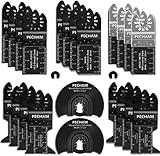
Blade Material Matched to Task: HCS vs Bi-Metal vs Carbide
Buying the wrong blade type is the most common reason for slow cuts, burnt wood, or broken teeth. Oscillating tool blades are not interchangeable by material, they are engineered for specific hardness levels.
| Blade Type | Material / Edge | Typical Size | Tooth / Grit Spec | Thickness | Best For | Relative Lifespan |
|---|---|---|---|---|---|---|
| HCS Wood Blade | High Carbon Steel | 32mm and 65mm wide, 40-50mm depth | 18 TPI, Japanese tooth or precision ground | 0.8 – 1.0 mm | Softwood, hardwood, plywood, laminate, PVC | 100-150 linear feet in pine before dulling |
| Bi-Metal | HCS body + HSS (High Speed Steel) teeth | 32mm, 44mm wide, 40mm depth; 85mm wide for remodeling | 18-24 TPI, hardened teeth | 1.0 – 1.2 mm | Nail-embedded lumber, sheet metal, screws, copper pipe | 3x – 5x longer than HCS in abrasive materials |
| Carbide-Tipped | Carbide teeth brazed to steel body | 32mm and 65mm wide | Variable tooth, carbide-tipped | 1.2 – 1.4 mm | Hardwood, hardened fasteners, stainless nails | 10x – 20x longer than bi-metal on hard materials |
| Carbide-Grit | Carbide particles bonded to edge | 65mm wide semi-circular, 90mm segmented | 30-40 grit, no teeth | 1.6 – 2.0 mm | Cement grout, plaster, porous concrete | 15-25 sq ft of grout per blade |
| Diamond-Grit | Diamond particles vacuum-brazed | 65mm and 90mm segmented | Fine diamond grit | 1.8 – 2.2 mm | Epoxy grout, hard tile, cement board | 2x – 3x longer than carbide-grit on hard grout |
1. HCS Blades: For Clean Wood Only
High Carbon Steel blades are the sharpest and fastest in wood because the softer steel can be ground to a finer edge. Use them for plunge cuts in baseboard, door jamb undercuts, trimming shims, and cutting softwood or hardwood without metal. They will lose teeth instantly if they hit a single nail or screw, so reserve them strictly for inspected, metal-free wood.
2. Bi-Metal Blades: For Nail-Embedded Lumber and Light Metal
Bi-metal oscillating tool blades combine a flexible spring-steel body with hardened High Speed Steel teeth. That construction lets the blade flex without snapping and survive intermittent contact with nails, brads, and sheet metal up to about 1.5mm thick. For demolition work, remodeling, or cutting reclaimed lumber, bi-metal is the default. Brands like Bosch, Imperial Blades, Diablo, Milwaukee, and DeWalt all offer 32mm and 44mm bi-metal blades specifically labeled Wood with Nails or Wood and Metal.
For thicker metal (over 1/16 inch / 1.6mm) or stainless steel, step up to a carbide-tipped wood/metal blade. The solid carbide teeth stay sharp far longer but cost more and cut wood less aggressively.
3. Carbide-Grit and Diamond-Grit: For Grout and Masonry
Toothed blades cannot cut grout. Carbide-grit blades use an abrasive edge that grinds through cement-based grout without chipping surrounding tile. The standard choice is a 65mm half-moon (semi-circular) or 90mm segmented blade. Use carbide-grit for standard sanded and unsanded cement grout in 1/8 to 1/4 inch joints.
For epoxy grout, hard porcelain, or grout that contains very hard aggregates, choose a diamond-grit blade. Diamond abrasive runs cooler and lasts significantly longer in hard materials, though it is slower to start in soft cement grout. Never use these blades for wood or metal, the grit will clog and overheat.
Starlock vs Universal-Fit: Compatibility by Brand (2026)
Not every oscillating tool blade fits every tool. In 2026 there are two main mounting systems. Buying the wrong interface is a waste of money, even if the blade material is correct.
| Mount System | How It Connects | Compatible Tools | Blade Availability |
|---|---|---|---|
| Universal / OIS (Oscillating Interface System) | 12-pin pattern with center hole, secured by bolt or quick-release lever | DeWalt, Milwaukee, Makita, Ridgid, Ryobi, Craftsman, most open-back tools sold before 2017 | Widest selection, lowest cost. Fits almost all non-Starlock tools. |
| Starlock | 3D raised mount with no bolts needed, tool-free click | Bosch GOP12V-28, GOP18V-28, GOP40-30; Fein FMM 350Q and SuperCut; selected Dremel Multi-Max models | Standard power and precision for DIY and pro. Not interchangeable with StarlockPlus/Max. |
| StarlockPlus | Larger 3D mount, higher torque transfer | Bosch GOP18V-34, GOP55-36; Fein SuperCut 450Q | Accepts Starlock blades, but not StarlockMax. Required for wider/deeper cuts. |
| StarlockMax | Largest 3D mount, maximum contact surface | Bosch GOP18V-34 and GOP55-36; Fein SuperCut 450Q (high output) | Heavy-duty line: carbide and 85mm wide blades. Backward compatible: accepts Starlock and StarlockPlus blades. |
Key rule: Starlock tools can only use Starlock blades. StarlockPlus tools can use Starlock and StarlockPlus blades. StarlockMax tools can use all three. Universal OIS blades do not fit any Starlock tool without an adapter, and adapters reduce torque transfer and are not recommended for grout removal or heavy metal cutting.
If you own a Bosch or Fein tool made after 2016, check the tool collar. If it says Starlock, you must buy Starlock. If you own DeWalt, Milwaukee, Makita, or Ryobi, buy universal OIS blades. Imperial Blades and Diablo make both interfaces for the same blade type, so check the packaging for the correct mount logo.
Decision Matrix: Which Blade to Buy for Your Situation
Use your primary material and frequency of use to pick correctly the first time.
- Situation: Trimming hardwood flooring, cutting pine, or plunge-cutting door jambs with no nails – Choose: 32mm or 65mm HCS precision wood blade. Why: Fastest, cleanest cut and lowest cost per blade (typically in the general market range of $8-$15 for universal, $12-$20 for Starlock).
- Situation: Demolition, remodeling, cutting studs, pallets, or reclaimed wood that may hide nails – Choose: 32mm or 44mm bi-metal wood-with-nails blade. Why: Survives metal contact without stripping teeth. Keep 2-3 on hand for a full day of demo.
- Situation: Cutting copper pipe, sheet metal, drywall screws, or thin aluminum trim – Choose: 32mm bi-metal metal blade or 32mm carbide-tipped blade for stainless or hardened screws. Why: Finer TPI (24 TPI) prevents grabbing in thin metal.
- Situation: Removing cement grout to replace a few tiles in a bathroom – Choose: 65mm carbide-grit semi-circular blade, universal or Starlock to match your tool. Why: Semi-circular shape lets you control depth and follow grout lines without gouging tile.
- Situation: Regrouting a large floor with epoxy grout or working with hard porcelain tile – Choose: 90mm diamond-grit segmented blade plus a diamond dust vacuum attachment. Why: Diamond lasts longer and resists clogging in hard, non-porous joints.
- Situation: You own both a StarlockMax tool and an older universal tool – Choose: Buy StarlockMax blades for the Bosch/Fein tool and separate OIS blades for the second tool. Why: There is no single blade that efficiently performs at full power on both systems.
Cost Per Use: A Worked Calculation
Blade price means little without lifespan. Here is a practical comparison for cutting 100 linear feet of nail-embedded 2×4 studs, a common remodeling task:
HCS blade: General market range $10. Hits 2-3 nails and loses teeth after ~10 feet. You would need 10 blades = ~$100 for the job, plus downtime changing blades.
Bi-metal blade: General market range $14. Cuts ~35-45 feet in nail-embedded wood before teeth dull. You would need 3 blades = ~$42 for the job.
Carbide-tipped blade: General market range $25-$35. Cuts ~90-120 feet in the same material. You would need 1 blade = ~$30 for the job.
The math flips for clean wood. In nail-free pine, a $10 HCS blade cuts 120+ feet, while a $30 carbide blade cuts only slightly more but 3x slower due to its thicker kerf. For clean wood, HCS has the lowest cost per foot. For mixed materials, bi-metal or carbide wins despite the higher upfront price.
Durability and Ownership Realities
Oscillating tool blades are consumables, but how you use them determines whether they last minutes or hours.
- What wears first: On toothed blades, the outer 5mm of teeth dull first from heat. On grit blades, the abrasive particles glaze over when run too fast or with too much pressure. Once teeth are rounded or grit is smooth, the blade will burn wood and skate on metal rather than cut.
- Heat is the killer: Oscillating blades need to oscillate, not be forced. Light pressure and a speed setting of 50-70% on wood and 70-85% on metal extends life by 40% or more compared to full speed with heavy pressure. Let the tool do the work and clear sawdust every 10-15 seconds on deep plunge cuts.
- Common mistakes: Using a wood blade on grout instantly destroys the teeth and overheats the motor. Bending a bi-metal blade sideways to pry will crack the weld at the anchor. Running a carbide-grit blade continuously without lifting to clear dust clogs the grit and cracks grout.
- Cleaning and storage: After cutting grout or plaster, tap the blade to remove dust and wipe with a dry cloth. Light surface rust on HCS blades can be removed with a wire brush and a drop of tool oil, but pitted blades should be discarded as they vibrate more. Store blades flat in their original case, not loose in a toolbox where teeth collide.
- Consumables to budget for: Expect to replace HCS blades every 1-2 major wood projects, bi-metal blades every 2-4 projects depending on nail exposure, and carbide-grit blades after every 100-150 square feet of grout. For pros using StarlockMax daily, a 3-pack of bi-metal or carbide blades is a realistic monthly consumable.
How to Get a Clean, Fast Cut Without Burning or Wobbling
Set up the blade correctly before you start. An improperly seated blade vibrates, cuts crooked, and fails early.
- Match the mount exactly. Confirm Starlock vs StarlockPlus vs universal OIS on both tool and blade. The blade should sit flush with no play.
- Angle the blade 15-20 degrees to the surface on entry, then flatten once the kerf is established. This reduces chatter on wood and prevents tile chipping on grout.
- For plunge cuts in wood, mark the depth on the blade with painter’s tape. Oscillating blades cut 40-50mm deep, but most trim and flooring only requires 15-25mm. Over-plunging hits subfloor or wiring.
- For grout, run at medium speed, keep the blade perpendicular to the joint, and make two light passes rather than one heavy pass. Use a vacuum shroud if available to prevent silica dust buildup, which both clogs the blade and reduces visibility.
- Check tightness after 30 seconds of cutting. Universal bolts and even Starlock interfaces can loosen slightly under vibration. A loose blade will squeal and leave a wavy cut.
Frequently Asked Questions
Can I use a universal OIS blade on a Starlock tool?
No. Starlock tools have a raised 3D mount that prevents a flat universal blade from seating correctly. Some adapters exist, but they reduce power transfer and can slip during grout removal. Buy the mount that matches your tool.
Why does my wood blade burn instead of cut?
Burning usually means the blade is dull, the speed is too high, or pressure is too heavy. Replace HCS blades once teeth look rounded, lower the speed to about 60%, and let the blade lightly kiss the wood. Resinous woods like pine also burn faster if dust is not cleared.
Are wider blades better?
Wider blades (65mm or 85mm) cut faster in straight lines but are harder to control in plunge cuts or corners. For detail work, door jambs, and plunge cuts, a 32mm blade offers better maneuverability. Use 65mm for long rip cuts in flooring and 85mm carbide or bi-metal blades only on StarlockPlus or StarlockMax tools that can drive the extra width.
How do I make grit blades last longer on grout?
Keep speed moderate, use light pressure, and vacuum dust frequently. Spraying a light mist of water is not recommended for most oscillating tools due to electrical risk, so instead pause every 12-18 inches to let the blade cool for 10 seconds. Forcing a hot grit blade is the fastest way to strip the abrasive.