What's inside
- Which M18 cut-off saw should you buy?
- Milwaukee M18 FUEL 9-inch cut-off saw: the head-to-head choice
- What matters most: depth, overload behavior, and control
- Runtime: a more useful way to estimate battery endurance
- Decision matrix: which setup fits your work?
- Ownership costs and parts that wear first
- How the M18 compares with a DeWalt battery cut-off saw
- Bottom line
- Which M18 cut-off saw should you buy?
- Milwaukee M18 FUEL 9-inch cut-off saw: the head-to-head choice
- What matters most: depth, overload behavior, and control
- Runtime: a more useful way to estimate battery endurance
- Decision matrix: which setup fits your work?
- Ownership costs and parts that wear first
- How the M18 compares with a DeWalt battery cut-off saw
- Bottom line
As an Amazon Associate I earn from qualifying purchases. This post may contain affiliate links at no extra cost to you.
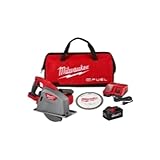
The best M18 cut off saw for most concrete, metal, and masonry work is the Milwaukee M18 FUEL 9-inch Cut-Off Saw (2786-20); it offers a 3-inch cutting depth, strong overload control, adjustable guarding, and the convenience of Milwaukee M18 batteries, although a high-output battery is important for demanding cuts.
As an Amazon Associate we earn from qualifying purchases at no extra cost to you.


Which M18 cut-off saw should you buy?
There is not a broad range of current Milwaukee M18 cut-off saws differentiated by wheel size in the way there is with drills or grinders. The main full-size option is the Milwaukee M18 FUEL 9-inch model, sold as a bare tool or in kits. The real buying decision is usually between that saw, a smaller cordless cut-off tool, and a larger-voltage competitor such as the DeWalt 60V MAX 9-inch cut-off saw.
| Tool or configuration | Wheel diameter | Maximum cutting depth | Power source | Best use |
|---|---|---|---|---|
| Milwaukee M18 FUEL 9-inch Cut-Off Saw, 2786-20 | 9 in | 3 in | One M18 battery | Concrete, masonry, rebar, pipe, sheet metal, and general construction cutting |
| Milwaukee M18 FUEL 9-inch with high-output battery | 9 in | 3 in | M18 high-output battery | Repeated cuts where reduced voltage sag and longer work intervals matter |
| Compact cordless cut-off tool, typically 3 to 5 in | 3–5 in | Approximately 1–2 in | Platform-specific battery | Tile, thin metal, small masonry repairs, and tight spaces |
| DeWalt 60V MAX 9-inch Cut-Off Saw, DCS690 | 9 in | 3-1/4 in | One 60V MAX battery | Deep, frequent concrete and masonry cutting for users on DeWalt’s platform |
Published dimensions and weight can vary by kit, battery, and regional specification. The Milwaukee 2786-20 is generally listed at about 20 lb with a battery installed, so battery selection affects not only runtime but also how tiring the saw is to hold during vertical or overhead work.
Milwaukee M18 FUEL 9-inch cut-off saw: the head-to-head choice
Concrete and masonry
The M18 FUEL 9-inch saw is built around a 3-inch maximum depth and accepts suitable abrasive or diamond wheels for dry or wet cutting. That is enough for many concrete pavers, blocks, bricks, stucco, shallow slab cuts, and metal pipe. Its water-delivery capability is valuable when using a compatible wet-cutting setup because water can control dust and help a diamond blade stay cooler.
For a 4-inch wall or slab, a single pass will not reach through the material. You must cut from both sides or finish the remaining section with another tool. Forcing the saw to achieve extra depth by twisting the blade is a poor trade: it increases binding, damages the wheel, and reduces control.
Metal cutting
With the correct wheel, the saw can cut steel pipe, threaded rod, angle iron, conduit, sheet material, and other construction metals. Metal cutting places a different demand on the tool than masonry. The wheel must be rated for the saw’s speed and material, and the guard, sparks, and hot offcuts require more attention.
The 9-inch format gives useful reach, but it is less nimble than a small grinder or compact cut-off tool. For occasional conduit work in a crowded mechanical room, a smaller tool may be easier to position. For repeated cuts through heavy pipe or structural stock, the Milwaukee’s larger wheel and full-size handles are more practical.
What matters most: depth, overload behavior, and control
Wheel diameter and cutting depth
A 9-inch wheel is the sensible middle ground for general construction. It reaches substantially deeper than a 4-inch or 5-inch cut-off tool without the bulk of a larger saw. The Milwaukee’s stated 3-inch capacity is the number to plan around; actual depth varies with wheel wear, guard position, and the material’s shape.
Overload performance
Brushless electronics and Milwaukee’s REDLINK PLUS system are intended to manage communication between the tool and battery, including overload protection. That does not make the saw immune to stalling. A dull diamond blade, an incorrect wheel, excessive pressure, or a pinched kerf can still stop the blade and drain a battery quickly.
For hard concrete or long cuts, use an M18 high-output battery rather than the smallest compact pack. A larger pack generally provides better sustained performance, but it also adds weight. If the saw repeatedly shuts down under load, first check blade suitability and cutting technique before assuming the motor is defective.
Guard adjustment and handling
A tool-free or easily adjusted guard is useful when the cut direction changes, particularly for flush-ish work, step cuts, and overhead positioning. Set the guard so the smallest practical portion of the wheel is exposed. Keep both hands on the saw, let the wheel reach speed before entering the material, and advance steadily rather than levering the tool sideways.
Control is also influenced by the battery. A compact battery makes the tool lighter but may sag sooner under a long concrete cut. A high-output pack improves sustained work but shifts the balance rearward and increases fatigue. For repeated cuts at waist height, that trade usually favors the larger pack; for short metal cuts from a ladder or awkward position, the lighter setup may be easier to control.
Runtime: a more useful way to estimate battery endurance
Manufacturers do not provide a universal “cuts per battery” figure because blade type, material thickness, pressure, temperature, and operator technique change the result. A practical planning estimate is to treat demanding masonry cutting as high-load work rather than compare amp-hour numbers in isolation.
For example, if a 6.0Ah M18 battery supplies roughly 108Wh under its nominal 18V rating, and the saw averages 900W while actively cutting, the theoretical loaded cutting time is:
108Wh ÷ 900W = 0.12 hours, or about 7 minutes of continuous trigger time.
Actual job time is longer because cutting is intermittent: you mark the material, reposition, clear the kerf, and change angles. It may also be shorter in very hard concrete or when the wheel is binding. Plan on at least one spare high-output battery for production work, and keep a charger nearby for larger jobs. This calculation is for planning, not a guaranteed runtime specification.
Decision matrix: which setup fits your work?
| Your situation | Best choice | Why |
|---|---|---|
| Already own several M18 batteries and make occasional 2–3 inch cuts | Milwaukee M18 FUEL 9-inch bare tool | Lower entry cost and no new battery platform |
| Frequent concrete or block cutting | M18 FUEL with a high-output battery and suitable diamond wheel | Better sustained performance and useful depth |
| Mostly thin sheet metal, conduit, or tile in tight spaces | Compact 3–5 inch cordless cut-off tool | Less weight and easier positioning; sacrifices depth |
| Already invested in DeWalt 60V MAX and need maximum depth | DeWalt DCS690 | Comparable 9-inch format with a slightly greater stated depth |
| Only a few cuts per year | Corded saw, rental, or the platform you already own | A battery saw may not justify its purchase and battery cost |
Ownership costs and parts that wear first
The wheel is the first consumable. Abrasive wheels wear quickly in masonry and can become expensive if used for long cuts. Diamond blades cost more initially but are usually the logical choice for repeated concrete and block work. Use a blade designed for the material: a metal abrasive wheel is not a substitute for a masonry diamond blade, and a masonry blade is not automatically suitable for steel.
Dust is the second ownership issue. Fine concrete dust can enter vents and controls, while wet cutting creates abrasive slurry around the guard and battery area. Remove the battery before cleaning, brush or blow debris away from the tool’s exterior, and wipe slurry from the guard and base before it hardens. Do not direct high-pressure water into the motor housing or battery contacts.
Common mistakes include using an under-rated wheel, cutting with a damaged or warped wheel, pushing hard enough to stall the motor, and allowing the kerf to close around the blade. Inspect the wheel before every job, confirm its maximum RPM exceeds the saw’s no-load speed, and replace it after impact damage or visible cracking.
How the M18 compares with a DeWalt battery cut-off saw
The DeWalt battery cut off saw most often compared with the Milwaukee is the 60V MAX DCS690. It is not an M18 tool, so the deciding factor may be your existing battery ecosystem rather than a small difference in specifications. DeWalt lists a 9-inch blade and 3-1/4-inch maximum depth, while Milwaukee’s M18 FUEL model lists a 3-inch depth.
Choose the Milwaukee cut off saw M18 if you already own M18 batteries, value platform compatibility, or need a versatile 9-inch saw for intermittent work. Choose the DeWalt if you are already invested in 60V MAX and prioritize the slightly deeper stated capacity for repeated heavy cutting. Neither choice eliminates the need for correct blade selection, dust control, and a spare battery.
Bottom line
For most owners searching for a Milwaukee M18 cut off saw, the M18 FUEL 9-inch 2786-20 is the clear full-size option. Its 3-inch depth, adjustable guard, brushless drive, and M18 compatibility make it a strong choice for mixed concrete, masonry, and metal work. Pair it with a high-output battery for demanding cuts, buy wheels matched to the material, and choose a compact cut-off tool instead when low weight and tight-space control matter more than depth.