What's inside
As an Amazon Associate I earn from qualifying purchases. This post may contain affiliate links at no extra cost to you.
The best budget cordless tool combo kit for most homeowners in 2026 is a four- or five-tool 18V/20V kit with two batteries, a charger, and a drill, impact driver, light, and saw; Ryobi ONE+ kits usually offer the lowest cost per useful tool, while DEWALT 20V MAX and Craftsman V20 kits are stronger choices when you value higher cutting performance or plan to expand into heavier work.
As an Amazon Associate we earn from qualifying purchases at no extra cost to you.



Quick picks for different buyers
| Best for | Platform and typical kit | Typical 2026 price range | Why it makes sense |
|---|---|---|---|
| Lowest long-term cost | Ryobi ONE+ 18V, 4–6 tools, two 1.5–4.0Ah batteries | $180–$350 | Large tool selection and inexpensive additions |
| Home repairs and remodeling | DEWALT 20V MAX, 4–6 tools, two 1.5–5.0Ah batteries | $300–$550 | Strong drills, impact drivers, saws, and widespread support |
| Occasional DIY use | Craftsman V20, 4–6 tools, two 1.5–4.0Ah batteries | $180–$350 | Good basic coverage without a professional-tool price |
| Compact workshop tools | Milwaukee M12, 3–5 tools, two 2.0–4.0Ah batteries | $250–$500 | Small, light tools for cabinetry, hardware, and light assembly |
| Frequent structural work | Ridgid 18V or DEWALT 20V MAX, brushless 4–6-tool kit | $350–$650 | Better sustained performance and more durable tool construction |
These are market ranges rather than fixed prices. Combo-kit promotions change frequently, and a kit with one large battery can be a better buy than a cheaper kit containing two small batteries.
What you should get for the money
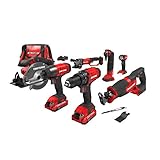
A useful starter kit normally includes a drill/driver, impact driver, reciprocating saw, circular saw, LED work light, charger, and two batteries. A five-tool kit may omit the light or reciprocating saw; a six-tool kit often adds an oscillating multi-tool. For woodworking, the oscillating tool is convenient, but a circular saw and drill provide more capability per dollar.
Prefer brushless tools if the price difference is reasonable. Brushless motors typically run cooler, waste less battery power, and need fewer replacement parts than brushed motors. Brushed tools can still be excellent for occasional shelf installation or furniture assembly, but they are less attractive when the kit will be used weekly.
Battery capacity matters more than the tool count
Battery capacity is measured in amp-hours, or Ah. A 2.0Ah battery stores roughly twice the energy of a 1.0Ah battery at the same voltage. Compact 1.5Ah or 2.0Ah packs keep a drill light, while 4.0Ah and 5.0Ah packs are more suitable for circular saws, reciprocating saws, and long sessions.
| Battery size | Best use | Approximate weight | Practical limitation |
|---|---|---|---|
| 1.5–2.0Ah | Drilling, driving, assembly, light touch-ups | 1.0–1.5 lb | Runs down quickly in saws |
| 3.0–4.0Ah | General DIY and mixed-tool use | 1.5–2.0 lb | Heavier in overhead work |
| 5.0Ah | Cutting, sanding, framing, outdoor work | 1.5–2.5 lb | Costs more and adds bulk |
| 6.0Ah or larger | High-demand saws and extended work | 2.0–3.0 lb | Often poor value for a small home kit |
Head-to-head: the main budget platforms
Ryobi ONE+ 18V: best budget platform for most homeowners
Ryobi’s advantage is not always the lowest initial price; it is the breadth of inexpensive tools that share one battery system. A four-tool kit commonly covers drilling, fastening, cutting, and lighting, while later additions include sanders, routers, fans, inflators, glue guns, and garden tools.
Choose Ryobi when your work is light to moderate and you want to build a broad collection gradually. Expect more plastic housings and less refined ergonomics than on professional lines. For occasional woodworking, trim repairs, flat-pack furniture, shelving, and small outdoor projects, that trade-off is usually sensible.
DEWALT 20V MAX: best upgrade when cutting performance matters
DEWALT 20V MAX kits often cost more, but their circular saws, reciprocating saws, and impact drivers are well suited to remodeling and repeated use. Look for a kit containing one 4.0Ah or 5.0Ah battery plus a compact battery, rather than two small packs.
The extra cost is easier to justify if you will cut sheet goods, pressure-treated lumber, or framing materials regularly. For five tools costing $400, the simple average is $80 per tool, but the battery, charger, and included accessories may account for $100 or more of the package value. The real tool cost is therefore closer to $300, or $60 per tool, before assigning value to the batteries.
Craftsman V20: a practical middle-ground choice
Craftsman V20 kits are worth considering for homeowners who want a familiar basic lineup without moving into premium pricing. The platform has common workshop tools, and kit contents can be generous during promotions. Check whether the saw uses a bare tool with no blade or includes a usable blade, since accessories can change the first-project cost.
This platform is most attractive for moderate use: weekend repairs, simple woodworking, drywall work, and occasional outdoor maintenance. If you expect daily use or demanding cutting, compare the specific brushless tools rather than choosing solely by tool count.
Milwaukee M12: best when small size beats maximum power
M12 tools use a smaller 12V battery system and are not a direct replacement for a full-size circular saw kit. They excel at cabinet hardware, electrical work, light drilling, compact impact driving, and tasks where a large tool becomes tiring or awkward.
An M12 kit can be the best value in a small workshop because the tools take little storage space. It is less suitable as your only platform if you need to cut thick lumber or run large hole saws frequently.
Decision matrix: match the kit to your situation
| Your situation | Recommended configuration | What to avoid |
|---|---|---|
| Under $250 and occasional use | Ryobi ONE+ or Craftsman V20, four tools, two batteries | Paying extra for six tools you will not use |
| First workshop, moderate experience | 18V/20V brushless kit with drill, impact driver, circular saw, and multi-tool | One-battery kits and brushed saws |
| Small apartment or compact shop | Milwaukee M12 or compact 18V kit with 2.0Ah batteries | Large high-capacity packs on every tool |
| Weekly remodeling | DEWALT 20V MAX or Ridgid 18V brushless kit with at least one 4.0Ah battery | Judging value by tool count alone |
| Already own batteries | Buy bare tools in the same platform | Starting a second battery ecosystem for one specialty tool |
How to calculate real per-tool value
Suppose a six-tool kit costs $360 and includes two batteries worth approximately $100 together, a charger worth $30, and a bag worth $20. That leaves $210 for the six tools, or $35 per tool. This does not mean every tool is equal: a circular saw and impact driver may represent most of the useful value, while a basic light contributes less.
A better calculation assigns the highest value to tools you would otherwise buy. If you need a drill, impact driver, and circular saw, compare the kit against buying those three individually. Ignore a free-looking light if you would never use it. A $300 four-tool kit can be a better purchase than a $350 seven-tool kit when its four tools match your actual jobs and its batteries are larger.
Ownership costs that listings often hide
- Blades and bits: Budget kits may include only one general-purpose blade and a small bit set. Plan on $20–$60 for better drill bits, driver bits, and a finish-quality circular-saw blade.
- Battery replacement: Heat, deep discharge, and storing a battery fully empty shorten its life. Keep packs dry, avoid leaving them in a hot vehicle, and remove them from the charger after they finish.
- Dust: Sawdust blocks vents and can accelerate motor and switch wear. Brush or blow out the tool with clean, low-pressure air; do not force debris deeper into the housing.
- Chucks and collets: A slipping drill chuck is often caused by an improperly tightened bit or a worn chuck, not a weak battery. Use clean, straight accessories and avoid side-loading the drill.
- Consumables: Reciprocating-saw blades and sanding sheets wear much faster than the tool. Budget for them when comparing a kit for demolition or refinishing.
Final buying advice
For the lowest complete-system cost, choose a Ryobi ONE+ 18V kit with four or five useful tools and two batteries. Choose DEWALT 20V MAX or a comparable brushless 18V platform when you expect frequent cutting, renovation, or heavier materials. Choose Milwaukee M12 when compact size and control matter more than maximum output, and Craftsman V20 when a well-priced basic set covers your occasional DIY needs.
Before buying, confirm the battery count, Ah ratings, charger type, saw-blade size, brushless status, and included accessories. The best budget cordless tool combo kit is not the one with the largest number printed on the box; it is the one that gives you the right two or three working tools, batteries large enough for your jobs, and a battery platform you will still want to use five years from now.